AI Shoppers Convert 90% Better, Adobe Says; 40 of 43 Retailers Don't Block AI Bots
AI-referred shoppers converted 90% better than other visitors on US retail sites in September 2026 and were worth 83% more per visit, Adobe data published on 29 October shows. Our robots.txt check of 43 large US retailers found 40 place no homepage block on nine AI crawlers, while Amazon blocks all of them.
 Vibhu Dhariwal
Cofounder & CTO, Digital Gratified
- Published
- Section
- Industry news
- Reading time
- 8 minutes
Ras Al Khaimah, United Arab Emirates, .
Shoppers who reach US retail sites by clicking a link in an AI assistant converted 90% better than visitors from every other source in September 2026, according to Adobe Digital Insights data published on 29 October. The same visits were worth 83% more revenue each. Adobe says the conversion figure is the highest it has recorded; in August 2025, AI visits converted 9% worse than the rest.
We set Adobe's new numbers against its four earlier AI traffic releases to chart how the gap has moved since mid-2024, then checked whether the retailers chasing this traffic actually let AI crawlers in. On 1 November we read the robots.txt files of 61 large US retail domains and tried to load their homepages in a headless browser. Most leave the door open in robots.txt. One of the biggest does not.
What Adobe reported
Adobe's figures come from its analysis of more than 1 trillion visits to US retail sites, covering 100 million SKUs across 18 product categories, plus a survey of more than 5,000 US consumers run in September. It counts a visit as AI traffic when a shopper clicks a link from an AI tool. The key September 2026 numbers, each measured against non-AI traffic:
- Conversion rate: 90% higher, up from 9% lower in August 2025.
- Revenue per visit: 83% higher, which Adobe calls the widest gap this year.
- Engagement: 73% more time on site, 25% more pages per visit and a 53% higher add-to-cart rate.
- Volume: AI traffic to US retail sites grew 71% year on year.
Adobe forecasts AI traffic up 159% year on year on Thanksgiving, 95% on Black Friday and 88% on Cyber Monday, and expects the revenue per visit advantage to double over the season.
How the conversion gap flipped
Adobe has published a conversion comparison in each of its retail AI traffic releases since June 2025. Put on one line, the series shows AI visitors going from rarely buying to buying far more often than other visitors.
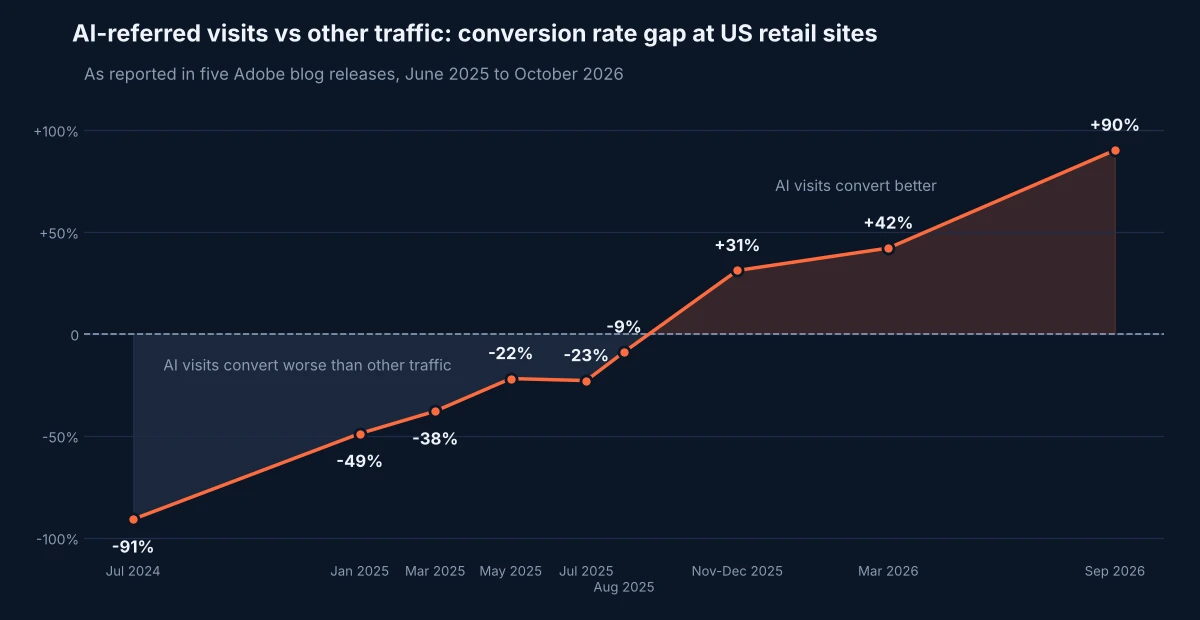
The crossover came in the 2025 holiday season, when Adobe put AI conversion 31% above other traffic after every earlier reading had been negative. The gain was not steady: AI visits still converted 22% worse in May 2025 and 23% worse in July 2025. And the September 2026 figure is more than double the 42% advantage Adobe reported for March 2026.
Revenue per visit followed a similar path: Adobe said an AI visit was worth 3% of a non-AI visit in July 2024, 27% less in July 2025 and 83% more in September 2026.
One caution: Adobe's releases measure relative rates, not volume. Earlier this month a separate GA4 analysis of 100 sites found ChatGPT sent well under 1% as many sessions as Google organic search. A high conversion rate on a small channel is a signal about intent, not yet a revenue line that rivals search.
Our check: do retailers let AI crawlers in?
If AI referrals are now the best-converting visits a retailer gets, the first thing to confirm is that the crawlers feeding those assistants can read the site. We fetched robots.txt from 61 large US retail domains and tested the homepage path against nine AI user agents, with Googlebot and Bingbot as controls. 43 domains returned a readable file.
| Crawler | Operator's stated use | Blocked at the homepage (of 43) | Retailers blocking |
|---|---|---|---|
| OAI-SearchBot | ChatGPT search results | 1 | Amazon |
| ChatGPT-User | User-initiated ChatGPT visits | 1 | Amazon |
| GPTBot | OpenAI model training | 3 | Amazon, eBay, Instacart |
| PerplexityBot | Perplexity | 3 | Amazon, eBay, Instacart |
| ClaudeBot | Anthropic | 3 | Amazon, eBay, Instacart |
| Claude-SearchBot | Anthropic search | 2 | Amazon, Instacart |
| Google-Extended | Google AI training control token | 2 | Amazon, Instacart |
| Meta-ExternalAgent | Meta AI | 3 | Amazon, eBay, Instacart |
| CCBot | Common Crawl | 3 | Amazon, eBay, Instacart |
| Googlebot, Bingbot (controls) | Search indexing | 0 | None |
Source: SaaS Link Building robots.txt check of 61 US retail domains, 1 November 2026. 18 domains did not return a readable file. "Blocked" means the homepage path is disallowed for that user agent.
The headline result is that 40 of the 43 retailers place no homepage-level block on any of the nine AI agents, and only 13 of the 43 mention any of the nine AI agents by name anywhere in the file.
The three that block take different lines. Amazon disallows every AI agent we tested, including OpenAI's search crawler. According to OpenAI's crawler documentation, sites that opt out of OAI-SearchBot will not be shown in ChatGPT search answers, though they can still appear as navigational links. eBay blocks the training and general crawlers (GPTBot, ClaudeBot, PerplexityBot, Meta-ExternalAgent, CCBot) but lets OpenAI's and Anthropic's search and user agents in, with exclusions for search result paths. Instacart runs an allowlist: a wildcard rule disallows the whole site, and named search engines plus OAI-SearchBot and ChatGPT-User get access, while PerplexityBot and Meta-ExternalAgent are explicitly disallowed.
The 18 domains that did not return a usable file are a finding in themselves. 13 answered our request with a 403, three returned no response, and two served something other than a robots.txt file. Our requests came from a cloud server, not a verified AI crawler, so this does not show those retailers block AI bots, but it does show how many sit behind bot walls that decide access before robots.txt is read.
What the page itself shows
Adobe's release also scores how much retail page content AI systems can read, using what it calls a Citation Readability Score. It puts the average US retail homepage at 63%, meaning more than a third of the content is not visible to AI systems and agents. Electronics scored 79% and grocery 55%, while general merchandise homepages averaged 40%. In April, using a tool it then called the AI Content Visibility Checker, Adobe put the average retail homepage at 75%. Adobe does not say whether the two scores are directly comparable, so we do not read the difference as a decline.
We ran a rough version of the same test. For each of 64 retail homepage addresses, we compared the visible words in the raw HTML the server sent with the words visible after a headless Chrome browser ran the page's JavaScript for six seconds. Only 16 homepages loaded fully; the rest returned access denied pages, challenge screens or timeouts. Of those 16, six served less than two thirds of their rendered text in the initial HTML: Gap, IKEA US, Victoria's Secret, Hobby Lobby, Walmart and Zappos. For a crawler that reads only the server response, much of what a shopper sees on those homepages is not there. Google documents how it renders JavaScript; not every AI crawler documents doing the same.
What this means for SEO teams
- Separate search agents from training agents in robots.txt. eBay and Instacart show the pattern: allow OAI-SearchBot and ChatGPT-User, decide on GPTBot and other training crawlers separately. A blanket AI block also removes you from ChatGPT search answers. Our earlier look at Google's plan to honor a shared AI training opt-out covers the training side.
- Check your firewall, not just robots.txt. A 403 at the edge overrides an Allow line. Ask whoever runs your CDN or bot management which AI agents are verified and allowed, and test from outside your own network.
- Compare raw HTML with the rendered page. Fetch a key category page with curl and count what product names, prices and copy are present before JavaScript runs. If the answer is little, server-side rendering of core content is the fix.
- Measure AI referrals as their own channel. Build a GA4 segment for AI assistant referrers and compare conversion and revenue per session against organic search on your own site. Adobe's averages may not match your category. Our guide to spotting AI agent sessions in server logs covers the crawler side.
Methodology
Adobe figures are taken from five posts on Adobe's business blog dated 24 June 2025, 21 August 2025, January 2026, 16 April 2026 and 29 October 2026, each linked above. Our robots.txt check ran on 1 November 2026 against the www host of 61 US retail domains chosen as large, well-known retailers across major categories (not a ranked or random sample). Each file was fetched once with a desktop Chrome user agent and parsed with Python's robots.txt parser for the homepage path; we verified the Amazon, eBay and Instacart results by hand. The homepage test loaded 64 addresses for a similar list of retailers (some with regional paths) in headless Chromium from a cloud server, and compared visible words in the raw response with the rendered text after six seconds, counting only pages that returned HTTP 200 with over 100 rendered words and no block page.
Conclusion
Adobe's series shows AI-referred shoppers moving from converting far worse than other visitors on US retail sites in 2024 to far better in 2026. Most large retailers have not blocked the crawlers behind that traffic in robots.txt, but a robots.txt Allow line is only the first gate: bot walls and JavaScript-heavy pages can still keep AI systems from seeing what shoppers see.
This holiday season will test whether those conversion rates hold at higher volume, and retail SEO teams have a few weeks to confirm the agents sending that traffic can read their pages.
Questions and answers
How does Adobe measure AI traffic to retail sites?
Adobe counts a visit as AI traffic when a shopper clicks a link from an AI tool. Its October 2026 figures draw on more than 1 trillion visits to US retail sites, covering 100 million SKUs in 18 product categories, plus a September survey of more than 5,000 US consumers.
When did AI visits start converting better than other traffic?
In the 2025 holiday season. Adobe's January 2026 release put AI conversion 31% above other traffic for November and December 2025, after every earlier reading it had published was negative. It reported 42% better in March 2026 and 90% better in September 2026.
Does blocking OAI-SearchBot keep a site out of ChatGPT search?
Yes, according to OpenAI's crawler documentation: sites that opt out of OAI-SearchBot will not be shown in ChatGPT search answers, though they can still appear as navigational links. GPTBot is a separate crawler used for model training.
Which retailers blocked AI crawlers in the robots.txt check?
Of 43 readable files, Amazon disallowed all nine AI agents tested, including OAI-SearchBot. eBay blocked training and general crawlers such as GPTBot and ClaudeBot but allowed OpenAI's and Anthropic's search agents. Instacart disallowed all bots by default and allowed a list that includes OAI-SearchBot and ChatGPT-User. The other 40 had no homepage-level block on any of the nine.
More releases
-
Studies
YouTube Was Cited in All 30 AI Overviews We Pulled, Supplying 34% of 271 Citations
YouTube was cited in every one of 30 US Google AI Overviews we pulled on 31 October, supplying 92 of 271 unique citations (34%). Nearly half of those links pointed to a timestamp inside a video, and half the queries had no YouTube result in the organic top 10.
-
Industry news
AI Overview Opt-Out Test Cut Organic Clicks; 73% of Cited Sites Had No Page-One Link
A one-site test of Google's Search generative AI control saw organic clicks fall after the site was excluded from AI Overviews and AI Mode. Our check of 36 US searches found that 72.8% of cited sites had no organic link on the same page, while about a third of top-three organic results belonged to cited sites.
-
Explainers
Checkout Showed Up in 25% of AI Agent Sessions: How to Spot Google-Agent in Your Logs
Sessions involving AI agents recorded a checkout 25.21% of the time against 14.65% for humans, Microsoft Clarity data from 230,511 sites shows. Here is what agents do on websites, where the study needs care, and how to verify Google-Agent with its user agent, IP file and signed requests.
Tell us the site and the goals.
Rankings in Google and visibility in AI answers, from one monthly plan. One call is enough to say which one fits. Email works just as well.