Is JavaScript Still Hiding Content From Search? 74 of 326 Top Homepages Rely on It
Google says loading content with JavaScript no longer makes Google Search harder, but AI crawlers measured in 2024 did not render it. Our 20 November crawl of 326 top homepages found 74 shipped under half their text in raw HTML, and few served crawlers a fuller page. Verdict: likely, mainly for AI search.
 Vibhu Dhariwal
Cofounder & CTO, Digital Gratified
- Published
- Section
- Studies
- Reading time
- 14 minutes
Ras Al Khaimah, United Arab Emirates, .
On 4 March 2026 Google deleted an outdated accessibility section from its JavaScript SEO basics guide, noting in its documentation changelog that using JavaScript to load content is not "making it harder for Google Search". Many technical SEOs still treat client-side rendering as a risk, and the rise of AI crawlers has given that argument new life. To test it, the SaaS Link Building newsroom fetched 1,000 of the web's most popular homepages on 20 November 2026, twice each: once as raw HTML and once fully rendered in a headless browser. Of the 326 homepages that returned usable pages both ways, 74 (22.7%) delivered less than half of their visible text before JavaScript ran.
Key findings
- 74 of 326 top homepages (22.7%) shipped under half of their rendered text in the raw HTML; 19 shipped no visible text at all until scripts ran.
- Across all 326 pages, the rendered versions held 99,757 more words than the raw HTML, a net 21.3% of the 468,167 words a browser displayed.
- On 37 homepages (11.3%), at least half of the links appeared only after rendering. 14 had no links in the raw HTML but 10 or more once rendered.
- Indexing signals were mostly stable: 3 canonical tags changed after rendering (each pointing to a language or regional version), and 5 robots meta tags differed between raw and rendered HTML.
- When we re-fetched the 74 JavaScript-dependent homepages with crawler user-agent strings, only 5 gave a Googlebot request at least half the rendered text in raw HTML, and only 3 did so for GPTBot.
The theory, and who holds it
The claim comes in two parts. The older one says Google struggles with JavaScript: pages wait in a rendering queue, links injected by scripts are found late, and content that only appears after rendering is indexed slowly or not at all. It dates from the years when Google rendered pages with an old version of Chrome and recommended workarounds such as dynamic rendering.
The newer version shifts the target. It accepts that Google renders pages but argues that search is no longer only Google. ChatGPT, Claude and Perplexity send their own crawlers, and if those crawlers read only raw HTML, a site built on client-side rendering may be close to invisible in AI answers even while it ranks in Google. Much of the public discussion since late 2024 traces back to one study from the hosting company Vercel.
So the question this investigation asks is narrower than "is JavaScript bad for SEO". It is whether, in 2026, JavaScript still hides meaningful content from the systems that decide search visibility, and whether large sites are doing anything about it.
Evidence for: JavaScript still hides content
Google's own documentation keeps the caveats
Google's JavaScript guide still describes a two-step process. Googlebot queues pages for crawling and for rendering, and the guide says a page may sit in the rendering queue for a few seconds "but it can take longer than that". The same guide recommends server-side rendering or pre-rendering because it is faster for users and crawlers, and adds that "not all bots can run JavaScript".
Three clarifications Google added in December 2025, listed in its Search documentation updates log, spell out where JavaScript can still cause problems:
- On 15 December 2025 Google clarified that when it meets a noindex tag in the original HTML it may skip rendering, so using JavaScript to remove that noindex may not work. Its advice is to leave noindex out of the original code if there is any chance you want the page indexed.
- On 17 December 2025 it added canonical guidance: canonicalization happens before and after rendering, so a canonical set by JavaScript should match the one in the original HTML, or the original HTML should carry none.
- On 18 December 2025 it noted that pages returning a non-200 status code might not be rendered at all.
Google's dynamic rendering page, meanwhile, now calls that technique a workaround rather than a long-term solution, and notes that other search engines may ignore JavaScript and miss content it generates.
AI crawlers did not render JavaScript when last measured
The strongest evidence for the newer theory is Vercel's December 2024 analysis of crawler traffic across its network. It found that "none of the major AI crawlers currently render JavaScript", naming OpenAI's GPTBot, Anthropic's ClaudeBot and PerplexityBot. Those crawlers did download JavaScript files (11.5% of ChatGPT crawler fetches and 23.84% of Claude's, by Vercel's count) but did not execute them. Vercel found that AppleBot and Googlebot did render, and reported that Gemini relies on Googlebot's infrastructure. We have written before about how Gemini and AI Mode fetch pages under Google's own user agents, which fits that picture.
We found no statement from OpenAI, Anthropic or Perplexity on whether their crawlers render JavaScript, and no newer primary measurement. That matters for the verdict below: the AI side of the theory rests on one dataset that is nearly two years old.
What our crawl found
If AI crawlers read raw HTML, the practical question is how much of the web's content exists in raw HTML. Our crawl suggests that for most large sites it is most of it, but for a sizeable minority it is very little.
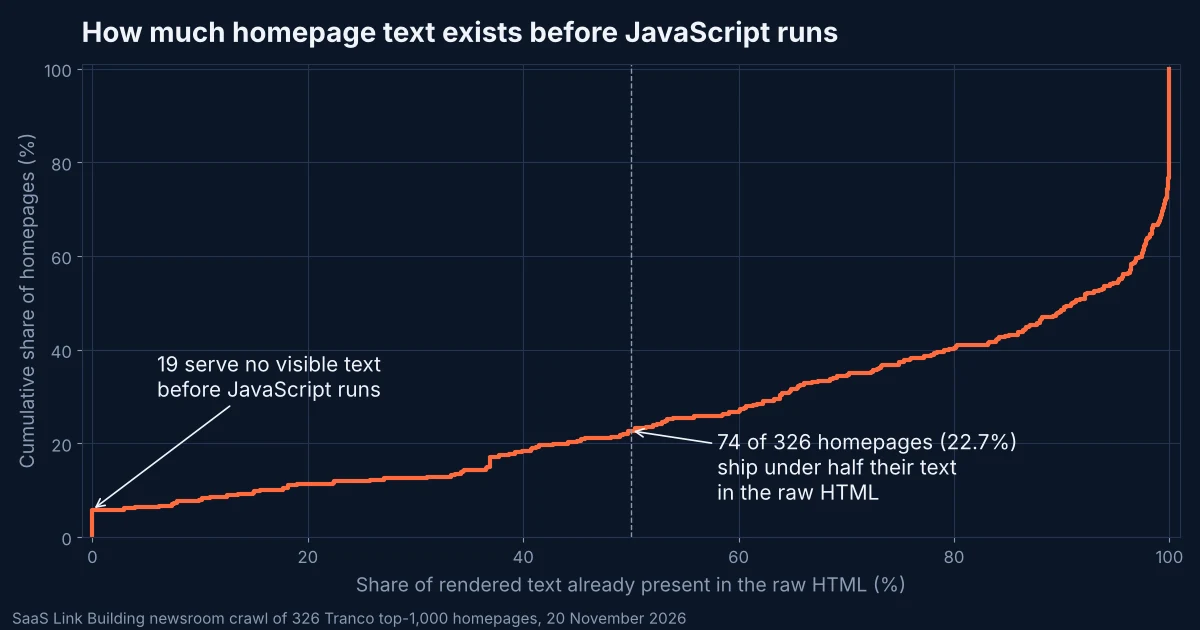
The curve is flat for the first stretch and steep at the end. Just over half of the homepages (168, or 51.5%) had at least 90% of their text in the raw HTML, the median page had 91%, and 26 had under 10%. The 19 homepages that shipped no visible text before scripts ran included Instagram, Reddit, Spotify, Temu, Threads, Duolingo and Disqus. A crawler that reads only raw HTML would see an empty page on each of them.
Text was not the only thing missing. On 37 homepages at least half of the links appeared only after rendering, and on 25 the page had no H1 heading until JavaScript added one. The table below shows how often the elements search systems read for indexing differed between the raw response and the rendered page.
| Element | Homepages affected (of 326) | What we saw |
|---|---|---|
| Title tag | 13 | 2 had no title until JavaScript set one; 11 had their title rewritten |
| Meta description | 10 | 6 added only by JavaScript; 4 changed by it |
| Canonical tag | 9 | 245 had one in raw HTML; 5 were added only after rendering, 3 changed and 1 removed |
| Robots meta tag | 5 | Values differed between raw and rendered HTML; three of the five involved a noindex added or removed by JavaScript |
| H1 heading | 25 | No H1 in raw HTML, one or more after rendering |
| Links | 37 | Half or more of the page's links present only after rendering; 14 had none in raw HTML |
The robots cases are the ones Google's December guidance targets. SurveyMonkey's homepage served our browser-style request a raw robots tag of "noindex, follow", which its scripts then changed to "index, follow". The European Union's portal served a language-selection page marked noindex that JavaScript replaced with a full, indexable homepage. Shopee Brazil went the other way, adding noindex only after rendering.
Few large sites compensate for crawlers
A site that depends on JavaScript can still serve crawlers a pre-rendered page, which is what dynamic rendering does. To see whether the 74 JavaScript-dependent homepages did this, we fetched each again with five user-agent strings: a Chrome browser, Googlebot, GPTBot, ClaudeBot and PerplexityBot.
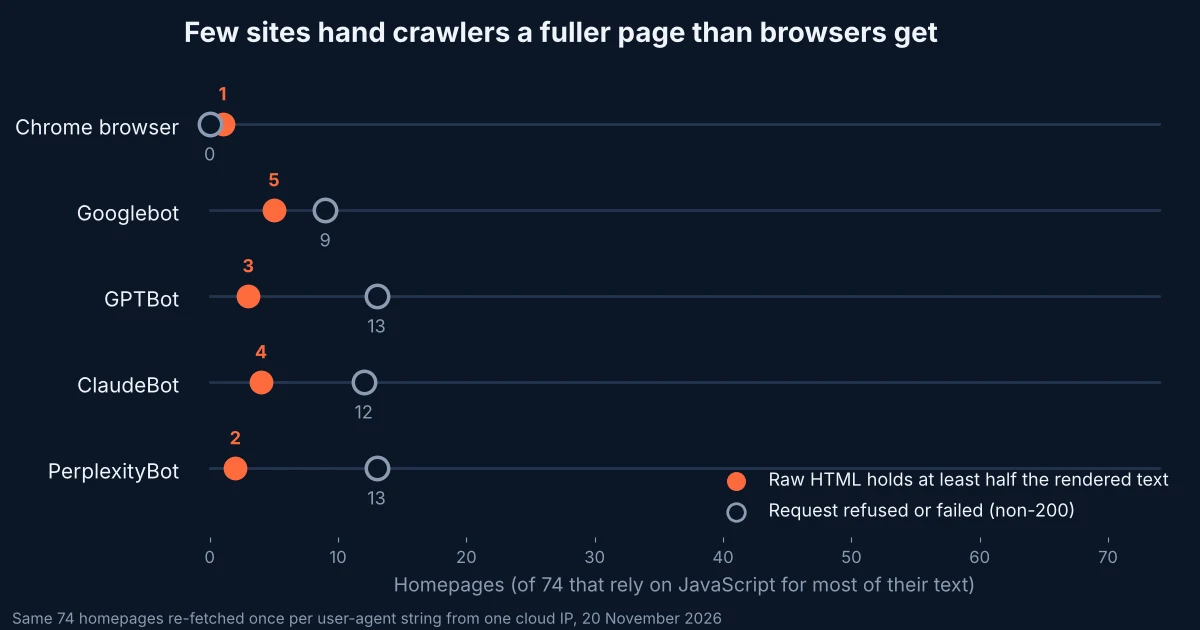
Most did not. Five of the 74 gave a Googlebot-labelled request a substantially fuller raw page; GPTBot got that treatment from 3, ClaudeBot from 4 and PerplexityBot from 2. Spotify was the clearest split: its homepage returned 314 words of raw text to the Googlebot string and none to GPTBot. AI user agents also received more non-200 responses, mostly 403s: 13 each for GPTBot and PerplexityBot, against 9 for Googlebot.
SurveyMonkey is a useful counterexample. When we fetched it separately with Googlebot and GPTBot user-agent strings, its homepage returned "index, follow" in the raw HTML, so the noindex our browser-style request saw is not what those crawlers receive. That suggests the site handles crawler requests separately, though from outside we cannot tell how or why. It also shows that raw HTML seen in a browser is not always what a bot gets.
Evidence against: rendering is no longer the bottleneck
On the Google side, the evidence that JavaScript is a serious problem is thin. Google's March 2026 changelog note is unusually direct: it says Google Search has rendered JavaScript for multiple years, and Google removed an outdated section on JavaScript and accessibility on that basis. The current guide says all pages with a 200 status code are sent to the rendering queue, whether or not they use JavaScript.
The best outside measurement agrees. Vercel's July 2024 study of more than 100,000 Googlebot fetches, mostly on nextjs.org, found that every HTML page returning a 200 status was fully rendered, including pages with complex JavaScript. Its median delay between crawl and render was 10 seconds and the 75th percentile 26 seconds, although the 90th percentile stretched to about three hours and the 99th to about 18 hours. The authors concluded that Google processes JavaScript-heavy pages no differently from static ones. The study covered mainly one framework-built site, so it says less about very large or slow sites.
Our own data also cuts against alarm. Half the homepages were almost fully server-rendered. Canonical tags, the signal most likely to cause real indexing damage when JavaScript rewrites it, changed on only 3 of 326 pages, and each change followed the site's own language or region routing: Kaspersky to its US site, Supercell and DeepSeek to their English paths. Many of the 19 empty raw pages belong to apps and social platforms whose homepage is a login or feed; their searchable content lives on other URLs that we did not test.
The AI side of the theory has its own weakness. Vercel's crawler analysis predates two years of rapid change in AI search products, and we found no 2026 primary source confirming that GPTBot, ClaudeBot or PerplexityBot still skip rendering. AI assistants can also reach pages through other routes, including browsing agents that run a full browser and search indexes built by companies that do render. Our test measured what a non-rendering fetcher would receive; it did not observe any AI crawler's actual behaviour.
Verdict: likely, but mainly for AI search
For Google, the theory is largely debunked. Google renders pages with a 200 status, its documentation says so plainly, and independent data shows renders arriving within seconds in most cases. The remaining Google risks are specific and documented: a noindex in the raw HTML that scripts are meant to remove, canonical tags that change after rendering, links that only exist after scripts run, and errors that stop rendering. Our crawl found noindex and canonical changes on a handful of top homepages, and render-dependent links on about one in nine; we did not test rendering errors.
For AI search, we rate the claim likely. If the major AI crawlers still behave as Vercel measured, the 22.7% of top homepages that ship under half their text in raw HTML, and the 19 that ship none, are serving those crawlers a thin or empty page, and almost none of them are compensating with a pre-rendered version. We label the AI crawler behaviour itself as unconfirmed for 2026: it rests on a 2024 dataset and on no statement from OpenAI, Anthropic or Perplexity.
What this means for SEO teams
- Check raw HTML, not just the rendered page. View source, or fetch the page with a plain HTTP client, and confirm that the main copy, primary navigation links and H1 are present before any script runs.
- Test with crawler user agents. Fetch key templates with Googlebot and GPTBot strings. A 403 or a different page for one of them is a configuration decision someone should have made on purpose. Our earlier report on the OpenAI crawler behind ChatGPT search covers which OpenAI bot to allow for search visibility.
- Keep indexing tags identical before and after rendering. Google's guidance is explicit: no noindex in the original HTML if the page should be indexed, and a canonical that matches the raw HTML or is absent from it.
- Use Search Console's URL Inspection rendered HTML to confirm what Google saw, and compare it with raw HTML for templates that rely on client-side rendering.
- Prefer server-side or static rendering for content you want cited. Google recommends it and it removes the AI crawler question entirely. Single-page apps should also watch the shift toward soft navigation metrics in CrUX, which changes how their performance is measured.
Methodology
We took the top 1,000 domains from the Tranco research list (list ID GQ9JK) and requested each domain's homepage over HTTPS on 20 November 2026 between 09:36 and 09:54 UTC, from a single cloud server. Each homepage was fetched twice: first as raw HTML with a desktop Chrome 131 user-agent string through a standard HTTP client that followed redirects, then in headless Chromium, waiting for the load event and then up to eight more seconds for network activity to stop before saving the rendered DOM.
From both versions we counted words of visible body text (excluding script, style, noscript, template and SVG elements), unique link targets, H1 elements, the title, meta description, canonical tag and robots meta tag. "Share of text in raw HTML" is raw word count divided by rendered word count, capped at 100%. 621 domains were excluded: 230 requests were refused by our crawl environment's network proxy, 182 returned a non-200 status or non-HTML content (many top-list domains are CDNs and API hosts with no website), 204 timed out or failed (113 of them during the headless render, which may under-count script-heavy sites), and 5 served a bot challenge page to the raw request. Of the 379 remaining, 326 returned a 200 rendered response with at least 50 words of text and form the sample.
For the 74 homepages with under half their text in raw HTML, we repeated the raw fetch with five user-agent strings (Chrome, Googlebot smartphone, GPTBot 1.3, ClaudeBot 1.0 and PerplexityBot 1.0) and counted a page as served fuller HTML when it returned at least half the rendered word count. These requests came from our server's IP address, not from Google's, OpenAI's, Anthropic's or Perplexity's published ranges, so sites that verify crawler IPs may answer the real crawlers differently. We also fetched SurveyMonkey's homepage separately with the Googlebot and GPTBot strings to compare its robots meta tag. A browser re-fetch returned half or more on one homepage, which reflects normal page variation between requests. Homepages are not representative of article or product pages, and a single fetch per site captures one moment.
Conclusion
JavaScript is no longer the Google problem it was, and Google's own documentation now says as much. The risk has moved. Almost a quarter of the top homepages we could test still deliver most of their words only after scripts run, and very few hand crawlers a pre-rendered alternative. For any team that wants to be read by AI search crawlers that skip rendering, raw HTML is again the version that matters.
The open question is whether the AI crawlers have changed since they were last measured. Until OpenAI, Anthropic or Perplexity document their rendering behaviour, or someone repeats the 2024 log analysis, the safe assumption is that they see what a plain HTTP request sees. Our running coverage of Google's 2026 documentation changes will track any further shift in Google's own guidance.
What do you think?
Have you compared server logs for GPTBot, ClaudeBot or PerplexityBot against pages that rely on client-side rendering, and did those pages earn AI citations anyway? Share your data or experience with the newsroom.
Questions and answers
Does Google render JavaScript before indexing?
Yes. Google's JavaScript SEO basics guide says all pages returning a 200 status code are sent to the rendering queue, where a headless Chromium executes the JavaScript. The guide adds that a page may wait in that queue for a few seconds, and sometimes longer.
Do AI crawlers such as GPTBot and ClaudeBot render JavaScript?
Vercel's December 2024 analysis of its network found that GPTBot, ClaudeBot and PerplexityBot did not render JavaScript, although they downloaded some JavaScript files. We found no statement from OpenAI, Anthropic or Perplexity confirming or updating that behaviour.
How many top homepages depend on JavaScript for their text?
In our 20 November 2026 crawl of 326 homepages from the Tranco top-1,000 list, 74 (22.7%) had less than half of their rendered text in the raw HTML, and 19 had no visible text until JavaScript ran.
Can JavaScript remove a noindex tag for Google?
Not reliably. In a December 2025 documentation update Google said that when it finds noindex in the original HTML it may skip rendering, so JavaScript that changes or removes the tag may not work. Google advises leaving noindex out of the original code if the page should be indexed.
More releases
-
Updates
Google Adds an AI Mode Sidebar to Its Homepage; Search Button Held in 30 of 30 Checks
Google began rolling out a collapsible sidebar of recent AI searches on its desktop homepage on 19 November 2026, Robby Stein said. Two days later, all 30 signed-out sessions we loaded across 20 locales still showed the classic Google Search button, with no sidebar or AI Mode button.
-
Studies
Google Calls '7 Tips' Posts Commodity Content; They Held 39% of Page One in Our Test
Google is telling brands to stop publishing generic "Top 10" tips posts, but its results still reward them. Across 30 US tips searches on 21 November, numbered lists held 90 of 233 page-one organic results and a third of AI Overview citations, and a page titled exactly like Google's own commodity example ranked first.
-
Industry news
Google Adds Target, Experian and H&R Block to Search Apps; Help Page Lists 0 of 8
Google is adding Target, Albertsons, Safeway, Shaw's, Experian and H&R Block as Connected Apps in Search and the Gemini app, with Angi and Thumbtack to follow. Its Search help page lists none of the eight yet, and in our 16-search test a partner's own site ranked in the organic top 10 on 10.
Tell us the site and the goals.
Rankings in Google and visibility in AI answers, from one monthly plan. One call is enough to say which one fits. Email works just as well.