Google's Ranking Hub Spells Out 3 of 10 CMA Fair Ranking Duties Before They Bind
Google's new Search ranking hub, published on 24 November, fully spells out three of the ten obligations in the UK CMA's fair ranking conduct requirement, which takes effect on 17 December. It names no notice periods in days, and the December core update preannouncement clears 15 business days on 15 December.
 Vibhu Dhariwal
Cofounder & CTO, Digital Gratified
- Published
- Section
- Industry news
- Reading time
- 8 minutes
Ras Al Khaimah, United Arab Emirates, .
Google's new Search ranking hub, added to the Search Central documentation on 24 November, arrived 23 days before the UK Competition and Markets Authority's fair ranking conduct requirement takes effect on 17 December. We compared the hub's three new pages with each of the ten obligations in the CMA's legal notice. Three are spelled out in full. Five are covered only in general terms, and two are not mentioned at all.
The Search Central documentation changelog lists the hub under 24 November, alongside Our principles for ranking results, How to stay informed on Google Search ranking updates and Submit feedback about ranking changes in Google Search. The same day, Google preannounced its December core update on the Search Status Dashboard.
What changed
- A public ranking standard. The principles page says every result type, from web listings to AI Overviews, carousels, images and videos, is "evaluated using the same criteria", which Google calls utility: how useful a result is for the query. It adds that Google makes no manual ranking adjustments except to meet legal obligations or enforce its content policies.
- A notice policy that names the CMA. The stay-informed page says Google gives notice for actionable policy changes and for broad ranking shifts, and that for changes where UK users may see a significant shift it gives notice in line with the CMA's fair ranking requirements.
- A feedback route in Search Console. When a significant ranking change or actionable policy update appears on the Search Status Dashboard, verified owners can use a Submit Feedback button in Search Console and tag the change with a hashtag such as #NovemberCoreUpdate2026. One of the six details Google asks for is the UK market impact of the change.
- A UK indexing appeal. Sites that serve UK users and have been manually excluded from the index as a whole can appeal through a new form that Google says will not work until 17 December 2026. When we opened the link logged out on 27 November, it redirected to a Google sign-in page.
Our check: Google's pages against the CMA's ten obligations
The CMA imposed the fair ranking requirement on 17 June 2026, after designating Google with strategic market status in general search in October 2025. The notice says the requirement "will come into force six months after the date of this Notice", which is 17 December, and it runs until 10 October 2030. It covers web results, images, videos and organic results inside AI Overviews and AI Mode shown to people in the UK, but not paid results.
| CMA notice paragraph | What it requires | Where Google's new pages address it | Our reading |
|---|---|---|---|
| 4.a | Ignore whether a publisher advertises, has other deals with Google, opts out of AI features or has used legal rights against Google | Hub says Google never accepts payment to rank pages; principles page says systems do not favour any site's interests | Partly: advertising is covered, AI opt-outs and legal disputes are not named |
| 4.b | Same objective criteria for Google's own products and third parties | Principles page: all result types judged on utility, with no result given preferential treatment | Addressed |
| 5 | New features may be exempt from 4.b for up to six months of testing | Not mentioned | Not mentioned |
| 6.a | Enough public information on how ranking works | Principles page, plus links to How Search Works and the rater guidelines | Partly: the CMA expects ranking criteria, policies and procedures; the page states principles |
| 6.b.i | At least 30 UK business days' notice of actionable changes | Stay-informed page describes notice by type of change | Partly: no number of days is given |
| 6.b.ii | At least 15 UK business days' notice of significant, explainable changes | Same page, citing core updates as the example | Partly: no number of days is given |
| 7.a | Clear process for feedback on how a change harms a UK market | Search Console Submit Feedback button, hashtag, UK market impact field | Addressed |
| 7.b | Process and substantive responses for manual action reconsideration | Feedback page links the Manual actions report and reconsideration requests | Partly: the CMA expects a 14 business day response standard; no timeline is stated |
| 8 | Report to the CMA when 50 publishers send feedback on one change | Not mentioned | Not mentioned (a duty owed to the regulator) |
| 9 | Alternative dispute route for sites manually excluded from the index | UK CMA indexing appeal, live from 17 December | Addressed |
Two caveats apply. The paragraph 8 report is owed to the CMA, not to site owners, and the notice lets Google take a different approach if it can show the CMA it complies. Whether the hub meets the rules is for the regulator to judge.
The notice clock for the December core update
The gap that matters most to SEO teams is the missing number of days. The CMA's interpretative notes say a change is "introduced" in the UK at the start of its UK rollout, and that it becomes "effective" once that rollout is complete. Google's stay-informed page promises to explain "our advance notice timelines" but does not state the 15 or 30 business day periods.
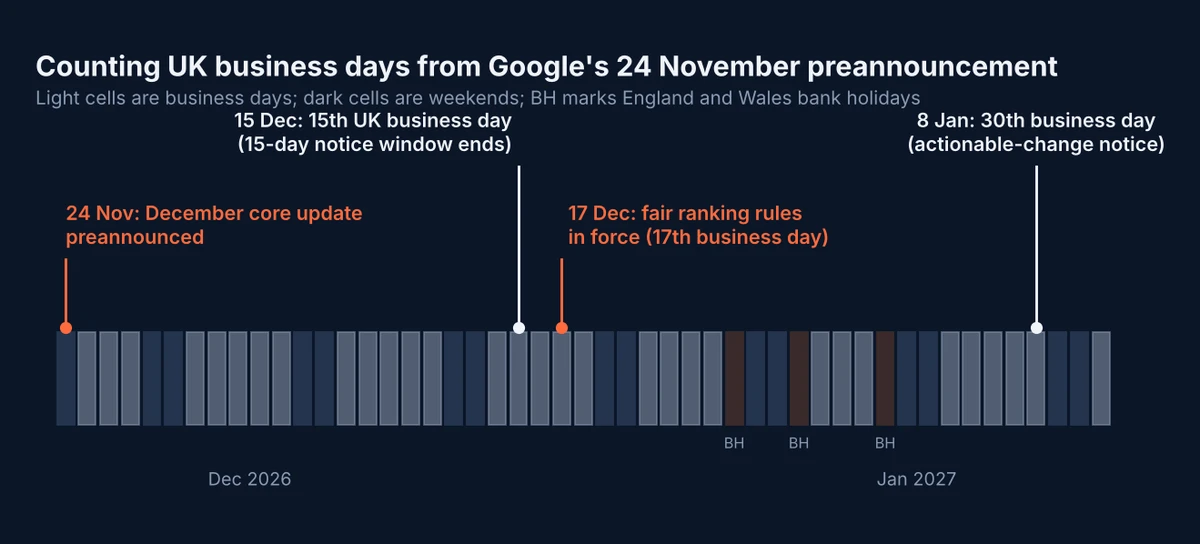
We counted forward from the 24 November preannouncement using the England and Wales bank holiday calendar published on GOV.UK. The 15th UK business day after it falls on 15 December, and 17 December, when the requirement takes effect, is the 17th. A rollout starting on or after 16 December would therefore follow at least 15 full business days of notice. The Status Dashboard entry says only that the update "is scheduled to be released in December 2026", with no date. If the December update were treated as an actionable change rather than a significant one, 30 business days would run to 8 January 2027.
Before this month, Google normally posted ranking updates to the dashboard at the moment of rollout. Our earlier count found that its last nine ranking posts came at rollout, and the November 2026 core update began without a preannouncement.
What the feedback route will and will not do
Google's feedback page says engineering teams review submissions together to spot systemic issues and that feedback does not lead to manual ranking adjustments for individual URLs. The CMA's notes point the same way: the feedback duty in paragraph 7.a does not cover complaints solely about one publisher's ranking relative to another, or objections to the stated purpose of a change. What it is meant to capture is evidence that a change is distorting a UK market in a way its stated purpose does not explain.
That matters for how submissions are written. Google's form asks for competing URLs that "appear to rank inappropriately", such as scraped copies outranking an original. Under the CMA's notes, the strongest submissions will tie those examples to a market-level effect. The regulator's trigger is volume: if 50 different publishers send feedback on the same material change within 30 business days of its UK rollout finishing, Google must pass details of all of it to the CMA within 15 business days. Separate brands within one corporate group count as different publishers.
What this means for SEO teams
- Watch the dashboard, not the blog. The stay-informed page names the Search Status Dashboard and its Atom/RSS feed as the place for preannouncements, rollout starts and completions. Subscribe to it.
- Use the hashtag. When feedback is warranted, include the update's hashtag (for example #NovemberCoreUpdate2026) and the six details Google lists: a Performance report snapshot, queries and locale, example URLs, timing of impact, context, and UK market impact.
- Wait before judging. Google advises waiting until an update is marked complete, plus at least a week of data, before evaluating traffic changes.
- Frame UK harm at market level. Feedback that only says a competitor outranks you falls outside what the CMA asked Google to collect.
- Know the separate AI rules. The CMA's notice says a separate Publisher Conduct Requirement, imposed on 3 June 2026, covers AI opt-out controls and attribution. We covered the deadline for AI engagement metrics earlier this month.
Methodology
On 27 November 2026 we downloaded the CMA's Fair Ranking Conduct Requirement notice, interpretative notes and summary from GOV.UK and Google's three ranking hub pages from developers.google.com. We split the notice's substantive obligations into ten items (paragraphs 4.a, 4.b, 5, 6.a, 6.b.i, 6.b.ii, 7.a, 7.b, 8 and 9) and checked each Google page against each item. "Addressed" means a Google page describes the specific mechanism; "partly" means it is covered in general terms or without a figure the CMA sets; "not mentioned" means no page refers to it. Business days were counted from 24 November 2026, excluding weekends and the England and Wales bank holidays listed in GOV.UK's public JSON feed (25 December, 28 December and 1 January). We also opened the UK indexing appeal link while logged out.
Conclusion
Google's ranking hub puts its feedback route, its UK appeal and its equal-treatment claim on the record before the CMA's rules bind. It is lighter on the parts publishers can measure Google against: the notice periods in days, the six-month testing exemption and a response time for reconsideration requests.
The first test comes with the December core update. If it starts on or after 17 December, it will be the first core update to roll out with the fair ranking rules in force, and the first that UK publishers can challenge through the CMA-backed feedback route.
Questions and answers
When does the CMA's fair ranking conduct requirement take effect?
The CMA imposed it on 17 June 2026 and its notice says it comes into force six months later, on 17 December 2026. It runs until 10 October 2030 unless varied or revoked.
How much notice must Google give before ranking changes in the UK?
Under the CMA notice, at least 30 UK business days before an actionable change and at least 15 business days before a significant and explainable change, such as a broad ranking update. Google's stay-informed page does not state these numbers.
How do site owners submit feedback on a Google ranking update?
Google's feedback page says verified owners can use the Submit Feedback button in Search Console when an update is on the Search Status Dashboard, including the update's hashtag, for example #NovemberCoreUpdate2026, plus details such as queries, example URLs and UK market impact.
Will Google change my rankings because I sent feedback?
No. Google says submissions are reviewed in aggregate to find systemic issues and do not result in manual ranking adjustments for individual URLs.
What is the UK CMA indexing appeal?
It is an appeal route for sites serving UK users that have been manually excluded from Google's index as a whole. Google says the form becomes active on 17 December 2026.
More releases
-
Explainers
Mueller Backs Shared Inventory Pages; 16 of 17 Top Marketplaces Run a Page per City
Google's John Mueller says a shared inventory section with location details per place works well, and that duplicating inventory across every location is hard for Search to manage. In our pull of 170 page-one results across 18 local searches, 147 used city-specific URLs and 16 of 17 recurring national sites ranked a separate page per city.
-
Studies
Amazon and Meta Talk Muse Access; Amazon Alone of 61 Retailers Bars ChatGPT-User
Amazon and Meta are discussing access for Meta's Muse shopping agent, Fortune reported on 25 November. Our fetch of 80 large retailers' robots.txt files found Amazon is the only one of 61 readable files that bars ChatGPT-User from its whole site, alongside seven other user-triggered agents. Muse has no token to block.
-
Updates
Google Local Pack Shows 'No Reviews' for Rated Firms; 0 of 238 Hit in Our Logged-Out Pull
Google's local pack is showing "No reviews" for some businesses that have reviews, Search Engine Roundtable reported on 26 November. Our logged-out pull of 238 listing appearances in 34 Google local result sets across seven US locations found none affected, and review counts matched Maps records in all seven we cross-checked.
Tell us the site and the goals.
Rankings in Google and visibility in AI answers, from one monthly plan. One call is enough to say which one fits. Email works just as well.