Mueller Backs Shared Inventory Pages; 16 of 17 Top Marketplaces Run a Page per City
Google's John Mueller says a shared inventory section with location details per place works well, and that duplicating inventory across every location is hard for Search to manage. In our pull of 170 page-one results across 18 local searches, 147 used city-specific URLs and 16 of 17 recurring national sites ranked a separate page per city.
 Vibhu Dhariwal
Cofounder & CTO, Digital Gratified
- Published
- Section
- Explainers
- Reading time
- 8 minutes
Ras Al Khaimah, United Arab Emirates, .
Google's John Mueller has told a marketplace operator that a single shared inventory section, with only location details split out per place, is a model he has seen work well, and that copying every listing into every location page is hard for Google Search to handle on purely technical grounds. He made the comment in a Bluesky post on 24 November, replying to a site owner with tens of thousands of landing pages split by geography and offer type who asked whether overlapping supply across those pages risked being treated as doorway spam. Search Engine Roundtable first reported the exchange on 25 November.
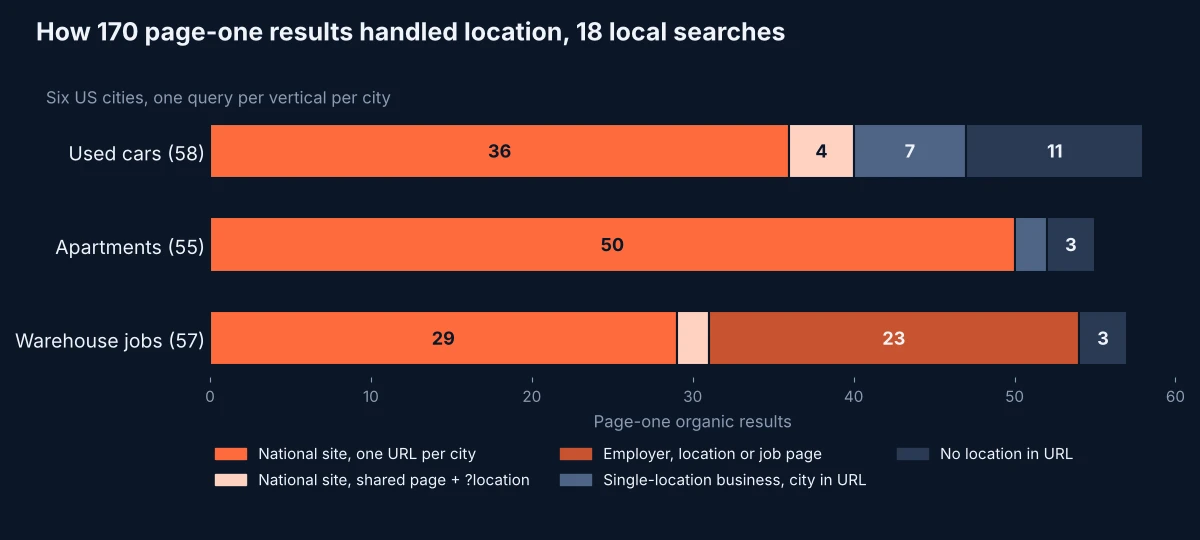
To see how far the live results are from that advice, we pulled Google's page one for 18 local marketplace searches across three verticals and six US cities. The answer: the one-page-per-city model, rather than the shared inventory model he described, is what Google ranks almost everywhere. Of 170 organic results, 147 (86%) carried the city or a smaller area in the URL path, and 16 of the 17 national sites that ranked in at least four of the six cities served a separate URL for each city.
What Mueller said
Mueller suggested "a shared inventory section, and just details per individual location". He did not say that city landing pages are spam, and he did not tie the advice to a ranking system. His point was narrower: multiplying every inventory item by every location creates a URL set that is difficult for Search to crawl and manage, before any question of quality or spam policy comes up.
That framing matches two Google documents. Google's spam policies list, as doorway abuse, pages "targeted at specific regions or cities that funnel users to one page", along with substantially similar pages that sit closer to search results than to a browseable hierarchy. Separately, Google's faceted navigation guidance warns that filter combinations can create effectively infinite URL spaces, which leads to overcrawling and slower discovery of new pages. A location filter layered on a product, model or job filter is one of those combinations.
Key findings from our SERP pull
- 147 of 170 page-one results put a city, ZIP code or neighbourhood in the URL path.
- National marketplaces and aggregators supplied 121 results. 115 of them were dedicated city URLs; only 6 were a shared page with the location passed as a query parameter (CarMax in four car searches, SimplyHired in two job searches).
- 17 national sites ranked in at least four of the six cities within one vertical. 16 used a different city URL every time. CarMax was the only one whose ranking URL was the same model page with a
?location=parameter. - In 8 of the 18 searches one domain held two page-one spots, usually with a second, narrower city page. Indeed did this in four of the six warehouse job searches.
- 5 deep pagination URLs (page 3, 4 or 12 of a city listing) reached page one, all in apartment searches.
- Single-location businesses (dealers, property managers, local staffing firms) took 25 results, and 9 of those still put a place name in the URL, even though each serves one location.
The national sites, city by city
The table lists every national site that ranked in four or more of the six cities in a vertical, and how its ranking URL handled location.
| Vertical | Site | Cities ranked (of 6) | Location in URL |
|---|---|---|---|
| Used cars | CARFAX, CarGurus, Autotrader, Edmunds | 6 each | City in path, one URL per city |
| Used cars | CarMax | 4 | Shared model page, ?location= parameter |
| Apartments | Apartments.com, Zillow, Trulia, RentCafe, Realtor.com | 6 each | City or sub-city in path |
| Apartments | Redfin | 5 | City in path |
| Apartments | Homes.com | 4 | City, ZIP or neighbourhood in path |
| Warehouse jobs | Indeed, ZipRecruiter, Amazon hiring | 6 each | City in path |
| Warehouse jobs | LinkedIn, Prologistix | 4 each | City in path |
The pattern is consistent: these sites rank with a page per city. That is not evidence that Google rewards the pattern, since the same sites also have strong brands, deep inventories and years of links. It does show that, in these verticals, Google has not demoted the city-page model as doorway abuse.
Where the model strains
The Phoenix apartment search is the clearest example of what Mueller described as hard to manage. None of its nine page-one results was a site's plain first page for two-bedroom rentals in Phoenix. Instead Google ranked page 3 and page 12 of one Zillow listing, page 4 of an Apartments.com listing, two ZIP code pages, a downtown page, a neighbourhood page, an "under $600" filter page and a two-bed, two-bath filter page. When a site generates location, bedroom, price and pagination combinations, Google can end up choosing an arbitrary slice of the set rather than the page the site would want to rank.
Repeat entries show the same strain. Indeed took two spots in four job searches with near-identical pages, such as warehouse jobs and part-time warehouse jobs in Columbus. For how far Google lets one domain stack results, see our test of how often YouTube breaks the two-per-site pattern.
What this means for SEO teams
Mueller's advice and the live results point to the same practical line: city pages are acceptable when each one carries information specific to that place, and risky when they are the full inventory reprinted with a new city name.
- Audit overlap before adding locations. For two neighbouring city pages, compare the listing IDs. If most listings repeat, the location layer adds URLs without adding unique content, which is the case Mueller described.
- Keep inventory in one place. Let item pages and the main category page hold the listings, and make location pages about the location: availability counts, pickup or branch details, local pricing, delivery areas. The CarMax pattern, one model page with location as a parameter, is the closest example in our sample.
- Cap the combinations you let Google crawl. Google's faceted navigation guidance suggests blocking filter URLs you do not need indexed in robots.txt, keeping filter order fixed in paths and returning a 404 for empty or nonsensical combinations.
- Watch which URL ranks. If Search Console shows pagination, ZIP or price-filter pages taking impressions for a city query, Google is picking from too many near-duplicates. Consolidating those variants, or keeping them out of the crawl as Google's faceted navigation guidance describes, narrows Google's choice to the page you want.
- Single-location businesses do not need city pages. Nine single-location businesses in our sample put a place name in the URL, but eleven local dealers ranked page one with no location in the URL at all. On related questions about consolidation, see Mueller's view that a site move does not fix a site's quality.
For category-level context, our earlier study found category pages took 67% of page one for generic shopping terms, and a separate test looked at whether keyword business names still win in Google Maps.
Methodology
On 26 November 2026 (UTC) we collected Google US organic results through a SERP API, localised to each city, with English interface settings. We ran one query per vertical in each of six cities (Denver, Austin, Phoenix, Atlanta, Columbus and Nashville): "used toyota rav4 for sale in [city]", "2 bedroom apartments for rent in [city]" and "warehouse jobs in [city]" (Columbus queries added "ohio"). The first Austin jobs query returned results unrelated to warehouse work, so we reran it as "warehouse jobs austin tx" and used that result. This produced 170 organic results (9 or 10 per search); ads, local packs and other features were excluded.
We classified each URL by whether the city, a ZIP code or a named area appeared in the URL path, only in the query string, or not at all, and by site type: national marketplace or aggregator, employer career site, or single-location business. Tracking parameters were ignored. We did not compare listing overlap between city pages or test canonical tags, so the study shows URL structure, not duplication rates. A single pull per query reflects one moment and one location setting, and results vary by searcher.
Conclusion
The model Mueller described, a shared inventory with location details layered on top, is the exception on today's page one: only CarMax and SimplyHired used it in our sample, while 16 of 17 recurring national sites ranked a dedicated city URL. Google has not said those pages are a problem, and our data does not show them being held back.
What the data does show is the cost Mueller pointed to. Where sites multiply location by bedroom count, price and page number, Google sometimes ranks a deep or narrow variant instead of the main city page. For marketplaces planning thousands of location pages, the safer route is to keep inventory shared and make each location page earn its URL with information that exists nowhere else on the site.
Questions and answers
What did John Mueller say about inventory pages per location?
In a Bluesky post on 24 November 2026, Mueller said a shared inventory section with only details per individual location is a model he has seen work well, and that duplicating all inventory across all locations is challenging for Google Search to manage from a technical point of view.
Are city landing pages doorway spam?
Mueller did not call them spam. Google's spam policies list pages targeted at specific regions or cities that funnel users to one page, and substantially similar pages closer to search results than a browseable hierarchy, as doorway abuse. Pages with genuinely location-specific information are a different case.
How common are city-specific URLs on page one?
In our pull of 170 Google page-one results for 18 used car, apartment and warehouse job searches in six US cities, collected on 26 November 2026, 147 put a city, ZIP code or neighbourhood in the URL path.
Which sites used a shared page with a location parameter?
Only CarMax, in four used car searches, and SimplyHired, in two warehouse job searches, ranked with a shared page that passed location as a query parameter. The other 115 aggregator results used a dedicated city URL.
What does Google recommend for filter and location URL combinations?
Google's faceted navigation documentation recommends blocking filter URLs you do not need indexed with robots.txt, keeping filter order consistent when filters are in the path, and returning a 404 status for empty or nonsensical filter combinations.
More releases
-
Studies
Amazon and Meta Talk Muse Access; Amazon Alone of 61 Retailers Bars ChatGPT-User
Amazon and Meta are discussing access for Meta's Muse shopping agent, Fortune reported on 25 November. Our fetch of 80 large retailers' robots.txt files found Amazon is the only one of 61 readable files that bars ChatGPT-User from its whole site, alongside seven other user-triggered agents. Muse has no token to block.
-
Updates
Google Local Pack Shows 'No Reviews' for Rated Firms; 0 of 238 Hit in Our Logged-Out Pull
Google's local pack is showing "No reviews" for some businesses that have reviews, Search Engine Roundtable reported on 26 November. Our logged-out pull of 238 listing appearances in 34 Google local result sets across seven US locations found none affected, and review counts matched Maps records in all seven we cross-checked.
-
Studies
Is Google Burying Independent Review Sites? They Took 14 of 31 No. 1 Spots in Our Test
Independent review sites say Google pushed them out of product search. Our pull of 31 "best [product]" searches on 26 November found specialist review sites held 14 No. 1 spots, level with media brands, while retailers and forums took 45.9% of page one and specialists were missing from 7 searches.
Tell us the site and the goals.
Rankings in Google and visibility in AI answers, from one monthly plan. One call is enough to say which one fits. Email works just as well.