Does a Keyword Business Name Still Win Google Maps? 81% of 800 Listings Use One
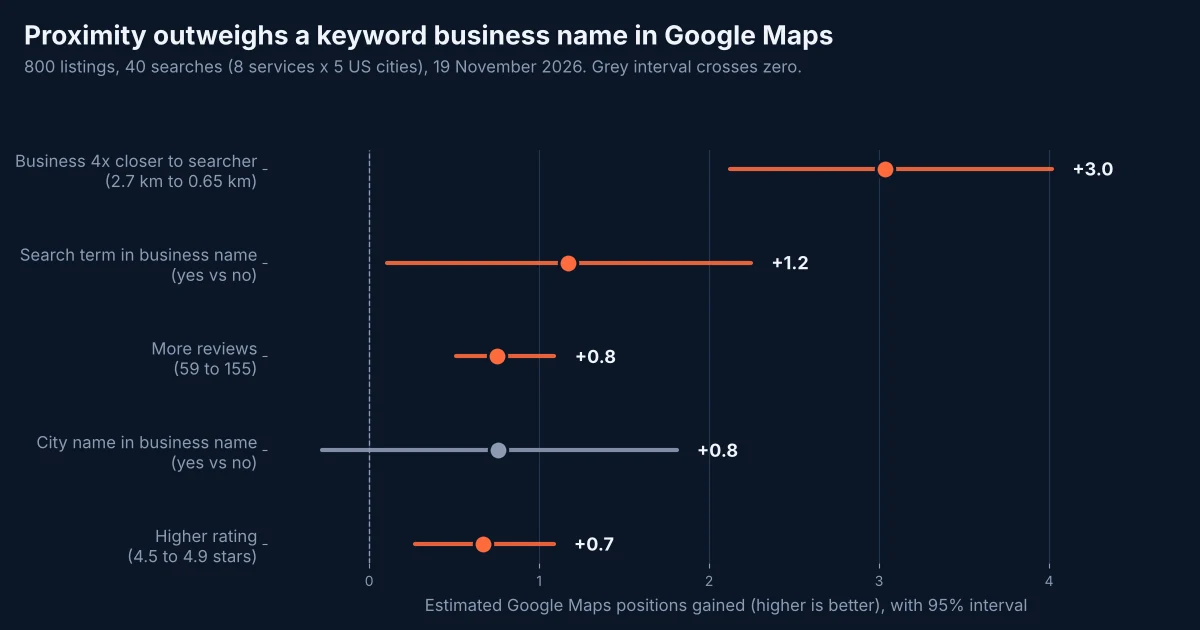
We pulled 800 Google Maps listings for eight services in five US cities. A business name containing the search term was associated with a gain of about 1.2 positions, while being four times closer to the searcher was worth about 3. Google allows only real-world names.
 Vibhu Dhariwal
Cofounder & CTO, Digital Gratified
- Published
- Section
- Studies
- Reading time
- 14 minutes
Ras Al Khaimah, United Arab Emirates, .
Local SEO practitioners have argued for years that the fastest way into Google's local pack is a business name that contains the search term. Google's Business Profile guidelines say the opposite should matter: the name must match the real-world name, and padding it with extra words can get a profile suspended. To test who is closer to the truth, we pulled 800 Google Maps listings for eight common service searches in five US cities on 19 November 2026 and measured how much a keyword name was worth next to distance, reviews and ratings.
The short answer: a name containing the search term is associated with a real but small edge, about one position in a list of 20. Being closer to the searcher was worth roughly two and a half times as much. And in one category, pest control, our pull surfaced a cluster of top-ranked listings with almost no reviews and descriptive names that read like search phrases.
Key findings
- 649 of the 800 listings (81%) had the search term, or its root, in the business name. Keyword names are the norm, not a differentiator.
- The share barely moves with rank: 84% of top-three listings carried the term, against 82% at positions 4 to 10 and 80% at positions 11 to 20.
- After controlling for distance, review count and rating within each search, a keyword name was associated with a gain of about 1.2 positions (95% interval 0.1 to 2.3).
- Moving a business four times closer to the map centre (from 2.7 km to 0.65 km) was associated with a gain of about 3.0 positions, the largest effect we measured.
- City names in business names were more common near the top (38% of top-three listings against 23% at positions 11 to 20), but that edge was not statistically distinguishable from zero once distance was accounted for.
- In pest control, 8 of the 15 top-three slots across the five cities went to listings with fewer than 10 reviews. No dentist, electrician, plumber or personal injury lawyer in the top three had fewer than 10.
The theory, and why practitioners believe it
The belief is not fringe. An annual survey of 47 local search practitioners, published by a local SEO software company, ranks keywords in the Business Profile name as the third most influential factor for the local pack and Maps. The same company published an analysis of more than 1.4 million listings in September 2026 that found keyword names correlated with more top-three placements in most of the 17 industries it studied. In retail, for example, it reported that 15.11% of listings with an exact-match keyword name reached the top three, against 3.05% of listings with no keyword in the name.
The logic is simple. Google says local results depend largely on relevance, and the name is the most prominent text on a profile. If Google matches the query against the name, a business called "Denver Garage Door Repair" looks more relevant to a search for garage door repair than one called "Harmony Doors". The practical consequence is that some businesses add service and city words to their profile names that do not appear on their storefronts, a tactic local SEOs call keyword stuffing.
The debate has a familiar shape. We tested similar claims about exact-match domains and keywords in title tags, and in both cases the signal existed but was far weaker than its reputation.
What Google says on the record
Google has never published a statement that a keyword name helps or does not help ranking. What it has published are rules and a description of its ranking inputs.
The rules are strict. Google's guidelines state that "Your name should reflect your business's real-world name", and they list taglines, store codes, hours, service details and location details as information that is not permitted. The guidelines warn that adding unnecessary information to a name could lead to suspension. The examples are instructive: Google rejects "Equinox near SOHO" but accepts "Equinox SOHO", which means a location word is acceptable when it is part of how the business actually presents itself. A city in a name is not a violation by itself.
On ranking, Google's help page on improving local ranking says local results are mainly based on relevance, distance and popularity, and its sections describe these as relevance, distance and prominence. It describes relevance as how well a profile matches what someone searches for and says that "More reviews and positive ratings can help your business's local ranking." It does not mention the business name. It also says there is no way to request or pay for a better local ranking.
Google has published enforcement numbers in recent spring posts. Its April 2026 Maps post says that in 2025 it removed more than 13 million fake Business Profiles, blocked or removed over 292 million policy-violating reviews and blocked 79 million inaccurate or unverified edits. The post says Gemini models now help catch unhelpful edits to place names. A year earlier, Google's April 2025 post reported that it removed more than 10,000 listings run by bad actors impersonating locksmiths in 2024. Neither post discusses keywords in names directly.
Our test
We ran eight searches (plumber, electrician, roofer, dentist, locksmith, personal injury lawyer, garage door repair and pest control) on Google Maps from a fixed point in downtown Austin, Phoenix, Atlanta, Chicago and Denver, collecting the top 20 listings each time. That gave 40 result sets and 800 listings. For each listing we recorded the name, rank, rating, review count and coordinates, and calculated the distance from the search point. The Methodology section below has the details.
| Positions | Listings | Search term in name | City name in name | Median reviews | Median distance |
|---|---|---|---|---|---|
| 1 to 3 | 120 | 84.2% | 37.5% | 155 | 0.65 km |
| 4 to 10 | 280 | 82.1% | 25.4% | 106 | 1.81 km |
| 11 to 20 | 400 | 79.5% | 22.5% | 59 | 2.74 km |
Source: SaaS Link Building analysis of 800 Google Maps listings from 40 searches, collected 19 November 2026.
The raw table already tells most of the story. The keyword share falls by fewer than five percentage points from the top three to the bottom of the list. Median review count falls by more than half and median distance roughly quadruples over the same range.
Raw shares can mislead, because the factors overlap. A business downtown might be more likely to use the city in its name and also sit closer to the search point. So we fitted a model that compares listings only against others in the same search and holds distance, review count and rating constant. We then estimated uncertainty by resampling whole searches 1,000 times.
Evidence that keyword names help
The keyword effect survived every check we ran. With all 800 listings, a name containing the search term was associated with a 1.2-position gain. Dropping the 26 listings more than 30 km from the search point raised the estimate to 1.4 positions. Dropping personal injury lawyers, the one category where keyword names are uncommon, raised it to 1.5. For the full sample, the resampled interval stayed above zero, if only just.
The top spot points the same way. In 32 of the 40 searches, the first listing carried the search term in its name. In the 35 searches that contained both keyword and non-keyword names, the keyword names had the better average rank in 21 and the worse average rank in 14.
Personal injury lawyers offer the clearest contrast, because law firms are usually named after their partners. Only 42% of the 100 lawyer listings we pulled contained "injury" in the name. In the top three, that rose to 53%. Several top-three firms used names that combined a surname with practice area and city, a format that closely mirrors the search.
Evidence against the strong version of the theory
The data does not support the idea that a keyword name is one of the most powerful levers in local search.
First, the size. A 1.2-position gain in a list of 20 is modest, and its lower bound is close to zero. The distance effect was about two and a half times larger, and even the low end of its interval (2.1 positions) sits above the keyword estimate. Reviews and rating each added a smaller but more precisely measured edge.
Second, saturation. When 81% of listings already carry the search term, a keyword name cannot separate many businesses from one another. For plumbers, roofers, locksmiths and garage door companies, the share was 90% or higher across the full result set. A business without the keyword is the exception, and the model's estimate rests on a relatively small group of those exceptions.
Third, most of those names look genuine. Trade businesses have long chosen names that describe the trade, and the guidelines allow a real-world name that happens to contain the service. Our data cannot tell a registered name from a stuffed one, so the 1.2-position estimate mixes both. The industry analysis cited above has the same limitation.
Fourth, the first-place listings were rarely the strongest on any single measure. The top listing was the most-reviewed business in its result set in only 1 of 40 searches and the closest to the search point in 6. Whatever Google weighs, it is combining several signals, which is what its help page says.
Finally, the city-name effect did not hold up. City names were more common near the top in raw terms, but once distance was in the model the estimate fell to 0.8 positions with an interval that crosses zero. Listings with the city in their name sat closer to downtown: a median of 1.46 km from the search point, against 2.27 km for the rest.
The pest control anomaly
One category behaved differently from the rest. In pest control, 52 of the 100 listings we pulled had fewer than 10 reviews, and those listings took 8 of the 15 top-three slots across the five cities. Across the other seven services combined, only 4 of 105 top-three slots went to listings with fewer than 10 reviews, and none in dentistry, electrical, plumbing or personal injury law.
Several of the top-ranked pest control listings had names built from the service and the city, and some showed further oddities in the data. One listing named after Los Angeles ranked second for pest control in Atlanta, with an address about 1.2 km from our Atlanta search point, and appeared a second time at position 16 in the same result set. Three top-three pest control listings linked to websites on the .site domain, and one of them linked to a domain carrying a different business name from the profile itself.
The following is speculation, and we label it as such: these are patterns that local spam fighters often associate with lead-generation listings of the kind Google described when it removed fake locksmith profiles. We did not verify any of these businesses, and each could be a legitimate new company. What the data does show is that in this category, a thinly reviewed listing with a descriptive name reached the top three in four of five cities we checked. That fits the keyword theory better than anything else in our sample, and it is also the category where Google's enforcement appears to have the most work left.
Verdict: likely, but smaller than its reputation
We rate the claim that keyword business names help Google Maps rankings as likely. A name containing the search term was associated with a small, measurable edge after we controlled for the factors Google names. The pest control results suggest the edge can matter more where competitors are weak.
The stronger claim, that the name ranks among the most influential local factors, is unproven on our data. Distance mattered more than twice as much, reviews and ratings were more reliably measured, and keyword names are so widespread that most businesses already have whatever benefit exists. Google has not confirmed that the business name is used in ranking. Its published ranking description does not mention the name.
What this means for SEO teams
- Do not rename a profile to chase rankings. The guidelines allow only the real-world name, and suspension is a listed consequence. On our estimate, a stuffed name buys roughly one position, which is a poor trade for a suspended profile.
- Put the service where it is allowed. Categories, services, the business description and the website are legitimate places to make relevance clear. If a business is choosing a new name for a real rebrand, a descriptive name is permitted as long as it is used on signage and stationery too.
- Treat reviews as the controllable lever. Review count and rating were the most precisely measured factors in our model. Google's own help page names them.
- Measure from several points. Distance dominated our results, so a single rank check from one address says little about how a business appears across its service area. Track a grid of points.
- Report competitors who break the rules, with evidence. If a competitor's profile name does not match its signage or website, Google's guidelines are the reference point. In categories like pest control, where our data showed thinly reviewed listings near the top, documented edits are the practical response.
- Watch how agents use profile data. Google is building more features on top of Business Profiles, from Ask Maps phoning businesses to AI answers that summarise them, which makes accurate profile data more important than clever naming.
Methodology
We collected Google Maps search results through a SERP data API on 19 November 2026 between 09:18 and 09:23 UTC. Each request used the google.com Maps vertical in English, US settings, a desktop device and a map centred on fixed downtown coordinates at zoom level 13: Austin (30.2672, -97.7431), Phoenix (33.4484, -112.0740), Atlanta (33.7490, -84.3880), Chicago (41.8781, -87.6298) and Denver (39.7392, -104.9903). We ran eight queries in each city and kept the top 20 organic Maps listings, giving 800 listings. Sponsored listings were not included.
A listing counted as having the search term in its name if the name contained the root of the query: plumb, electric, roof, dent (at the start of a word), lock, injur, garage or pest. A listing counted as having the city name if it contained the city or its common abbreviation (ATX, PHX, ATL, CHI). The rating contrast compares 4.5 and 4.9 stars, a typical spread within one result set. Distance is the great-circle distance from the search point to the listing's coordinates.
The model is an ordinary least squares regression of rank on keyword name, city name, the log of review count plus one, the log of distance, star rating and an indicator for listings without a rating, with each search's average removed so listings are compared only within their own result set. Confidence intervals come from 1,000 bootstrap resamples of whole searches. Contrasts for distance and reviews use the median values for positions 11 to 20 and positions 1 to 3. This is an observational test of correlation at one point in time. It cannot show causation, it cannot tell a registered business name from a stuffed one, and Maps results vary by device, account and exact location.
Conclusion
A keyword in the business name is associated with a better Google Maps position, but in our sample the advantage was about one place in twenty, smaller than the gain from being closer to the searcher and far smaller than its reputation as a top-three local factor. Google's rules allow only real-world names, and its published ranking description does not mention names at all.
The exception was pest control, where thinly reviewed listings with descriptive names took more than half of the top-three slots. That is where the keyword theory looks strongest, and where it is hardest to separate naming from spam.
What do you think?
If you have renamed a Business Profile, legitimately after a rebrand or by removing keywords after a suspension, how far did its Maps position move in the following weeks? Tell us what you saw and in which category.
Questions and answers
Does Google allow keywords in a Business Profile name?
Only if they are part of the business's real-world name. Google's guidelines say the name should reflect the name used on the storefront, website and stationery, and that adding unnecessary information such as service or location details could lead to suspension.
What does Google say determines local ranking?
Google's help page says local results are mainly based on relevance, distance and popularity (prominence), and that more reviews and positive ratings can help a business's local ranking. It does not mention the business name.
How much did a keyword name help in this test?
Across 800 Google Maps listings collected on 19 November 2026, a name containing the search term was associated with a gain of about 1.2 positions (95% interval 0.1 to 2.3), after controlling for distance, reviews and rating within each search.
What mattered more than the business name?
Distance. Moving from the median distance at positions 11 to 20 (2.74 km) to the median in the top three (0.65 km) was associated with a gain of about 3.0 positions.
How many fake Business Profiles did Google remove in 2025?
Google's April 2026 Maps post says it removed more than 13 million fake Business Profiles in 2025 and blocked or removed over 292 million policy-violating reviews.
More releases
-
Industry news
Google Pushes Hotel Booking Into AI Mode; Its Partners Were Cheapest at 1 of 25 Hotels
Google's hotel listings are reportedly sending bookings into AI Mode via a Continue on Google button. Our pull of live rates for 25 US hotels found Google's 10 booking partners matched or beat hotel websites at 21 of 22, but offered the lowest listed price at only one.
-
Industry news
Microsoft Confirms Ads in Bing AI Overviews; Its 21% Purchase Claim Uses 2024 Data
Microsoft confirmed on 19 November that ads now run beside AI Overviews on Bing in every market except China, through existing Performance Max and AI Max campaigns. The confirmation came 20 days after the first sighting, and the only performance figure offered comes from December 2024 Edge data.
-
Studies
67 of 425 Top Sites Using Hreflang Break Google's Rules; 7 Still Use es-419
A crawl of the top 2,000 domains on 19 November 2026 found 425 homepages using hreflang, and 67 of them broke at least one rule in Google's documentation: unsupported codes such as es-419 and en-uk, missing self-references, relative URLs or alternates that never link back.
Tell us the site and the goals.
Rankings in Google and visibility in AI answers, from one monthly plan. One call is enough to say which one fits. Email works just as well.