Microsoft Confirms Ads in Bing AI Overviews; Its 21% Purchase Claim Uses 2024 Data
Microsoft confirmed on 19 November that ads now run beside AI Overviews on Bing in every market except China, through existing Performance Max and AI Max campaigns. The confirmation came 20 days after the first sighting, and the only performance figure offered comes from December 2024 Edge data.
 Vibhu Dhariwal
Cofounder & CTO, Digital Gratified
- Published
- Section
- Industry news
- Reading time
- 7 minutes
Ras Al Khaimah, United Arab Emirates, .
Microsoft has confirmed that ads now appear in AI Overviews on Bing. In its November product roundup on the Microsoft Advertising blog, published on 19 November 2026, the company said ads can now show next to AI-generated answers on Bing when an offer is relevant, that the placement is live in every market except China, and that no separate campaign is needed. The confirmation comes 20 days after a screenshot of a sponsored unit inside a Bing AI Overview first circulated on 30 October. The main performance figure Microsoft offers in support, a 21% rise in purchases after a Copilot interaction, comes from 11 days of Edge user data in December 2024.
What Microsoft confirmed
- Placement: ads can appear alongside AI Overviews on Bing when Microsoft judges the offer relevant. Its example is a hotel ad shown next to an AI-generated itinerary for a trip to Snowdonia National Park.
- Setup: the post says "there's no separate campaign set-up required". Ads in AI Overviews are served through existing campaigns, and Microsoft names Performance Max and AI Max among them.
- Reach: available in all markets except China, according to the post.
- Framing: Microsoft calls the placement the latest step in bringing ads to AI experiences, building on ads in Copilot.
- Evidence offered: a 21% increase in purchases after a Copilot interaction, footnoted as Microsoft internal data from Edge users between 21 and 31 December 2024.
The same roundup announced Discover, an AI-curated content feed on the Edge new tab page and Windows, URL inclusions for AI Max, general availability of AI content declarations for ad creative, and a recap of a bidding upgrade shared earlier in the week.
What the announcement leaves out
We compared the November post with what advertisers and SEO teams would need to plan for the change. Several points are not addressed:
- Labelling. The post does not say how ads inside or beside an AI Overview are marked. The 30 October screenshot, shared on X by search marketer Khushal Bherwani and reported by Search Engine Roundtable, described what it showed as sponsored results within AI Overviews.
- Exclusion. Because the placement rides on existing campaigns, advertisers on Performance Max or AI Max may already be eligible. The post does not describe a setting that keeps ads out of AI Overviews.
- Reporting. There is no mention of a segment that separates AI Overview impressions or clicks from standard Bing search ads.
- Organic layout. Microsoft does not say whether the ad sits above, inside or below the cited sources, which is the detail that matters most for publishers whose pages are cited.
How old is the supporting data?
Microsoft footnotes each statistic in the roundup with its data window, which makes it possible to check how current each one is. The figure attached to AI Overview ads is the oldest by a wide margin: its data window closed 688 days before the announcement. The other footnoted figures we could date all come from 2026.
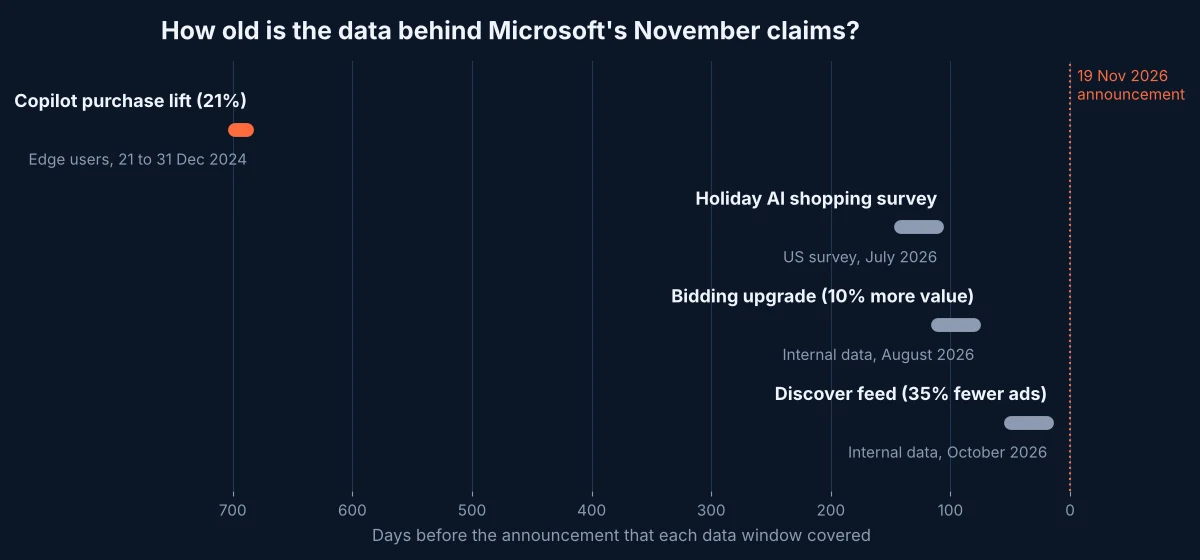
The 21% figure also measures something different from the new placement. It describes purchases after a Copilot interaction in the Edge browser, recorded before Bing renamed its Copilot Search answer box to AI Overview. It says nothing about how ads beside a Bing AI Overview perform, and the post gives no click-through or conversion figure for the new format.
From roadmap to rollout: the timeline
| Date | Event | Source |
|---|---|---|
| 21 April 2026 | Microsoft says AI Max, in open pilot from May, will deliver ads on Copilot Search and Copilot Answers as well as Bing | Microsoft Advertising blog |
| 30 October 2026 | Screenshot of a sponsored unit inside a Bing AI Overview shared on X | Khushal Bherwani; reported by Search Engine Roundtable |
| 1 November 2026 | Our check of 36 US Bing results pages finds 12 AI Overviews and no ad inside any of them | our earlier Bing AI Overview ads check |
| 19 November 2026 | Microsoft confirms ads in AI Overviews on Bing in all markets except China | Microsoft Advertising blog (linked above) |
The gap between the April roadmap and the November confirmation was 212 days. The gap between the first public sighting and Microsoft's confirmation was 20 days.
When we checked Bing on 1 November, the test was not visible, but the conditions for it were. AI Overviews showed on 12 of 36 pages, and 10 of those 12 pages already carried ads elsewhere on the page. Software comparison and informational queries were the ones that produced both an AI Overview and ads, while consumer product searches produced ads but no AI Overview.
A busy week for Microsoft's AI search business
The ad confirmation landed in the same week Microsoft opened its Web IQ grounding service to all Azure users, which we covered alongside how many sites that block AI bots still admit Bingbot. Together the two moves show Bing's index offered twice over: as grounding data for other companies' AI agents, and as ad inventory beside Bing's own AI answers. For site owners, Bingbot access now feeds both.
What this means for SEO and PPC teams
- Check your campaign types. If you run Performance Max or AI Max on Microsoft Advertising, assume your ads are eligible for AI Overviews from now on, since Microsoft says no separate setup is needed. Watch search term reports for informational and comparison queries that previously drew few ad clicks.
- Ask your account team about exclusion and reporting. The announcement does not cover either. Get answers in writing before holiday budgets peak.
- Re-baseline Bing organic clicks. If your pages are cited in Bing AI Overviews, mark 19 November in your analytics. Compare Bing referrals and the AI performance data in Bing Webmaster Tools, including the Topics Portfolio beta, in the weeks either side, especially for comparison and how-to queries.
- Collect screenshots. With no documentation of the layout or label, first-hand captures (query, device, market, time) remain the best record of where the ad sits relative to cited sources.
- Treat the 21% figure with care. It is a 2024 Copilot statistic from Edge users, not a measure of AI Overview ad performance. Build forecasts on your own data once impressions start to appear.
Methodology
On 19 November 2026 we read the Microsoft Advertising blog posts dated 21 April 2026 and 19 November 2026 and recorded every statistic in the November post with its footnoted data window. For the chart, each window is plotted as the number of days between its start and end dates and 19 November 2026; where Microsoft gave only a month (July, August and October 2026), we used the first and last day of that month. Day counts were calculated in code. The 1 November figures come from our earlier check of 36 US desktop Bing results pages, described in full in that article. We attempted a fresh pull of Bing results pages on 19 November through two commercial SERP data services, but the responses we sampled returned results unrelated to the query (for example, Detroit hotels for a query about hotels near Snowdonia) and carried no ad or AI Overview data, so we did not use them.
Conclusion
Microsoft has now confirmed what a single screenshot suggested three weeks ago: ads run next to AI Overviews on Bing, across every market except China, through campaigns advertisers already have. The announcement is light on the details that decide its impact, including labelling, exclusion controls, reporting and where the ad sits relative to cited sources. The only performance figure tied to the new placement is a 2024 Copilot statistic rather than evidence from the placement itself.
For teams that rely on Bing, the practical steps are to confirm which campaigns are eligible, press Microsoft for reporting and exclusion options, and set a 19 November baseline for both paid and organic Bing traffic.
Questions and answers
Does Bing show ads in AI Overviews?
Yes. Microsoft Advertising confirmed on 19 November 2026 that ads can appear next to AI-generated answers on Bing when an offer is relevant, in all markets except China.
Do advertisers need a new campaign to appear in Bing AI Overviews?
No. Microsoft says there is no separate campaign setup. Ads in AI Overviews are served through existing campaigns, including Performance Max and AI Max.
Where does Microsoft's 21% purchase figure come from?
Microsoft footnotes it as internal data from Edge users between 21 and 31 December 2024, measuring purchases after a Copilot interaction. It is not a measurement of ads in Bing AI Overviews.
Can advertisers opt out of Bing AI Overview ads?
Microsoft's 19 November announcement does not describe an opt-out or a reporting segment for the placement. Advertisers should ask their Microsoft Advertising account team.
More releases
-
Industry news
Google Pushes Hotel Booking Into AI Mode; Its Partners Were Cheapest at 1 of 25 Hotels
Google's hotel listings are reportedly sending bookings into AI Mode via a Continue on Google button. Our pull of live rates for 25 US hotels found Google's 10 booking partners matched or beat hotel websites at 21 of 22, but offered the lowest listed price at only one.
-
Studies
67 of 425 Top Sites Using Hreflang Break Google's Rules; 7 Still Use es-419
A crawl of the top 2,000 domains on 19 November 2026 found 425 homepages using hreflang, and 67 of them broke at least one rule in Google's documentation: unsupported codes such as es-419 and en-uk, missing self-references, relative URLs or alternates that never link back.
-
Studies
Does a Keyword Business Name Still Win Google Maps? 81% of 800 Listings Use One
We pulled 800 Google Maps listings for eight services in five US cities. A business name containing the search term was associated with a gain of about 1.2 positions, while being four times closer to the searcher was worth about 3. Google allows only real-world names.
Tell us the site and the goals.
Rankings in Google and visibility in AI answers, from one monthly plan. One call is enough to say which one fits. Email works just as well.