67 of 425 Top Sites Using Hreflang Break Google's Rules; 7 Still Use es-419
A crawl of the top 2,000 domains on 19 November 2026 found 425 homepages using hreflang, and 67 of them broke at least one rule in Google's documentation: unsupported codes such as es-419 and en-uk, missing self-references, relative URLs or alternates that never link back.
 Vibhu Dhariwal
Cofounder & CTO, Digital Gratified
- Published
- Section
- Studies
- Reading time
- 7 minutes
Ras Al Khaimah, United Arab Emirates, .
One in six of the world's most visited websites that use hreflang annotations break at least one of the rules Google sets for them, a SaaS Link Building crawl of the top 2,000 domains on 19 November 2026 found. Of the 425 homepages that declared hreflang, 67 used language or region codes Google does not support, left the page itself out of its own set, used relative URLs, or pointed to alternate pages that never linked back. Google's hreflang documentation says codes outside its two standards are not supported and that annotations without return links may be ignored or not interpreted correctly.
The errors are not confined to small sites. ChatGPT's homepage, Strava and Google's own safety.google site all label Latin American Spanish pages es-419, a code Google's documentation names as unsupported. IBM's US homepage uses en-uk, HP lists country before language in all 81 of its codes, and Atlassian's homepage annotates 11 language versions while leaving out the English page it serves.
Key findings
- 1,200 of the 2,000 domains returned an HTML homepage; 425 of those (35.4%) declared hreflang: 423 in the HTML head and 2 only in an HTTP Link header.
- 67 of the 425 (15.8%) broke at least one of the rules Google's documentation sets out, and 20 broke two or more.
- 34 sites (8.0%) used at least one code outside ISO 639-1 and ISO 3166-1 Alpha 2, the only standards Google accepts. Across all sites, 385 of 9,307 annotations (4.1%) carried such a code.
- 22 sites (5.2%) did not list the homepage itself, which Google says every language version must do.
- In a sample of 1,057 alternate pages from 395 sites, 70 (6.6%) did not link back to the homepage that named them, and 77 (7.3%) redirected somewhere else first.
- 128 sites (30.1%) had no x-default value, which Google recommends but does not require.
Where top sites go wrong
Google's documentation lists a short set of requirements: each version must list itself and every other version, alternate URLs must be fully qualified with http or https, every annotated page must link back to the pages that name it, and codes must come from ISO 639-1 for language and ISO 3166-1 Alpha 2 for region. A four-letter ISO 15924 script code such as zh-Hant is also accepted. The table counts how many of the 425 homepages broke each rule.
| Problem | Sites | Share of 425 | Examples found |
|---|---|---|---|
| Any unsupported language or region code | 34 | 8.0% | See breakdown below |
| Three-letter language codes (ISO 639-2 or 639-3) | 14 | 3.3% | fil, fil-PH, kok-IN, prs-AF |
| Withdrawn or invalid language codes | 8 | 1.9% | in, iw, jw, at-de, au-en |
| Invalid region codes | 8 | 1.9% | zh-FT, en-XD, ca-en, kr-ko |
| Numeric region es-419 | 7 | 1.6% | chatgpt.com, strava.com, safety.google |
| Extra subtags after the region | 4 | 0.9% | ca-ES-VALENCIA, zh-tw-au |
| Underscore instead of hyphen | 3 | 0.7% | pt_BR, ca_ES |
| en-uk instead of en-gb | 1 | 0.2% | ibm.com |
| Page does not list itself | 22 | 5.2% | atlassian.com, php.net |
| Relative alternate URLs | 3 | 0.7% | gnu.org, 1password.com |
| Sampled alternate omits the return link | 29 of 395 | 7.3% of sampled sites | wise.com, atlassian.com |
| No x-default (recommended, not required) | 128 | 30.1% | Not counted as an error |
A site can appear in more than one row, so the rows do not add up to 67.
Codes Google cannot read
The most common code fault was a three-letter language code. Microsoft's office.com and cloud.microsoft homepages list fil-PH for Filipino, kok-IN for Konkani and prs-AF for Dari, and chess.com uses fil. These are valid in other standards, but Google's documentation says only ISO 639-1 codes are supported, and those languages have no two-letter code.
Others are plain mistakes. Garmin still uses in and iw, withdrawn codes for Indonesian and Hebrew that ISO 639-1 replaced with id and he. HP builds all 81 of its codes country first, so its Austrian German page reads at-de, where "at" is not a language code, and its Canadian English page reads ca-en, which parses as Catalan for a region called "EN". Many of its other codes pass a format check but mean something else: se-sv, intended for Swedish in Sweden, reads as Northern Sami for El Salvador, and be-fr reads as Belarusian for France. Our count only flags codes that are invalid, so it understates this kind of error. Duolingo uses zh-FT, and Shein appends a second region to Chinese codes, as in zh-tw-au.
The es-419 case is the most widespread single code. It is a valid tag in the wider BCP 47 standard and is common in software localisation, but Google's page says codes outside its two standards, "such as es-419, aren't supported." Seven homepages in our crawl used it, including one run by Google.
Missing self-references and return links
Twenty-two homepages left themselves out of their own set. Atlassian's homepage lists Japanese, French, German, Spanish and seven more versions but no English URL, and the French page it points to does not list the English homepage either. PHP.net carries a single x-default that points to /index while its canonical is /index.php.
To test return links, we fetched up to three alternate URLs per site and checked whether each one listed the homepage that named it. Most did.
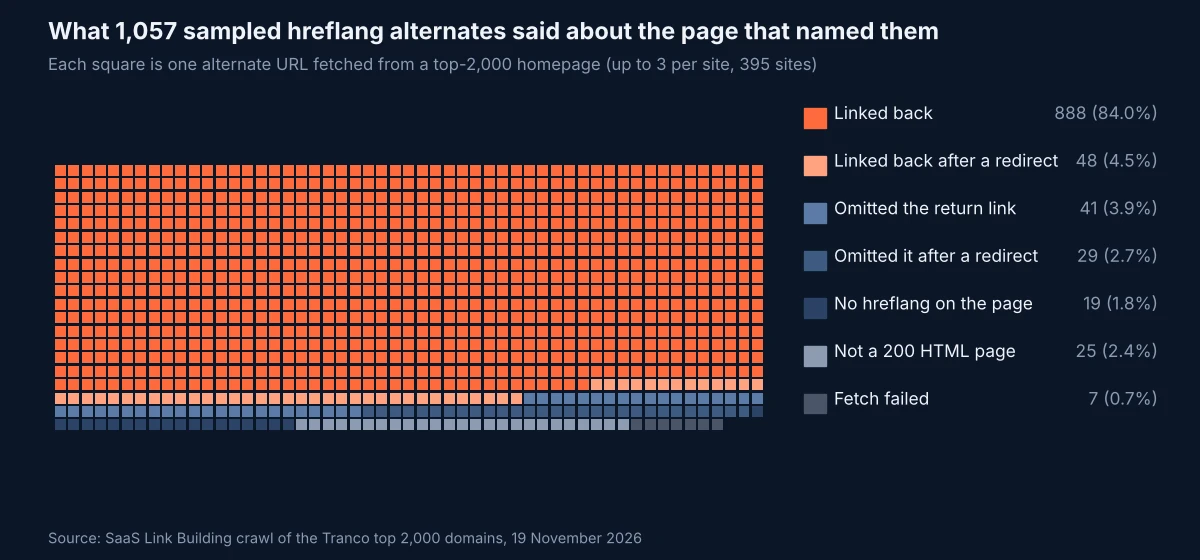
Where links were missing, the cause was usually a mismatch rather than an absent tag. Wise's Finnish page, for example, lists its English version as wise.com/gb/, not the wise.com/ homepage that names it. Under Google's rule, the homepage's annotation for that page has no confirmed partner. Another 77 alternate URLs (7.3%) redirected before loading, which means the hreflang target was not the final URL Google would index; we saw the same pattern in our study of redirect codes on top sites.
What this means for SEO teams
Google's documentation does not describe a penalty for hreflang errors. It says annotations without return links may be ignored or misread. Our crawl suggests the most frequent problems are mechanical and can be found with a script.
- Validate every code against the two lists. Replace es-419 with country codes (es-MX, es-AR and so on) or plain es; change en-uk to en-gb; swap in and iw for id and he; and check that country-first codes are not being emitted by your CMS.
- Use hyphens, not underscores. Locale strings such as pt_BR often leak in from application code.
- List the page itself. Each page in a cluster needs its own URL in the set, including the default or homepage version.
- Point at final URLs. Alternates should return 200 without a redirect, and should match the canonical of the target page.
- Check reciprocity from both ends. Fetch each alternate and confirm it names the original URL exactly, including trailing slashes and country folders.
- Add x-default for selectors and auto-redirecting homepages, which Google's documentation recommends for unmatched languages.
Teams that keep hreflang in XML sitemaps rather than HTML should run the same checks against the sitemap; Google treats HTML, HTTP headers and sitemaps as equivalent methods. Our earlier look at how top sites handle sitemap lastmod found similar gaps between documented rules and live files.
Methodology
On 19 November 2026, between 13:23 and 13:30 UTC, we requested the homepages of the top 2,000 domains in the Tranco list (list ID L5KW4), trying https://domain/ and then https://www.domain/, following redirects with a desktop Chrome user agent from a US cloud server. 1,200 returned an HTML page with status 200. We parsed every link element with rel="alternate" and an hreflang attribute, plus hreflang entries in HTTP Link headers. Sitemap-based hreflang was not checked, so sites that rely on sitemaps alone are counted as not using hreflang.
Codes were checked against ISO 639-1 language codes, optional ISO 15924 script codes and ISO 3166-1 Alpha 2 region codes, with x-default treated as valid. A page counted as self-referencing if its final URL or its canonical URL appeared in its own set (ignoring trailing slashes and case in the host). For return links, we took up to three non-default alternates per site, chosen at random, fetched them, and checked whether their hreflang set contained the original final URL or canonical. Geo-redirects, bot protection and our server location can affect what a crawler sees, so return-link and redirect figures are a sample, not a full audit. Many of the 800 domains without an HTML result are CDN, API or tracking hosts with no homepage, or blocked automated requests.
Conclusion
Most of the 425 top sites that use hreflang implement it cleanly, but 67 break a rule in Google's documentation, and the faults are mundane: retired or three-letter codes, es-419, underscores, missing self-references and alternates that do not point back. Similar gaps between guidance and practice showed up in our crawl of URL word separators on top sites. Because Google may quietly drop faulty annotations rather than flag them, international sites should validate codes and reciprocity in their own crawls rather than wait for the wrong version to rank.
Questions and answers
Does Google support the es-419 hreflang code?
No. Google's hreflang documentation says only ISO 639-1 language codes and ISO 3166-1 Alpha 2 region codes are supported, and names es-419 as an example of a code that is not. Seven of the 425 top homepages we crawled on 19 November 2026 used it.
How many top sites use hreflang on their homepage?
Of the Tranco top 2,000 domains, 1,200 returned an HTML homepage when we crawled them on 19 November 2026, and 425 of those (35.4%) declared hreflang in the HTML head or an HTTP Link header. Sites that use only XML sitemaps for hreflang were not counted.
What were the most common hreflang errors?
Unsupported codes were the most common fault (34 of 425 sites), followed by pages that did not list themselves (22 sites). In a sample of 395 sites, 29 had at least one alternate page that did not link back to the homepage that named it.
Is x-default required for hreflang?
No. Google's documentation recommends x-default as a fallback for unmatched languages, especially on language selectors and auto-redirecting homepages, but does not require it. In our crawl, 128 of 425 sites (30.1%) did not use it.
Can hreflang alternate URLs be relative?
No. Google's documentation says alternate URLs must be fully qualified, including http or https. Three of the 425 homepages in our crawl used relative URLs.
More releases
-
Industry news
Google Pushes Hotel Booking Into AI Mode; Its Partners Were Cheapest at 1 of 25 Hotels
Google's hotel listings are reportedly sending bookings into AI Mode via a Continue on Google button. Our pull of live rates for 25 US hotels found Google's 10 booking partners matched or beat hotel websites at 21 of 22, but offered the lowest listed price at only one.
-
Industry news
Microsoft Confirms Ads in Bing AI Overviews; Its 21% Purchase Claim Uses 2024 Data
Microsoft confirmed on 19 November that ads now run beside AI Overviews on Bing in every market except China, through existing Performance Max and AI Max campaigns. The confirmation came 20 days after the first sighting, and the only performance figure offered comes from December 2024 Edge data.
-
Studies
Does a Keyword Business Name Still Win Google Maps? 81% of 800 Listings Use One
We pulled 800 Google Maps listings for eight services in five US cities. A business name containing the search term was associated with a gain of about 1.2 positions, while being four times closer to the searcher was worth about 3. Google allows only real-world names.
Tell us the site and the goals.
Rankings in Google and visibility in AI answers, from one monthly plan. One call is enough to say which one fits. Email works just as well.