301 or 302? Google Explains Redirect Codes; 75 of 435 Top Sites Use Temporary Ones
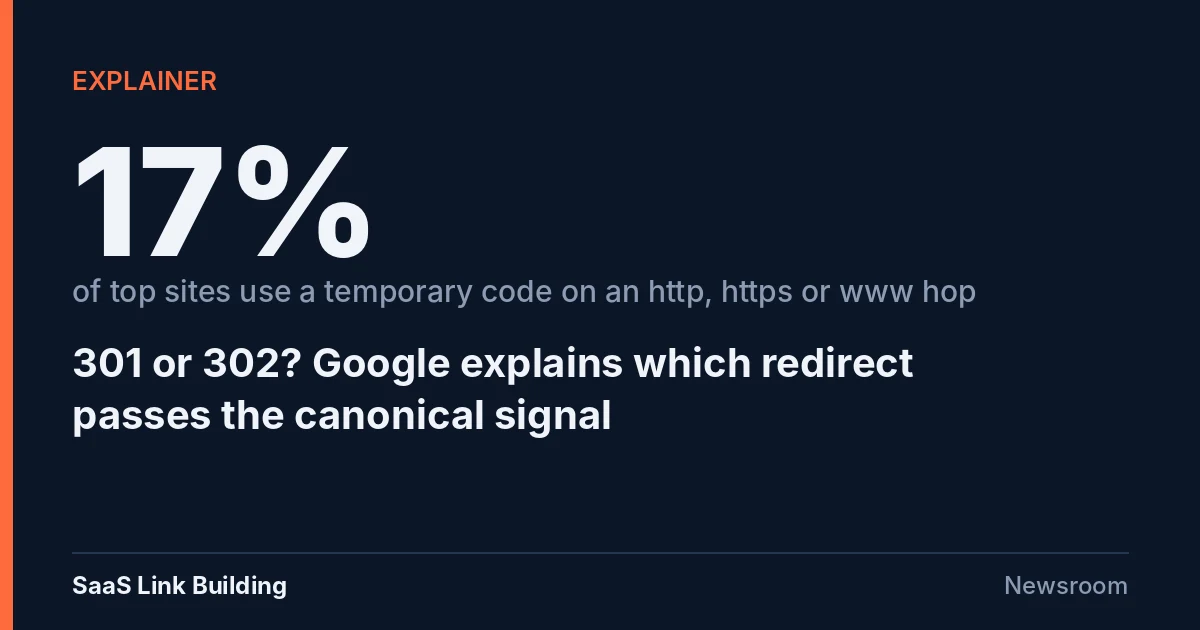
Google's Gary Illyes and Cherry Prommawin have explained how 301, 302, 307 and 308 redirects differ for Search: only permanent codes mark the target as canonical. Our crawl of the top 1,000 domains found 75 of 435 sites (17.2%) still use a temporary code on an http, https or www redirect.
 Vibhu Dhariwal
Cofounder & CTO, Digital Gratified
- Published
- Section
- Explainers
- Reading time
- 8 minutes
Ras Al Khaimah, United Arab Emirates, .
Google's Gary Illyes and Cherry Prommawin used a recent episode of the Search Central video series "The Non-Canonical Cabinet", "301, 302, 307, 308: Which redirect is the chosen one?", to explain how the four redirect codes differ for Google Search. The short version, which matches Google's written documentation: permanent redirects tell Google the target should be the canonical URL, temporary ones do not. To see how often that distinction is ignored where it matters most, we followed the redirect chains of the 1,000 most popular domains on 16 November. Of the 435 sites that redirected from http, https, www or bare-domain variants to a working homepage, 75 (17.2%) used a temporary code on at least one of those hops.
What Google says about each redirect code
According to Search Engine Journal's write-up of the episode, published on 5 November, Illyes said Google's crawlers follow every redirect type in the same way, and the difference shows up later, in indexing. He described 307 and 308 as the modern counterparts of 302 and 301, with the main difference being how they treat a request's method and body (form data sent by POST, for example). Prommawin's point, as reported, was that both kinds of redirect help Google group duplicate URLs into a cluster, but only a permanent one pushes the canonical choice toward the target.
Google's own pages say the same thing in more detail. The Redirects and Google Search guide says that with a permanent redirect the indexing pipeline uses the redirect as a signal that the target should be canonical, while with a temporary redirect it does not, although the target "might still be indexed" if other canonical signals point to it. Google's HTTP status code reference puts it in terms of signal strength:
| Redirect | Google treats it as | Signal for the target | Typical use |
|---|---|---|---|
| 301 Moved Permanently | Permanent | Strong | Domain moves, http to https, URL changes you will not undo |
| 308 Permanent Redirect | Equivalent to 301 | Strong | Same as 301 where the request method must be kept |
| 302 Found | Temporary | Weak | Short-lived moves, geolocation or login routing |
| 303 See Other | Temporary | Weak | Sending a browser to a result page after a form post |
| 307 Temporary Redirect | Equivalent to 302 | Weak | Temporary moves where the method and body must be kept |
| Meta refresh, 0 seconds | Permanent | Treated like a 301 | Platforms with no server access |
| Meta refresh, delayed | Temporary | Treated like a 302 | Rarely a good idea for Search |
The same reference says Google's crawlers follow up to 10 redirect hops by default and ignore any content served on a redirecting URL. The redirects guide ranks server-side redirects as the most reliable and says to use JavaScript redirects only as a last resort.
Key findings from our crawl
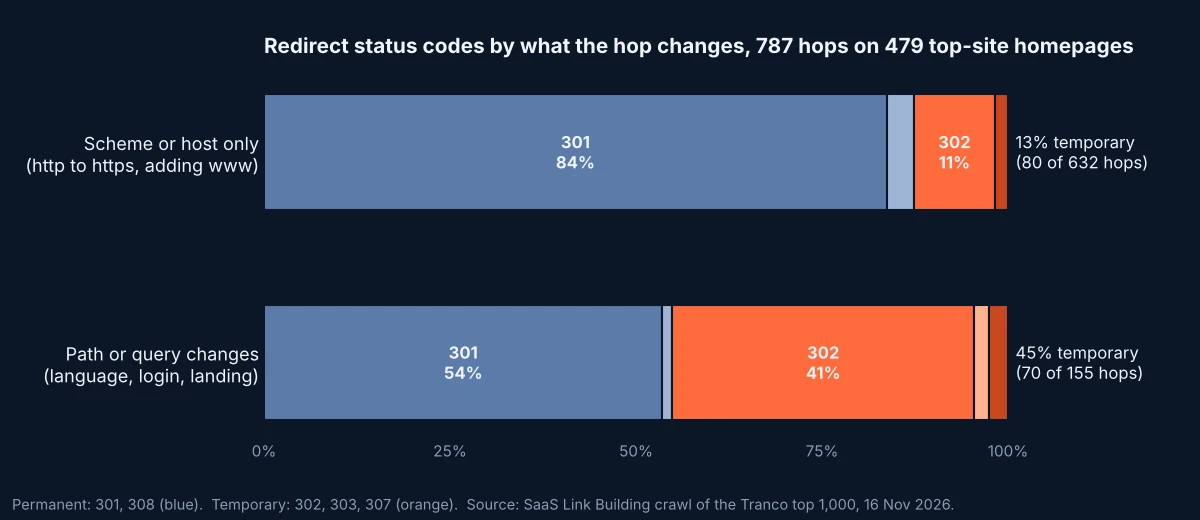
- Most canonical hops are permanent, but not all. Of the 632 hops that only changed the scheme or hostname (http to https, bare domain to www and back), 552 used a 301 or 308. The other 80 used a 302, 303 or 307, and they were spread across 75 sites.
- The very first hop is often the weak one. 423 homepages started with an http to https redirect. 48 of them (11.3%) did it with a 302 or 307, including microsoft.com (307), mozilla.org (302) and debian.org (302).
- Mixed chains are common. 82 sites combined permanent and temporary codes in a single chain. nasa.gov and state.gov both upgrade to https with a 301, then add "www" with a 302.
- Temporary codes cluster where they belong. On hops that changed the path or query string, the kind used for language selection, login checks and campaign landing pages, 70 of 155 (45.2%) were temporary. On scheme and host hops the rate was 12.7%.
- Chains are short enough for Googlebot. 253 sites (52.8%) needed two or more hops and 56 needed three or more, but the longest chain we recorded was six hops, inside Google's 10-hop default.
- 308 is still rare. Only 25 of 787 redirect hops (3.2%) used it, against 612 that used a 301.
How long the chains run
| Redirect hops before the homepage | Sites | Share of 479 |
|---|---|---|
| 0 (http served the page directly) | 24 | 5.0% |
| 1 | 202 | 42.2% |
| 2 | 197 | 41.1% |
| 3 | 43 | 9.0% |
| 4 to 6 | 13 | 2.7% |
The longest chains belonged to large brands moving visitors across their own properties. Requesting hp.com took five hops, one of them a 302 between the bare https domain and www, before landing on a US English homepage. A crawl we ran in October for Google's favicon rules found the same pattern from a different angle, with three in four top homepages ending on another hostname.
Does a 302 on the www hop actually hurt?
For a famous homepage, probably not much. Google calls a temporary redirect a weak signal, not no signal, and the canonical choice also draws on rel="canonical", sitemaps and the other hints in its canonicalization guide. When every one of those points at https://www, a 302 from the bare domain is unlikely to change which URL Google shows. Our crawl cannot tell us which URL Google picked for these sites, and we have not tested whether rankings differ.
The risk grows when the redirect is the main signal Google has. In a domain migration, a rebrand, or a section moved to a new folder, the old URLs carry the links and history. Google's guide says a temporary redirect is meant to keep the old URL in search results, so a 302 left in place after a move asks Google to keep showing the address you are leaving.
Worked examples: which code to send
| Situation | Code | Why |
|---|---|---|
| http://example.com to https://www.example.com | 301 (or 308) | The https www URL is the one you want indexed for good |
| Old blog post merged into a newer guide | 301 | The new URL should take over the old one's place |
| Product out of stock for two weeks, sent to its category | 302 or 307 | The product URL should stay in results and come back |
| Checkout fails over to a backup payment server | 307 | Temporary, and the POST data must survive the redirect |
| Homepage sends visitors to /en/ or /de/ by language | 302, plus hreflang | The choice depends on the visitor, so no single target is permanent |
| A form submission lands on a thank-you page | 303 | Tells the browser to fetch the result page with GET |
What SEO teams should do
- Trace the four entry points. Request http and https, with and without www, for your homepage and a few deep URLs, and record the status code of every hop, not only the final page.
- Fix temporary codes on permanent moves. Any hop that changes only the scheme or hostname, or belongs to a completed migration, should be a 301 or 308. Check CDN rules, load balancers and platform defaults.
- Collapse chains. Point each legacy URL straight to its final destination; every extra hop is another URL that must stay reachable.
- Keep temporary redirects temporary. Put an end date on every 302 or 307 you set up for a sale, an outage or a test, and review them after migrations.
- Send internal links to the final URL. Redirects should catch old and external links. Your own navigation, canonical tags and sitemaps should already use the destination, as our coverage of Mueller's advice on picking one URL form also stressed.
A one-line check from a terminal shows every hop and its code:
curl -sIL http://example.com/ | grep -iE "^(HTTP|location)"Context
The episode is part of the series that also produced Google's 23 October help-page updates on URL separators and robots.txt encoding. This time the redirects guide was not edited; it still shows a last-updated date of 14 April 2026, so the video restates existing rules rather than announcing new ones.
Methodology
We took the top 1,000 domains from the Tranco research list (ID JZWZY) and requested http://<domain>/ for each on 16 November 2026 between 05:21 and 05:23 UTC, with a desktop Chrome user agent. We did not follow redirects automatically: each hop was requested separately so we could record its status code and Location header, up to 12 hops. 479 domains ended on a 200 response; 292 did not answer (mostly infrastructure and CDN domains) and 229 ended on another status, 152 of them a 403. For each of the 787 redirect hops among the 479 sites, we compared the source and target URLs and classed the hop as a scheme or host change if the path and query string stayed the same, and as a path change otherwise. We counted 301 and 308 as permanent and 302, 303 and 307 as temporary, following Google's documentation. Limits: we crawled as a browser, not as Googlebot, so some sites may send Google different codes; we did not follow JavaScript redirects; and we did not check which URL Google has chosen as canonical for any site.
Conclusion
Google's message in the episode is the one its documentation already states: a 301 or 308 asks Google to index the new URL, a 302 or 307 asks it to keep the old one. Most of the web's largest sites follow it for the basic http, https and www moves, yet one in six still sends a temporary code somewhere on that path, and one in nine of those that upgrade to https does it on the very first hop.
For a dominant brand with consistent canonical signals, that is a small inefficiency. For a site in the middle of a migration, where the redirect is the strongest signal Google has, the choice of code decides which URL Google is asked to keep.
Questions and answers
What is the difference between a 301 and a 302 redirect for Google?
Google's redirects guide says a permanent redirect (301 or 308) is used by its indexing pipeline as a signal that the target should be canonical, while a temporary redirect (302, 303 or 307) is not, so the source URL tends to stay in results. Google's HTTP status code reference calls a 301 a strong signal and a 302 a weak one.
Are 307 and 308 redirects treated differently from 302 and 301?
No. Google's HTTP status code documentation says a 307 is equivalent to a 302 and a 308 is equivalent to a 301. The practical difference is that 307 and 308 keep the original request method and body, which matters for form submissions.
How many redirects will Googlebot follow?
Google's crawling documentation says its crawlers follow up to 10 redirect hops by default, and that some product crawlers use different limits. The longest homepage chain in our crawl of 479 top sites was six hops.
How does Google treat meta refresh and JavaScript redirects?
Google interprets an instant (0 second) meta refresh as a permanent redirect and a delayed one as temporary. It recommends JavaScript redirects only when server-side and meta refresh redirects are not possible, because it may not see them if rendering fails.
How common are temporary redirects on top sites?
In our 16 November 2026 crawl of the Tranco top 1,000, 75 of the 435 sites with an http, https or www redirect (17.2%) used a 302, 303 or 307 on at least one of those hops, and 48 of 423 sites used a temporary code for the first http to https hop.
More releases
-
Updates
Gemini 4 Carbon Reaches AI Pro Users in AI Mode, but Stays Out of All 30 EEA Countries
Google's Rajan Patel says Gemini 4 Carbon appearing in AI Mode for AI Pro subscribers is not a bug, though Google's help page still lists it for Ultra only. Our check of Google's country lists finds Carbon in AI Mode missing from all 30 EEA countries, despite both paid plans being sold there.
-
Updates
Search Console API Adds Branded, Multimodal and Multi-Country Filters, 361 Days After UI
Google's Search Analytics API can now return branded and non-branded data, multimodal search performance from Lens and Circle to Search, and multi-country or multi-device filters in one request. The branded filter reached the API 361 days after its announcement, and Google's API specification caps each filter list at 1,000 values.
-
Industry news
Google Loses Second Round to SerpApi: Court Sided Against It on 12 of 15 Points
A federal judge dismissed Google's amended DMCA complaint against SerpApi on 9 November 2026, the second dismissal in the scraping case. Our reading of the 19-page order finds the court sided with SerpApi on 12 of 15 contested points. Google has until 30 November to refile or the case ends with prejudice.
Tell us the site and the goals.
Rankings in Google and visibility in AI answers, from one monthly plan. One call is enough to say which one fits. Email works just as well.