Search Console API Adds Branded, Multimodal and Multi-Country Filters, 361 Days After UI
Google's Search Analytics API can now return branded and non-branded data, multimodal search performance from Lens and Circle to Search, and multi-country or multi-device filters in one request. The branded filter reached the API 361 days after its announcement, and Google's API specification caps each filter list at 1,000 values.
 Vibhu Dhariwal
Cofounder & CTO, Digital Gratified
- Published
- Section
- Updates
- Reading time
- 7 minutes
Ras Al Khaimah, United Arab Emirates, .
Google has added three Search Console reporting options to the Search Analytics API: the branded queries classification, the web multimodal search type and filters that match several countries or devices in one request. The Search Console team (Daniel Waisberg, Nati Yosephian and Karin Gadasi) announced the change on 16 November 2026 in a Search Central blog post, saying it followed "ecosystem requests" to make the data available for custom reporting.
All three options already existed in the Search Console interface. What is new is that dashboards, scripts and third-party tools can now request them directly. We compared Google's written reference with the machine-readable API specification that client libraries are generated from, and measured how long each feature took to reach the API. The branded filter took 361 days from its announcement. One limit that matters for large reports, a cap of 1,000 values per filter list, appears in the specification but not in the human-readable reference.
What changed
- Branded classification. Requests can now group or filter by brandedClassification, with the values BRANDED and NON_BRANDED. Google's blog post says the response will contain no rows for properties that are not eligible for the branded filter.
- Web multimodal search type. Setting type to webMultimodal returns performance from Google Lens, Circle to Search on Android and image uploads in Google Search. Google says the same data will reach BigQuery for properties with an active bulk data export.
- filterLists. A new field inside dimensionFilterGroups matches one dimension against several exact values at once, so a single request can cover a region such as DACH or a pair of devices.
The Search Analytics API reference was updated with the new fields. It also adds conditions the blog post does not spell out: brandedClassification accepts only the equals operator, it cannot be combined with a query filter in the same request, and branded data is available from 21 February 2026 onwards.
Our check: the reference against the specification
Google publishes the API's formal definition as a discovery document, the file Google's client libraries are built from. The copy we fetched on 16 November carried a revision string of 20261115, the day before the announcement, and already listed every new field. Comparing it with the reference page turned up details that only one of the two states.
| Detail | API reference page | Discovery document (rev. 20261115) |
|---|---|---|
| Search type value for multimodal | webMultimodal | WEB_MULTIMODAL (7th search type value) |
| Branded as a grouping dimension | Implied (any filter dimension can be grouped) | BRANDED_CLASSIFICATION listed as a dimension |
| Branded operators | equals only; no query filter alongside | Not stated |
| Branded data start | 21 February 2026 | Not stated |
| filterLists dimensions | country, device | COUNTRY and DEVICE only |
| Maximum values per filter list | Not stated | 1,000 |
| Same dimension in filters and filterLists | Not allowed in one request | Not stated |
| OR between filters in a group | Not yet supported | Only AND listed |
Source: Google's Search Analytics API reference and the Search Console API discovery document, both fetched by SaaS Link Building on 16 November 2026.
The last row is the one that changes practice. When we tested the interface's new multi-select device filter on 6 November, the API offered no OR logic, so the only way to rebuild a two-device view was a notEquals filter excluding the third device. filterLists removes the need for that workaround, and for countries it replaces either a regular expression or one request per country.
How long the API took to catch up
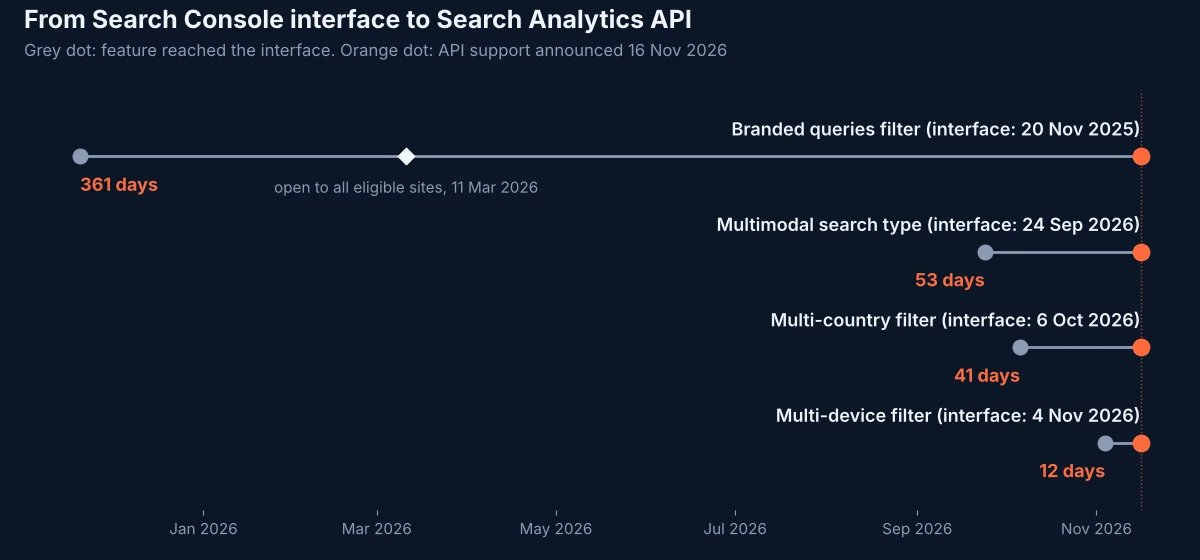
The branded filter is the outlier. Google announced it on 20 November 2025 as a gradual rollout and updated that post on 11 March 2026 to say it was available to all eligible sites, which still left 250 days before API access. Multimodal reporting arrived in the interface on 24 September 2026. Country multi-select was announced in a Search Central post on LinkedIn on 6 October, a date we confirmed from the post's identifier, and device multi-select was spotted on 4 November.
Google did not explain the gap. Its 2025 post describes branded classification as produced by "an internal, AI-assisted system" rather than keyword rules. Our speculation is that a model-based classification took longer to expose through the API, but Google has not said so.
A worked example: one request per region
To show what a filter list replaces, we grouped this site's own country data into regional lists. Between 16 October and 13 November 2026, saaslinkbuilding.com recorded web impressions from 98 countries. Before filterLists, query-level or page-level data for a region usually meant one request per country code, then a merge. Now each region is one request.
| Region (filter list) | Country codes in list | Codes with impressions | Impressions | Clicks |
|---|---|---|---|---|
| DACH | 3 | 3 | 28 | 1 |
| Nordics | 5 | 5 | 20 | 0 |
| Gulf | 6 | 5 | 22 | 0 |
| South Asia | 8 | 6 | 257 | 6 |
| Latin America | 19 | 12 | 67 | 0 |
| EU 27 | 27 | 24 | 176 | 3 |
Source: Search Console data for saaslinkbuilding.com, web search, 16 October to 13 November 2026, grouped by country and summed by SaaS Link Building on 16 November 2026.
The request for the EU 27 row needs only one filter group:
"dimensionFilterGroups": [{
  "filterLists": [{
    "dimension": "country",
    "expressions": ["aut", "bel", "bgr", "...", "swe"]
  }]
}]
Even the largest regional list sits far below the 1,000-value ceiling, so the cap is unlikely to bite for country groups. It could matter only for tools that build very long lists programmatically.
What this means for SEO teams
- Retire the device workaround. If your dashboards use a notEquals filter to combine devices, switch to filterLists so the logic matches what colleagues select in the interface.
- Collapse per-country loops. Scripts that request query data country by country can now send one request per region. Keep the row limits in mind: the API still returns top rows, not every row.
- Test branded eligibility first. Send one request grouped by brandedClassification. Google says ineligible properties get a response with no rows, so build that case into reports rather than treating it as zero branded traffic. Remember that subdomain and URL-prefix properties are excluded.
- Do not stack branded and query filters. The reference rules out combining them. Pull branded totals first, then run query-level pulls separately.
- Add multimodal as its own series. Lens and Circle to Search traffic sits outside the default web type, so it will not show up in existing web exports. Retail and image-heavy sites should request it separately.
- Watch your client library. Generated libraries follow the discovery document. If yours rejects WEB_MULTIMODAL or filterLists, regenerate or update it.
Context
The release continues a run of reporting changes in Search Console this autumn, from country and device multi-select to the new documentation on Search referer values Google added on 12 November. Earlier this autumn we logged a long data delay and a broken date picker in the same tool, a reminder to sanity-check automated pulls.
It also lands during the November 2026 core update, which began on 10 November according to Google's Search Status Dashboard, at a time when many teams are pulling more data than usual.
Methodology
On 16 November 2026 we fetched Google's Search Analytics API reference page and the Search Console API v1 discovery document and compared the fields, values and limits each one states. Interface launch dates come from Google Search Central blog posts and the timestamp encoded in the identifier of Google Search Central's LinkedIn post (6 October 2026); the device multi-select date is the earliest public report we found. Lags are calendar days to 16 November 2026. The regional table sums this site's Search Console web data grouped by country for 16 October to 13 November 2026. Summed country rows can differ slightly from a filtered request's totals.
Conclusion
The Search Analytics API now matches the interface on branded classification, multimodal search and multi-value country and device filters. The practical gains are fewer requests per region and an end to device workarounds. The fine print is split between two Google documents: the reference holds the branded restrictions, while the specification alone states the 1,000-value limit per filter list.
Questions and answers
What did Google add to the Search Analytics API?
On 16 November 2026 Google added three options: the brandedClassification dimension for branded and non-branded data, a webMultimodal search type covering Google Lens, Circle to Search and image uploads, and a filterLists field that matches several countries or devices in one request.
Why does a branded query request return no rows?
Google says the response contains no rows for properties that are not eligible. The branded filter is limited to top-level properties with enough query and impression volume, so URL-prefix and subdomain properties are excluded. Branded data in the API starts on 21 February 2026.
Can I combine branded and query filters in one API request?
No. The Search Analytics API reference says filtering or grouping by brandedClassification cannot be combined with a query filter in the same request, and only the equals operator is supported for it.
How many values can a filterLists entry hold?
Google's Search Console API discovery document sets a maximum of 1,000 expressions per filter list, and limits filter lists to the country and device dimensions. A single request cannot filter the same dimension in both filters and filterLists.
Does multimodal data reach BigQuery bulk exports?
Yes, according to Google's announcement: web multimodal data will also be available in BigQuery for properties with an active bulk data export.
More releases
-
Updates
Gemini 4 Carbon Reaches AI Pro Users in AI Mode, but Stays Out of All 30 EEA Countries
Google's Rajan Patel says Gemini 4 Carbon appearing in AI Mode for AI Pro subscribers is not a bug, though Google's help page still lists it for Ultra only. Our check of Google's country lists finds Carbon in AI Mode missing from all 30 EEA countries, despite both paid plans being sold there.
-
Industry news
Google Loses Second Round to SerpApi: Court Sided Against It on 12 of 15 Points
A federal judge dismissed Google's amended DMCA complaint against SerpApi on 9 November 2026, the second dismissal in the scraping case. Our reading of the 19-page order finds the court sided with SerpApi on 12 of 15 contested points. Google has until 30 November to refile or the case ends with prejudice.
-
Studies
Does Google Pause Updates for the Holidays? One Ran on 51% of Peak-Season Days
Google says it tries to avoid ranking updates from late November to mid-December. Its own Search Status Dashboard shows a notable update rolling out on 53 of 104 days in that window from 2022 to 2025, against 30% of days across the year. The one gap since 2022: no launches in late November.
Tell us the site and the goals.
Rankings in Google and visibility in AI answers, from one monthly plan. One call is enough to say which one fits. Email works just as well.