Search Console Now Combines Device Filters; Page-Level Splits Kept 15% of Our Impressions
Google Search Console's Performance report now lets users select several device types at once, a month after countries got the same option. Our API check found combined device figures match property totals exactly, but with a /blog/ page filter the device rows held only 15% of impressions.
 Vibhu Dhariwal
Cofounder & CTO, Digital Gratified
- Published
- Section
- Updates
- Reading time
- 7 minutes
Ras Al Khaimah, United Arab Emirates, .
Google Search Console now lets users tick more than one device type in the Performance report's device filter, so desktop, mobile and tablet traffic can be viewed as one combined total. Search Engine Roundtable reported the change on 4 November 2026 after a user shared a screenshot of the new checkboxes, 29 days after the same report gained multi-select for countries on 6 October. Google's help page on advanced filtering and comparison now describes both: users can select "multiple countries or devices to see their combined data."
The interface change is small, but it raises a practical question the coverage so far has not answered: do combined device numbers add up to the totals you already see? We pulled this site's own Search Console data by device through the API to check. At property level they reconcile exactly. Once a page filter is added, they did not come close.
What changed
- Device filter is now multi-select. Users can check Desktop, Mobile and Tablet in any combination instead of picking one device at a time, according to the screenshot Search Engine Roundtable published.
- Countries came first. When Google added country multi-select in October, it said in a LinkedIn post that the update was meant to help users "analyze traffic patterns across different countries and devices", as Search Engine Roundtable reported at the time. Device multi-select followed a month later.
- Compare mode is unchanged. Google's help page still describes Compare as a side-by-side view of two devices, countries, search types or search appearances.
- Search appearance stays single-select. The same page says users cannot filter by multiple search appearances.
Google has not published a Search Central blog post about the device change, and its Search documentation updates log had no November entry when we checked it on 6 November.
Our check: what combined devices look like
We pulled clicks, impressions and average position by device for saaslinkbuilding.com through the Search Console API, web search type, for the 28 days ending 3 November 2026. The single-device rows below are Google's figures. The combined rows are the totals the new filter should show: clicks and impressions are simple sums, and the positions are our own impression-weighted averages, because Google's Performance report documentation defines average position as the average position of the topmost result from your site, which makes it an average over impressions rather than a figure you can add.
| Device selection | Clicks | Impressions | Average position |
|---|---|---|---|
| Desktop only | 9 | 1,615 | 59.0 |
| Mobile only | 3 | 231 | 62.4 |
| Tablet only | 0 | 6 | 94.3 |
| Desktop + Mobile | 12 | 1,846 | 59.4 (calculated) |
| Desktop + Tablet | 9 | 1,621 | 59.1 (calculated) |
| Mobile + Tablet | 3 | 237 | 63.2 (calculated) |
| All three (no filter) | 12 | 1,852 | 59.6 (Google's total) |
Source: Search Console API for saaslinkbuilding.com, web search, 7 October to 3 November 2026, pulled 6 November 2026. Combined positions are impression-weighted by SaaS Link Building.
Two things stand out. First, the device rows add up exactly to the property total: 1,615 plus 231 plus 6 is 1,852 impressions, and 9 plus 3 is 12 clicks. The same held over 90 days, where 11,294 desktop, 1,397 mobile and 24 tablet impressions matched the 12,715 total. Second, our weighted position for all three devices (59.5) came within a tenth of Google's reported 59.6, and the 90-day check landed the same way (78.5 against 78.6), so impression weighting is a close approximation, not an exact one.
Where the numbers stop adding up
The picture changed when we narrowed the same 28 days to URLs containing /blog/. Without a device breakdown, the API returned 723 impressions and 6 clicks for those pages. Split by device with the same page filter, it returned 86 desktop impressions and 25 mobile impressions, and no tablet row: 111 impressions in all, or 15% of the unfiltered figure, and 2 of the 6 clicks.
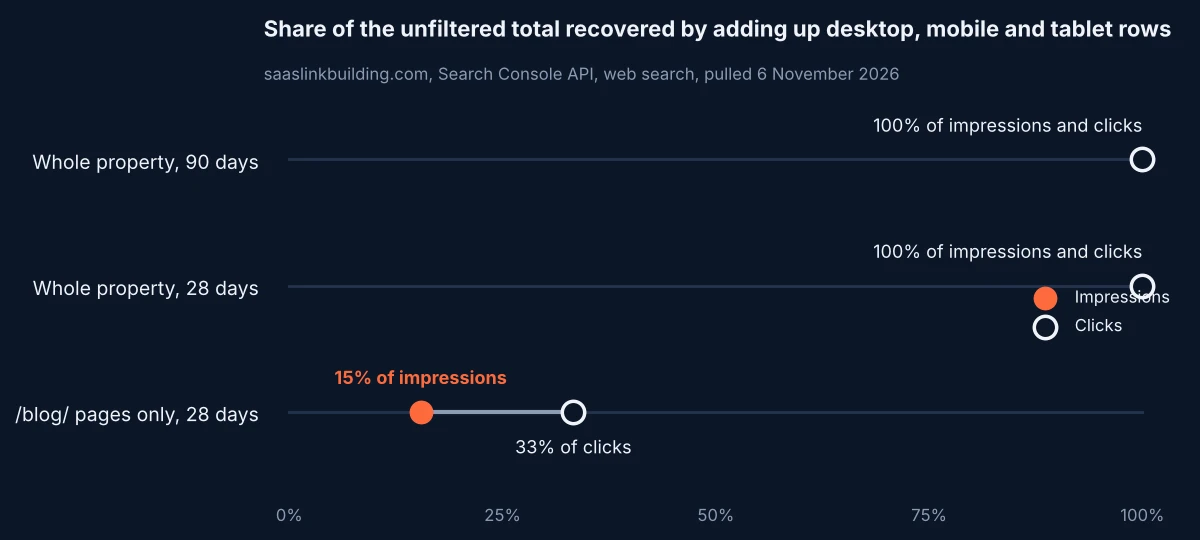
Google's help page gives the likely reason: filtering by query or URL can change report totals because of data truncation and the omission of anonymized queries. A small site like this one, where many pages earn a handful of impressions, is close to the worst case, and larger properties will see a much smaller gap. We have not confirmed that the web interface shows the same shortfall as the API, so treat the 15% as a warning sign for low-volume pages rather than a rule.
How the filter maps to the API
Anyone building dashboards on the Search Analytics API will notice that it still has no OR option inside a filter group: the reference lists "and" as the only accepted groupType, with OR marked as not yet supported. Device combinations can still be reproduced, because there are only three device values (DESKTOP, MOBILE and TABLET) and the API accepts a notEquals operator. A desktop plus mobile view is simply every device except tablet:
"dimensionFilterGroups": [{
  "filters": [{
    "dimension": "device",
    "operator": "notEquals",
    "expression": "TABLET"
  }]
}]
Country combinations are harder, since excluding every other country is impractical. An includingRegex filter on the country dimension is one option the reference allows, though we have not tested how it behaves with three-letter country codes.
What this means for SEO teams
- Use it for desktop plus tablet, or mobile plus tablet. Tablet traffic is usually too thin to read alone (6 of 1,852 impressions here, 0.3%). Folding it into the device it behaves most like removes a noisy row from reports.
- Reconcile before you report. After selecting several devices, check the combined clicks against the unfiltered total for the same dates. If you also filter by page or query, expect the combined figure to come in lower, sometimes far lower on small sites.
- Do not average positions by hand. If you rebuild combined views in a spreadsheet, weight each device's position by its impressions. A simple average of 59.0, 62.4 and 94.3 gives 71.9, which is 12 places off the real figure.
- Isolate anomalies faster. The device filter is useful when one device carries an odd spike, as in the desktop-heavy click spike we examined on 1 November. Deselecting the suspect device now leaves the rest of the traffic visible in one view.
- Keep API exports aligned. If your reporting pulls from the API, use the notEquals pattern above so dashboards match what colleagues see in the interface.
Context: a run of Search Console changes
The device filter lands in a busy stretch for the tool. In the last few weeks Google rewrote its help text on Crawled, currently not indexed to call the status common, and earlier in October we tracked a long data delay, a broken date picker and 10 entries in Google's 2026 anomalies log. Multi-select filtering is one of the few recent changes aimed at analysis rather than diagnosis.
Methodology
On 6 November 2026 we queried the Search Console API for the domain property sc-domain:saaslinkbuilding.com, web search type, for 7 October to 3 November 2026 (28 days) and 6 August to 3 November 2026 (90 days), the latest dates available. We pulled totals with no dimensions, totals grouped by device, and, for the 28-day window, the same two pulls restricted to page URLs containing /blog/, plus single-device pulls for desktop and mobile with that filter. Combined positions are weighted by each device's impressions, using Google's positions rounded to one decimal place, which explains small differences from Google's own totals. Our property is small, so the size of the page-filter gap reflects a low-volume site.
Conclusion
Multi-select device filtering gives Search Console users a faster way to combine desktop, mobile and tablet traffic, and at property level the combined figures add up exactly to the totals. The catch is in filtered views: on our own pages, a device split under a page filter returned only 15% of the impressions the unfiltered page view showed. Check combined numbers against an unfiltered total before they go into a report.
Questions and answers
Can I select more than one device in the Search Console Performance report?
Yes. Since early November 2026 the device filter accepts several selections, so desktop, mobile and tablet can be combined into one total. Google's help page on advanced filtering says you can select multiple countries or devices to see their combined data.
Do combined device numbers match the property total?
At property level they did in our check: desktop, mobile and tablet impressions summed to exactly 1,852 over 28 days and 12,715 over 90 days, the same as the unfiltered totals. With a page filter applied, the device rows returned only 111 of 723 impressions.
How is average position calculated for combined devices?
Google defines average position as the average position of the topmost result from your site, so it is an average over impressions. To rebuild a combined figure yourself, weight each device's position by its impressions rather than taking a simple average.
Can the Search Console API combine devices with OR?
Not directly. The Search Analytics API reference lists only "and" as a supported groupType. Because there are only three device values, a two-device view can be built with a notEquals filter that excludes the third device.
More releases
-
Explainers
Google Briefly Shields Key URLs From 4xx Drops; VLC Still Sends 418 to 4 AI Bots
Google's Gary Illyes says Search can briefly keep important URLs indexed after they start returning 4xx errors, as it did when VideoLAN's VLC site served HTTP 418. Our checks found the teapot code still aimed at four AI crawlers, and no use of 418 among 792 top homepages.
-
Studies
AI Mode Showed Home Service Booking Cards on 19 of 48 Searches; Plumbers Got None
Google AI Mode showed home services booking cards on 19 of 48 searches we ran across Austin, Denver, Atlanta and Phoenix the day after launch. Thumbtack supplied 17 of the 46 cards, ServiceTitan was already live despite a coming-soon label, Jobber supplied none and plumber searches returned no cards at all.
-
Industry news
Facebook's AI Answer Pages Reach Google Page One on 8 of 25 Searches We Ran
Facebook's AI-generated answer pages at facebook.com/fb-answers/ reached Google's page one on 8 of 25 searches we ran on 5 November, sometimes twice per query, as SEOs call the more than 6 million indexed pages scaled content abuse. Facebook's robots.txt leaves the directory open to Googlebot while blocking a sister directory.
Tell us the site and the goals.
Rankings in Google and visibility in AI answers, from one monthly plan. One call is enough to say which one fits. Email works just as well.