Google Now Calls Crawled, Not Indexed Common; 3 of 3 AI Overviews Point to Thin Content
Google has rewritten the Crawled - currently not indexed entry in its Search Console help, calling the status common and often no cause for action. In three AI Overviews we pulled on 4 November, all named thin or low-value content as the first cause, and none of 34 sources linked the new help text.
 Vibhu Dhariwal
Cofounder & CTO, Digital Gratified
- Published
- Section
- Updates
- Reading time
- 8 minutes
Ras Al Khaimah, United Arab Emirates, .
Google has rewritten the "Crawled - currently not indexed" entry in the Page indexing report help page for Search Console. The live entry now tells site owners that Google does not index every page on the web and that the status is "a common message for many sites" that does not necessarily point to a problem. Search Engine Roundtable reported the change on 3 November, comparing the page with an archived copy from 26 October.
We checked how Google's own AI Overviews answer questions about the same status. In three AI Overviews we pulled on 4 November, every one listed low-value or thin content as the first common cause, and none of their 34 source links pointed to the rewritten help article.
What changed
The definition itself is the same: the page was crawled by Google but not indexed. What surrounds it is new. Based on Search Engine Roundtable's comparison with the archived copy and our reading of the live page, the entry has grown from a single line into a short triage guide.
| Element | Previous entry (archived 26 October) | Current entry |
|---|---|---|
| Definition | Page crawled, not indexed | Unchanged |
| Outlook | The page might or might not be indexed later | Google does not index all pages; the status is common and not necessarily an issue |
| Resubmitting | No need to resubmit the URL for crawling | Not mentioned |
| Diagnosis | None | For important pages, use URL Inspection and other tools to look for blockers such as crawler blocks |
| Escalation | None | Use the indexing issue form only for a suspected complete, site-wide indexing bug |
| Content quality | Not mentioned | Not mentioned |
Sources: Google's live Search Console help page; previous wording as quoted by Search Engine Roundtable from an archived copy.
Two details stand out. The new text narrows when Google wants to hear about indexing problems: the report an indexing issue form is offered only for a suspected bug that stops indexing across a whole site, not for individual URLs. And the entry still says nothing about quality, even though Google's John Mueller has linked indexing problems to site quality in public this year.
The edit does not appear in Google's Search documentation updates log, whose most recent entry is dated 26 October.
What Google has said about quality
The help page is now the most neutral of Google's recent statements on this status.
- 16 July: In the Search Off the Record episode on reading the indexing report, Martin Splitt and John Mueller argued against treating the report as a checklist of errors and said a healthy site does not need a 100% index rate. According to Search Engine Roundtable's write-up, Mueller said crawled but not indexed is sometimes a sign that Google's systems are worried about a site's overall quality.
- 2 November: Replying on Bluesky to an SEO whose client had only its homepage indexed after a hack clean-up, Mueller said it sounded like "a general quality issue that might be unrelated to the hack" (post). He added that a long-running hack or a core update landing at the same time can make the cause hard to see.
- 3 November: The rewritten help entry calls the status common and points owners to technical checks, with no reference to quality.
A status that usually needs no action can still sometimes signal quality worries, but the help page is what most site owners will read, and it now leans toward reassurance.
What Google's AI Overviews say instead
To see how the topic is presented to people searching for answers, we pulled US Google results for five phrasings of the question on 4 November and retrieved the AI Overview for each where one was available. Three returned a full AI Overview.
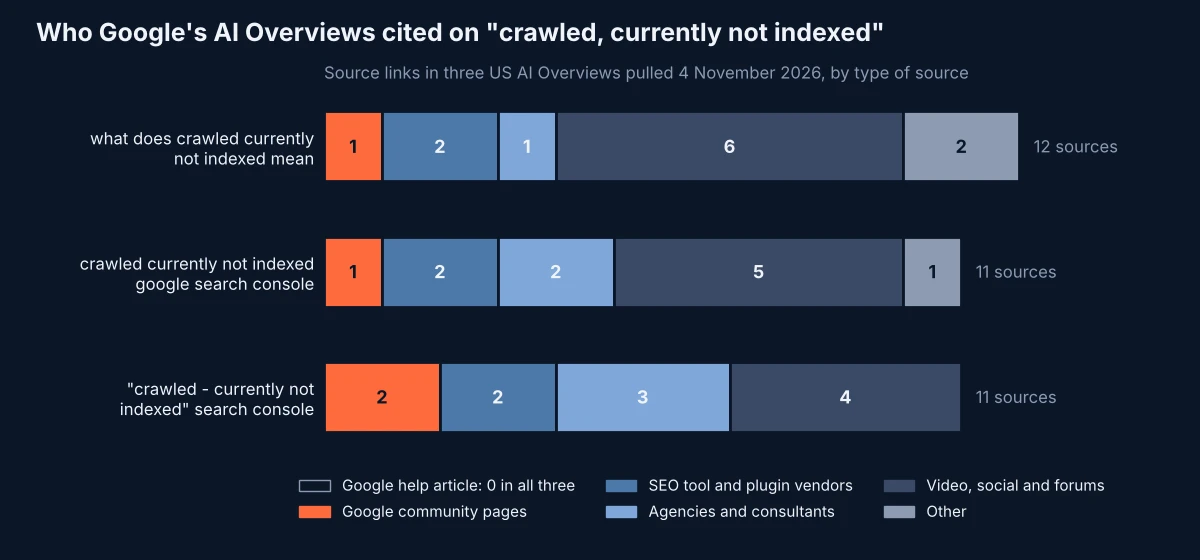
- All three put low-value, thin or duplicate content first in their list of common causes.
- All three said the status is not, or not necessarily, a technical error, which matches the new help text.
- All three included a fix or address section built around improving content, consolidating or pruning pages, and adding internal links.
- 0 of 34 source links pointed to the Page indexing help article. One overview did link to it inline once, inside its first fix step.
- 15 of 34 sources were videos, social posts or forum threads, and 12 came from SEO tool or plugin vendors, agencies and consultants. Google's own community threads and guides supplied 4.
A site owner who searches the status is told by Google's AI feature that content quality is the likely cause, while Google's documentation says it may need no action at all.
Google's organic results were less useful still. Three of our five queries returned organic results unrelated to Search Console (pages about the word "currently", about fixing household goods, or other search engines' home pages), the kind of query-word misfire we covered when rank trackers found Google ignoring query words. On the two queries with relevant organic results, Google's help article was not among the 17 organic links returned.
A check on our own newsroom
For scale, we ran Search Console's URL Inspection on the 115 posts this newsroom had published between 13 October and 4 November. Google answered for 114.
| Coverage state | Posts | Share |
|---|---|---|
| Submitted and indexed | 103 | 90.4% |
| Discovered - currently not indexed | 6 | 5.3% |
| URL is unknown to Google | 4 | 3.5% |
| Crawled - currently not indexed | 1 | 0.9% |
Source: Google Search Console URL Inspection API, run 4 November 2026 on saaslinkbuilding.com posts.
On a young site the bigger bucket is "Discovered", where Google knows the URL but has not fetched it yet, not "Crawled". The one crawled but unindexed post had been fetched successfully a day earlier. That fits the help page's message: a single URL in this state is not, on its own, evidence of a site problem. Our earlier report on the stalled Page indexing report covers why the report itself can lag behind URL Inspection.
What SEO teams should do
- Triage by importance, not by count. The help page now explicitly frames diagnosis around important pages. Export the affected URLs, drop feeds, parameters and tag archives, and look only at pages you need in search.
- Run URL Inspection on a sample. Use the URL Inspection tool and its live test to rule out blocked resources, empty rendered HTML, a stray noindex or a canonical pointing elsewhere. These are the blockers the new text tells you to check first.
- Look for patterns over time. A steady trickle of crawled but unindexed URLs is normal. A sudden jump in one template, or indexed pages moving into the state, deserves a closer look at that template's content and internal links.
- Do not lean on the escalation form. Google now reserves it for complete, site-wide indexing failures. Individual URLs will not qualify.
- Keep quality on the list. The help page dropped no warning about quality because it never carried one, and Mueller's statements this year still apply. If many important pages sit in this state, compare them honestly with what already ranks. Our summary of Google's crawl, index and re-rank timelines gives a sense of how long changes take to show.
- Update client reporting. If audits label this status an "error", match Google's wording: common, and worth investigating only for pages that matter.
Methodology
We read the live Page indexing report help article (support.google.com/webmasters/answer/7440203, English) on 4 November 2026 and compared its "Crawled - currently not indexed" entry with the previous wording as quoted by Search Engine Roundtable from an archived copy dated 26 October. We could not open the archived copy ourselves, so the previous-entry column relies on that comparison. We checked Google's Search documentation updates log on the same day.
On 4 November we ran five US English Google searches through a SERP API: "crawled currently not indexed", "how to fix crawled currently not indexed", "what does crawled currently not indexed mean", "crawled currently not indexed google search console" and the quoted phrase "crawled - currently not indexed" with "search console". Three returned a retrievable AI Overview (the bare phrase and the "how to fix" query did not). We recorded each overview's text and every entry in its reference list (34 in total) and classed each reference by domain: Google help article, Google community pages (support.google.com threads and community guides), SEO tool and plugin vendors, agencies and consultants, video, social and forum platforms, and other (a Q&A site and a website builder's help centre). Inline links inside the overview text were counted separately. AI Overviews vary by user, location and time, so these results are a snapshot, not a measurement of all overviews.
For the newsroom check we ran the Search Console URL Inspection API on all 115 published post URLs listed in our sitemap on 4 November 2026; one request returned a Google server error and is excluded.
Conclusion
Google's rewrite turns the "Crawled - currently not indexed" entry into something closer to advice: expect it, check important pages for technical blockers, and escalate only site-wide failures. It also says less than Google's own staff have said in public, leaving out the quality link Mueller has drawn since July.
Google's AI Overviews fill that gap from the other side, steering searchers straight to content quality using third-party guides rather than the updated help page. For SEO teams, the practical reading is the one both sources share when taken together: treat the status as normal until it affects pages you need, then check the technical basics before you rewrite content.
Questions and answers
What does Google's help page now say about Crawled - currently not indexed?
The Page indexing report help page says the page was crawled but not indexed, that Google does not index all pages across the web, and that the status is common for many sites and does not necessarily indicate an issue that needs attention.
What should I do if important pages show Crawled - currently not indexed?
Google's help page says to use the URL Inspection tool and other tools to check whether anything on your site, such as blocking Google's crawlers, is stopping those pages from appearing in search.
When should I use Google's report an indexing issue form?
The updated help entry points to the form only when you have fully diagnosed possible issues and suspect a complete, site-wide indexing bug.
Does Google link Crawled - currently not indexed to content quality?
The help page does not mention quality. John Mueller has linked indexing problems to quality in public, including in a Bluesky reply on 2 November 2026 about a site with only its homepage indexed.
What did Google's AI Overviews say about this status?
In three AI Overviews we pulled on 4 November 2026, all three listed thin or low-value content first among common causes, and none of their 34 reference links pointed to Google's Page indexing help article.
More releases
-
Studies
Does Schema Markup Help You Rank? 186 Top-10 Pages Show No Edge, Only Richer Snippets
Schema markup sat on 90.3% of the 186 top-10 Google pages we fetched across 36 searches, yet pages with and without it ranked almost identically (average position 4.48 against 4.50). Its measurable payoff was display: 15 of 17 recipe pages with Recipe markup showed stars or cook times.
-
Explainers
Gemini and AI Mode Fetch as Google and Google-Lens; 397 of 534 Fetcher Ranges Lack rDNS
Gemini and Google's AI Mode fetch pages with user agents Google has not documented, a 3 November test found. Our check of five Google crawler pages and 798 published IP prefixes shows the tokens are unlisted and that 397 of 534 ranges in one Google fetcher file have no reverse DNS record.
-
Updates
Google Lifts EEA Site Reputation Penalties; Publisher Coupons Took 21% of Irish Results
Google is emailing site owners that site reputation abuse manual actions no longer affect search results shown in the European Economic Area, a change in force since 30 August. In our check of 11 coupon searches, publisher-hosted coupon pages took 21% of Irish organic results against 13% in the UK.
Tell us the site and the goals.
Rankings in Google and visibility in AI answers, from one monthly plan. One call is enough to say which one fits. Email works just as well.