Facebook's AI Answer Pages Reach Google Page One on 8 of 25 Searches We Ran
Facebook's AI-generated answer pages at facebook.com/fb-answers/ reached Google's page one on 8 of 25 searches we ran on 5 November, sometimes twice per query, as SEOs call the more than 6 million indexed pages scaled content abuse. Facebook's robots.txt leaves the directory open to Googlebot while blocking a sister directory.
 Vibhu Dhariwal
Cofounder & CTO, Digital Gratified
- Published
- Section
- Industry news
- Reading time
- 8 minutes
Ras Al Khaimah, United Arab Emirates, .
Facebook's AI-written answer pages, published under the address facebook.com/fb-answers/, are drawing accusations of scaled content abuse from SEOs after a practitioner's write-up documented them and Search Engine Roundtable reported on 5 November that Google had indexed more than 6 million of them. We ran 25 Google searches the same day and found an fb-answers page on page one for 8 of them, alongside a robots.txt file that walls off a similar Meta directory from Googlebot but leaves this one open.
Google has not commented publicly on the pages in any source we found, and nothing below should be read as a finding by Google. What we can show is how the pages are surfacing in Google's results, and how they line up against Google's own written policy.
What changed
According to the write-up that set off the discussion, Meta began filling the /fb-answers/ directory in mid-2026. Each page is an AI-generated summary of a topic, built from public Facebook posts by people and Pages, and one SEO consultant said on X that the directory ranks across classic results, AI Overviews and AI Mode. Meta's own 15 June announcement of AI Mode on Facebook describes answers "grounded in what people are saying publicly across our apps" inside the Facebook app. It does not mention publishing those answers as open web pages for search engines.
Key findings from our check
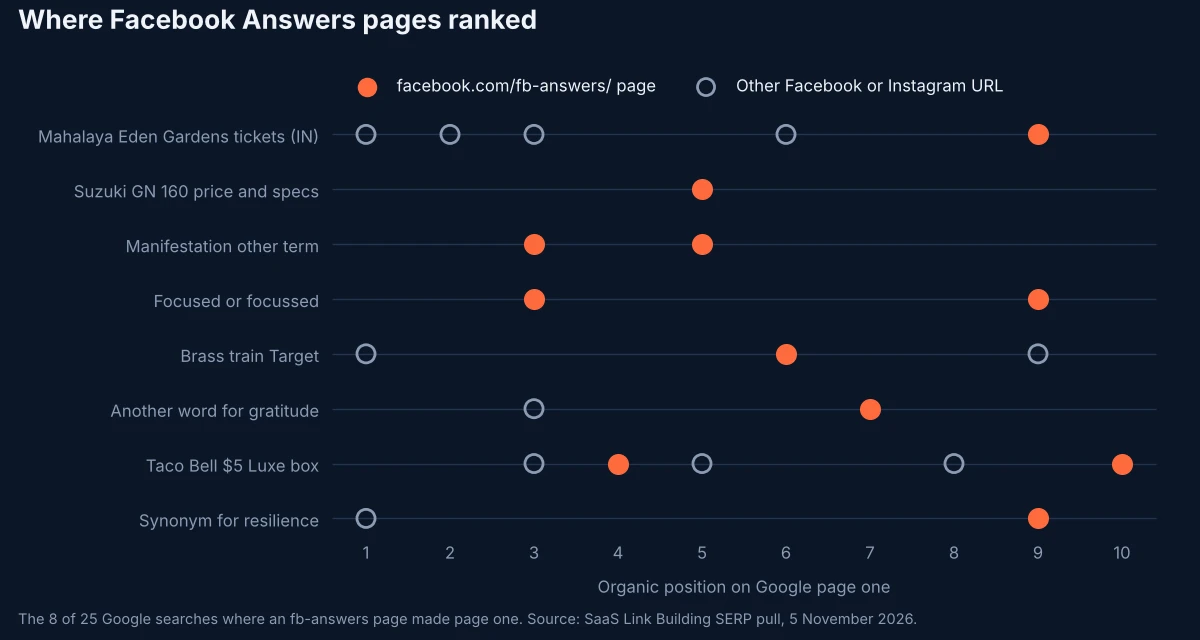
- 8 of 25 searches showed at least one fb-answers page in Google's organic top 10, with 11 fb-answers URLs in total.
- Median position 6. Two of the 11 sat at position 3; none ranked first.
- Two pages for one query, three times. "Manifestation other term", "focused and focussed" and the Taco Bell Luxe box search each returned two different fb-answers pages.
- Foreign-locale copies in US results. Three of the 11 URLs carried a ?locale= parameter (Hebrew, Swedish and Persian interface settings) even though every search was run in English for the US.
- Facebook as a whole held 45 of 231 page-one results (19.5%). Add Instagram and Meta properties took 55 (23.8%). Most of the Facebook share was ordinary group posts, Page posts and videos, not fb-answers pages.
What Facebook's robots.txt shows
Facebook's public robots.txt file treats this directory differently from a similar one. The file blocks every unnamed crawler from the whole site, and fully blocks AI-related user agents including GPTBot, ClaudeBot, PerplexityBot and Applebot-Extended, plus the Google-Extended token. In the Googlebot group, and in the groups for 20 other named crawlers, it disallows a directory called /meta-ai-answers/. There is no rule for /fb-answers/. The file also lists 205 sitemaps, one of them named groups_fb_answer_posts_0.
A site: search for the blocked /meta-ai-answers/ directory returned no Google results in our check. So Meta has kept one AI answers directory out of Google, opened another, and blocked the AI crawlers that might reuse the same material elsewhere.
| Search (market) | fb-answers positions | Other Facebook URLs | Instagram URLs |
|---|---|---|---|
| Mahalaya Eden Garden show tickets price (India) | 9 | 3 | 1 |
| Suzuki GN 160 price and specifications (US) | 5 | 0 | 0 |
| Manifestation other term (US) | 3, 5 | 0 | 0 |
| Focused and focussed (US) | 3, 9 | 0 | 0 |
| Brass train Target (US) | 6 | 1 | 1 |
| Another word for gratitude (US) | 7 | 1 | 0 |
| Is Taco Bell still doing the $5 Luxe box (US) | 4, 10 | 2 | 1 |
| Synonym for resilience (US) | 9 | 1 | 0 |
| Other 17 searches combined | none | 26 | 7 |
| All 25 searches | 11 URLs | 34 | 10 |
Source: SaaS Link Building pull of Google organic page one, 5 November 2026. 231 organic results in total.
Where the pages win, and where they lose
The pages did best on short definitional and spelling queries, where the established results are dictionaries and thesauruses. On "focused and focussed", fb-answers pages took position 3, above Merriam-Webster's entry at 6, and position 9. They were absent where an official source exists: neither the FESCO nor the LESCO electricity bill search, in the US or Pakistan, showed one, and Google ranked the utilities' own sites at the top in Pakistan.
The snippets Google showed also hint at quality problems. For the Suzuki GN 160 search, the fb-answers snippet quoted prices for two other Suzuki models, the DR160 and V-Strom 160, while dealer and review pages on the same results page listed the GN160 itself at ₱125,000. One Mahalaya tickets page's snippet gave a price "from S$12" and called it "a free community event" in consecutive sentences; a second fb-answers page on the same event said no official price had been shared. In the 15 searches built from topics we found in Google's index, the exact page we started from ranked on only 3 occasions; in two others a sibling page on the same topic ranked instead, a sign of overlapping pages written for close variants of one query.
What Google's policy says
Google's spam policies define scaled content abuse as many pages "generated for the primary purpose of manipulating search rankings and not helping users". Its listed examples include using generative AI to produce many pages that add nothing for users, and stitching together content from other pages without adding value. Its guidance on generative AI content repeats the warning and points to the rater guidelines' sections on scaled content and low-effort main content.
The policy turns on purpose and value, not on how a page was made, so whether fb-answers crosses the line is a judgment only Google can make. Meta could argue the pages summarise real community posts that are hard to find otherwise. Critics answer that combining posts into millions of keyword-shaped pages is exactly what the stitching example describes. Google's site reputation policy, which we covered when Google lifted EEA site reputation penalties, applies to third-party content riding a host's signals, so it does not obviously fit first-party pages Meta generates itself.
The case is also a test of a long-running question: whether Google treats big platforms differently. Our earlier test of whether Google favors big brands found platforms such as YouTube and Reddit winning over brand sites, and our Reddit SERP study showed how far forum content already reaches into page one. How Google handles a directory this large on facebook.com will be watched closely.
What this means for SEO teams
- Check your own SERPs. Search your top informational queries, especially definitions, comparisons and "how to" questions, and note any facebook.com/fb-answers/ result. These pages compete for the same mid-page positions many content sites hold.
- Look at what the page cites. The pages draw on public Facebook posts. If your brand's Page or community posts are quoted, the summary may describe your product without linking to your site.
- Don't copy the tactic. Google's policy applies however the content is produced, and what a platform gets away with is no guide for a smaller domain. If you host similar generated pages, Google's own advice is to keep them out of Search, as it told platforms in its October update on link-shared pages.
- Watch for a correction. If Google acts, fb-answers visibility could fall quickly, which would show up as ranking gains for the pages they displaced. Record your positions now so you can measure it.
Methodology
On 5 November 2026 we used a SERP API to collect Google's organic page one (lightweight results, no AI Overview capture) for 25 English-language queries. Fifteen were built from fb-answers topics we found through a site:facebook.com/fb-answers/ search and in the results that followed, including regional versions run in India and Pakistan where the topic was local. Ten were similar long-tail questions (spelling, synonyms, restaurant deals, store restocks, bike prices, bill checks) chosen without knowing whether fb-answers pages ranked for them. We counted every organic result, 231 in all, and classed each facebook.com URL as fb-answers or other (group, Page post or video), and each instagram.com URL separately. We read Facebook's public robots.txt on the same day. We did not crawl or fetch any Facebook content pages, in line with the automated collection notice in that file, so quality observations come only from the snippets Google displayed. A 25-query sample shows presence and position, not overall prevalence; the 6 million indexed figure is Search Engine Roundtable's, not ours.
Conclusion
Facebook's AI answer pages are not dominating Google, but they are clearly on page one for a meaningful slice of everyday questions, sometimes in duplicate and sometimes with snippets that contradict themselves. Facebook's robots.txt leaves the directory open to Googlebot while closing the site to AI crawlers and blocking a sister directory, which points to a choice by Meta and sets up a policy test for Google.
Whether Google treats 6 million AI pages on facebook.com the way its scaled content abuse policy reads will say a lot about how evenly that policy is enforced. We will rerun these 25 searches if Google responds or visibility changes.
Questions and answers
What are Facebook Answers pages?
They are AI-generated topic summaries published under facebook.com/fb-answers/, built from public Facebook posts by people and Pages. Search Engine Roundtable reported on 5 November 2026 that Google had indexed more than 6 million of them.
How often did fb-answers pages rank in our test?
An fb-answers page appeared in Google's organic top 10 on 8 of the 25 searches we ran on 5 November 2026, with 11 fb-answers URLs in total and a median position of 6. None ranked first.
Does Facebook block Google from crawling these pages?
No. Facebook's robots.txt disallows a directory called /meta-ai-answers/ for Googlebot but has no rule for /fb-answers/. The same file fully blocks user agents such as GPTBot, ClaudeBot and PerplexityBot, plus the Google-Extended token.
Has Google said the pages break its spam policies?
We found no public comment from Google. Its spam policies define scaled content abuse as many pages made mainly to manipulate rankings rather than help users, and list mass generative AI pages without added value as one example.
More releases
-
Studies
Does Schema Markup Help You Rank? 186 Top-10 Pages Show No Edge, Only Richer Snippets
Schema markup sat on 90.3% of the 186 top-10 Google pages we fetched across 36 searches, yet pages with and without it ranked almost identically (average position 4.48 against 4.50). Its measurable payoff was display: 15 of 17 recipe pages with Recipe markup showed stars or cook times.
-
Explainers
Gemini and AI Mode Fetch as Google and Google-Lens; 397 of 534 Fetcher Ranges Lack rDNS
Gemini and Google's AI Mode fetch pages with user agents Google has not documented, a 3 November test found. Our check of five Google crawler pages and 798 published IP prefixes shows the tokens are unlisted and that 397 of 534 ranges in one Google fetcher file have no reverse DNS record.
-
Updates
Google Lifts EEA Site Reputation Penalties; Publisher Coupons Took 21% of Irish Results
Google is emailing site owners that site reputation abuse manual actions no longer affect search results shown in the European Economic Area, a change in force since 30 August. In our check of 11 coupon searches, publisher-hosted coupon pages took 21% of Irish organic results against 13% in the UK.
Tell us the site and the goals.
Rankings in Google and visibility in AI answers, from one monthly plan. One call is enough to say which one fits. Email works just as well.