Does Google Pause Updates for the Holidays? One Ran on 51% of Peak-Season Days
Google says it tries to avoid ranking updates from late November to mid-December. Its own Search Status Dashboard shows a notable update rolling out on 53 of 104 days in that window from 2022 to 2025, against 30% of days across the year. The one gap since 2022: no launches in late November.
 Vibhu Dhariwal
Cofounder & CTO, Digital Gratified
- Published
- Section
- Studies
- Reading time
- 15 minutes
Ras Al Khaimah, United Arab Emirates, .
Every November the same question returns to SEO forums and agency Slack channels: will Google leave rankings alone until the holiday shopping season is over? Google's public liaison for Search, Danny Sullivan, answered it on the record in a Search Central Q&A published on 2 November 2023. Google, he wrote, tries to avoid updates "during the late-November to mid-December period when possible", while adding that this is not always possible and that updates which have been months in development are released once they are ready.
That sentence is the closest thing to an official holiday policy Google has published. We tested it against Google's own record. On 16 November 2026 we collected every incident in the ranking history of the Google Search Status Dashboard, which runs from December 2021 to today, and counted which days had a notable ranking update in progress. The answer is more interesting than either "yes" or "no", and it matters right now: the November 2026 core update began on 10 November and was still listed as rolling out when we collected the data.
The theory, and who holds it
The holiday freeze is one of the oldest beliefs in search marketing. The idea is simple: retailers and the agencies that serve them earn a large share of their year between Black Friday and Christmas, so a ranking shake-up in that window would hurt the businesses least able to absorb it, and Google, aware of the backlash, holds major changes back until January.
The belief is widespread enough that Google framed its own answer around it. The 2023 Q&A posed the question as whether there should be no updates at all during the holiday shopping season, which suggests how Google understands the question is usually put. Ecommerce teams still use the idea to plan code freezes, migrations and content launches, on the assumption that the ground will not move under them in December.
There are really two versions of the theory, and they need separate tests:
- The strong version: no notable Google ranking update is in progress during the peak shopping weeks.
- The weak version: Google avoids launching notable updates in that period, even if something launched earlier is still rolling out.
What Google has said on the record
The 2023 Q&A is the primary source, and it supports only a soft commitment. Three points stand out:
- Google says it tries to avoid updates in a window it defines as late November to mid December, which is narrower than "the holidays" and does not cover the second half of December.
- The commitment is conditional: Google says it applies only where possible. The same answer says updates developed over several months are released when they are ready.
- The Q&A was published on the day the November 2023 core update started, and Google said in the same post that a reviews system update would follow the next week. In other words, Google restated its holiday preference while announcing two updates that, as it turned out, were still rolling out well into the window.
Google's core updates documentation says nothing about seasonal timing. The dashboard entry for the current update says the November 2026 core update "may take up to 2 weeks to complete", which, if it holds, would end the rollout around 24 November, before Thanksgiving on 26 November and Black Friday on 27 November.
What Google's own dashboard shows
The Search Status Dashboard lists 41 ranking incidents dated from 1 December 2021 to 10 November 2026. Two are labelled "Ranking is experiencing an ongoing issue" rather than named updates, so we excluded them, leaving 39 notable updates: core, spam, reviews, product reviews, helpful content, page experience and one Discover update. For each we took the start date and the duration the dashboard reports and marked every calendar day on which the update was in progress.
We then had to turn "late November to mid-December" into dates. We used 20 November to 15 December inclusive, a 26-day window that covers Thanksgiving week, Black Friday and Cyber Monday in every year of the record. Moving either end by a few days does not change the direction of the result.
Key findings
- Updates were more common inside the window, not less. Across the four complete years 2022 to 2025, a notable update was rolling out on 437 of 1,461 days (29.9%). Inside the four holiday windows it was rolling out on 53 of 104 days (51.0%).
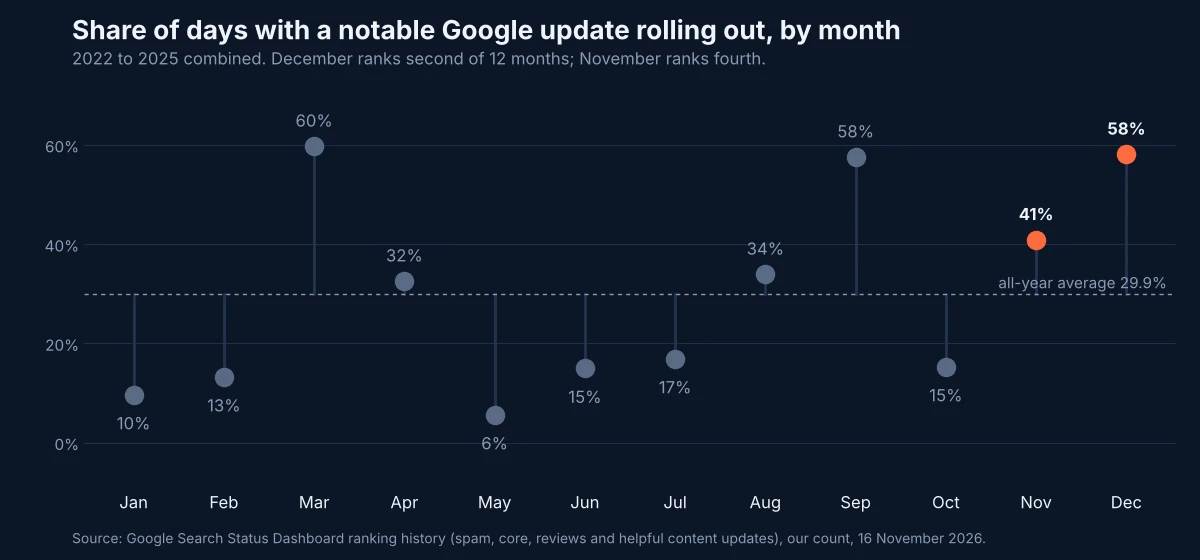
- December is one of the busiest months. Measured as the share of days with an update in progress, December (58.1%) sits with March (59.7%) and September (57.5%) as one of the three busiest months of the year. November ranks fourth at 40.8%.
- Black Friday weekend was hit in two of the four seasons the dashboard fully covers. The November 2023 core and reviews updates were both in progress over Black Friday and Cyber Monday 2023, and the November 2024 core update was still rolling out over the 2024 weekend. In 2022 and 2025 the dashboard shows nothing in progress over that weekend. The year before the dashboard record begins, the November 2021 core update ran from 17 to 30 November 2021, through Black Friday and Cyber Monday, according to Search Engine Land's report of Google's completion announcement.
- No update has started in the second half of November since 2021. The latest November start in the dashboard record is 11 November (2024). Every launch inside our window from 2021 to 2025 came in December, between 1 and 14 December. The November 2021 core update, which started on 17 November 2021, is the last known late-November launch, and it predates the dashboard's ranking history.
- Holiday-season updates roll out for longer. The three completed updates that started in November averaged 26.1 days from start to finish and the six that started in December averaged 19.7 days, against 13.4 days for the 29 completed updates that started in other months.
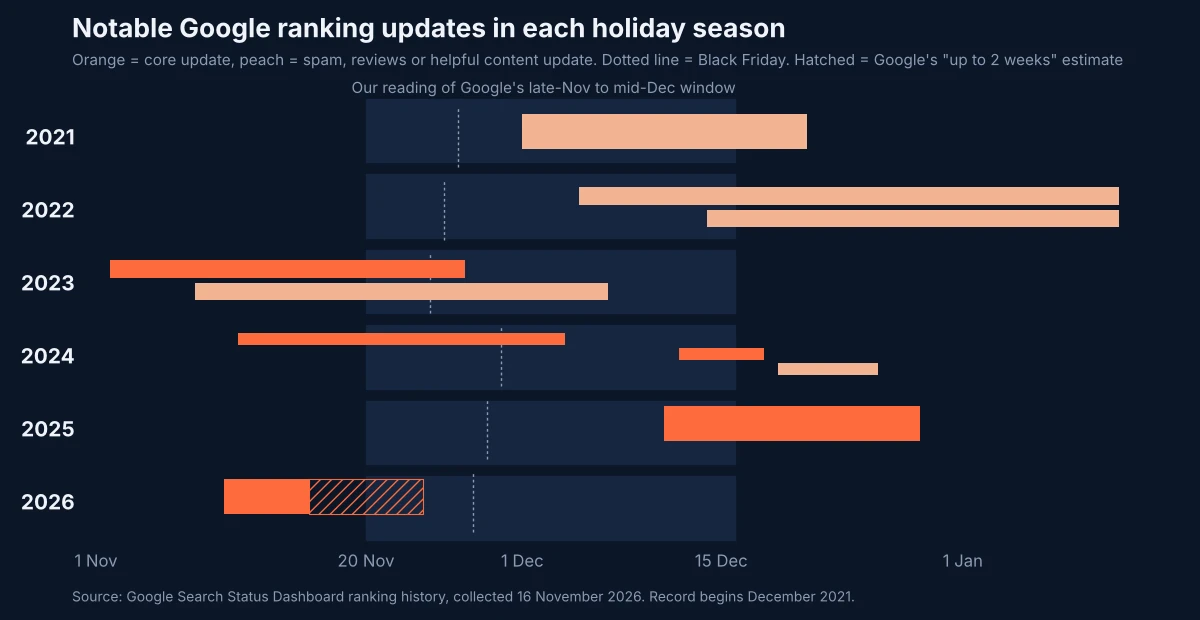
Season by season
| Season | Window days with an update rolling (of 26) | Updates in progress in the window | Update rolling over Black Friday? |
|---|---|---|---|
| 2021 | 15 | December 2021 product reviews update (from 1 Dec, 20 days) | Yes: November 2021 core update, 17 to 30 Nov (before the dashboard record) |
| 2022 | 11 | December 2022 helpful content update (from 5 Dec, 38 days); December 2022 link spam update (from 14 Dec, 29 days) | No |
| 2023 | 18 | November 2023 core update (from 2 Nov, 25 days 21 hours); November 2023 reviews update (from 8 Nov, 29 days) | Yes, both |
| 2024 | 19 | November 2024 core update (from 11 Nov, 23 days 13 hours); December 2024 core update (from 12 Dec, 6 days 4 hours) | Yes |
| 2025 | 5 | December 2025 core update (from 11 Dec, 18 days 2 hours) | No |
| 2026 | Window not yet reached | November 2026 core update (from 10 Nov, still rolling out on 16 Nov) | Not yet known |
Source: Google Search Status Dashboard ranking history, our count. The 2021 window count covers dashboard updates only, because the dashboard's ranking history begins with the December 2021 product reviews update; adding the November 2021 core update would cover every day of the 2021 window.
Evidence for the theory
The weak version of the theory, that Google avoids launching updates in the thick of the shopping season, has real support.
Google says it tries. A named Googler stated the preference on Google's own blog. That is a stronger basis than most ranking folklore, which usually rests on nothing Google has said.
Launches cluster at the edges. In the four Novembers the dashboard fully covers (2022 to 2025), no notable update started between 12 and 30 November, and none has so far in 2026. The November launches came early in the month (2, 8, 10 and 11 November), and the December launches came from 1 December onwards, with the three most recent December core and spam updates starting on 12 December 2024, 19 December 2024 and 11 December 2025, close to or after the end of Google's stated mid-December boundary. Thanksgiving week itself has not seen a new notable launch in the dashboard record. Notably, the record of late-November quiet begins after the November 2021 core update, which launched on 17 November 2021 and ran through Black Friday that year.
The 2026 update fits the pattern so far. Google launched the current core update on 10 November with an estimate of up to two weeks. If Google meets its own estimate, the rollout ends before Thanksgiving, which is what a team trying to keep the shopping weeks clear would aim for.
Gaps exist. In 2022 and 2025 the dashboard shows no notable update in progress from 20 November until 5 December and 11 December respectively, so for those two years the Black Friday and Cyber Monday period was quiet.
Evidence against the theory
The strong version, that the shopping weeks are an update-free zone, does not survive Google's own data.
The window is busier than the average day. A notable update was rolling out on 51.0% of window days from 2022 to 2025, against 29.9% of all days. If Google spread updates evenly across the calendar, you would expect about 31 of those 104 window days to be affected. The real figure was 53.
December is a launch month, not a quiet month. Five of the 39 updates started inside our window and ten of the 39 started in November or December. Over 2022 to 2025, 30 updates started across 1,461 days; at that rate the four 26-day windows would be expected to hold about two launches. They held four: the helpful content and link spam updates in December 2022, the December 2024 core update and the December 2025 core update.
Early-November launches run straight through Black Friday. Starting an update on 2 or 11 November is only a holiday-friendly choice if it finishes quickly. The November 2023 core update took 25 days 21 hours and the November 2024 core update took 23 days 13 hours, so both were still moving rankings over the biggest shopping weekend of the year. Whatever Google intends, from a retailer's point of view those weekends were not frozen.
Holiday rollouts are slower. Updates started in November took about twice as long to complete as updates started in other months, and December starts about half as long again (26.1 and 19.7 days on average against 13.4 days). The December 2022 helpful content update ran for 38 days, from 5 December 2022 into January 2023. Longer rollouts mean more holiday days with rankings in motion, whatever the launch date.
Why the two readings diverge (speculation)
The following is our interpretation, not something Google has stated. Google's wording is about avoiding updates in the window without saying whether it means launches or rollouts, and the pattern in the data is consistent with a team that avoids starting notable updates in late November but does not stop rollouts that began earlier. If that is the internal rule, it would explain both the empty second half of November and the bars that run through it. It would also explain why the three most recent December launches started between the 11th and the 19th: they arrive as Google's stated window closes.
The longer holiday rollouts have no official explanation. Reduced staffing over the holidays, larger changes being saved for the end of the year, or chance in a small sample (three November launches, six December launches) could each account for it. We cannot tell which from the dashboard alone, and the sample is too small to treat the gap as a firm rule.
Verdict: debunked, with one narrow exception
Debunked as most site owners understand it. Google's own dashboard shows that from 2022 to 2025 a notable ranking update was more likely to be in progress during the late-November to mid-December window than on an average day of the year, December is among the busiest months for updates, and in two of the last three seasons, and in 2021, a core update was rolling out over Black Friday weekend. Danny Sullivan's caveat that this is not always possible has carried a lot of weight.
The narrow exception is recent: since 2022, Google has not launched a notable update between 12 and 30 November, after launching a core update on 17 November 2021. If your plan relies on nothing new starting during Thanksgiving week, four years of record are on your side, though not a long or guaranteed one. If it relies on rankings sitting still until January, the record is not.
What this means for SEO teams
- Do not plan around a freeze. Treat late November and December as a period when a notable ranking update is as likely to be in progress as at any other time, and more likely than in May or January. Build reporting that can separate an update from seasonal demand before the season starts.
- Watch the current rollout's end date. The November 2026 core update is the one most likely to touch Black Friday traffic. Google estimated up to two weeks from 10 November. If the dashboard has not marked it complete by about 24 November, assume rankings will still be moving over the shopping weekend, as they were in 2023 and 2024. Our early churn check of this update found most top-10 URLs holding in the first four days.
- Expect a December launch. Google launched a core or spam update between 11 and 19 December in three of the last four full years (2022, 2024 and 2025); in 2023 the November reviews update was still rolling out into December instead. Keep site migrations, URL changes and large template releases away from mid-December, so that a traffic drop can be attributed cleanly.
- Annotate rollout days, not launch days. Several holiday-season updates in the record ran for three weeks or more, and one for 38 days. A change that starts on 11 December can still be moving rankings after Christmas. Mark the whole rollout in your analytics and Search Console annotations.
- Read seasonal data with two baselines. Compare holiday performance with the same period last year and with the weeks before the update started. Last year's comparison period may itself have overlapped a core update; our analysis of Google's 2026 update calendar lists every rollout this year.
Methodology
On 16 November 2026 we downloaded the ranking history page of the Google Search Status Dashboard and its incidents JSON feed. The history page lists 41 ranking incidents dated from 1 December 2021 to 10 November 2026, each with a start date and duration (all times US Pacific, as the dashboard states). We excluded the two incidents titled "Ranking is experiencing an ongoing issue" (5 October 2023 and 15 August 2024), which are ranking issues rather than named updates, leaving 39 notable updates. For each completed update we treated every calendar day from the start date to the start date plus the reported whole days as an update day, ignoring the extra hours the dashboard lists (counting those hours as a further day raises the all-year share to 30.8% and the window share to 51.9%, and does not change any conclusion). The November 2026 core update, still in progress, was counted to 16 November only; the 24 November end date used in the chart is derived from Google's two-week estimate, shown hatched, and is not counted in any figure.
Our holiday window is 20 November to 15 December inclusive (26 days), our reading of Google's "late-November to mid-December". Year-level comparisons use the four complete calendar years 2022 to 2025 (1,461 days). Black Friday is the day after the fourth Thursday of November. Average rollout lengths cover the 38 completed updates. We counted updates that overlap as a single update day. The dashboard only lists updates Google considers notable, so smaller ranking changes are not visible to this method. The November 2021 core update is not in the dashboard history; its dates come from Search Engine Land's report of Google's announcements and are used only where stated.
Conclusion
Since 2022, Google does appear to have kept the last two weeks of November free of new launches, and it has said publicly that it tries to keep the shopping season quiet. But its own dashboard shows rankings in motion on half of the days in that season over the past four years, with December among the busiest months of the year and two recent Black Friday weekends spent mid-rollout. The holiday freeze is a launch-timing preference, not a ranking freeze, and SEO teams should plan for the season accordingly.
The November 2026 core update is the test case. If it closes inside Google's two-week estimate, this year's Black Friday will look like 2022 and 2025. If it runs as long as the last two November core updates did, it will look like 2023 and 2024.
What do you think?
Has a December core update ever hit your holiday traffic, and did you see the drop during the rollout or only once January data came in? Send us your Search Console dates and we will add them to our next look at this question.
Questions and answers
Does Google stop ranking updates during the holiday season?
No. Google said in a Search Central Q&A on 2 November 2023 that it tries to avoid updates from late November to mid-December when possible. Its Search Status Dashboard shows a notable ranking update in progress on 53 of the 104 days from 20 November to 15 December across 2022 to 2025, compared with 29.9% of all days in those years.
Has a Google update rolled out over Black Friday?
Yes. According to the Search Status Dashboard, the November 2023 core and reviews updates were in progress over Black Friday and Cyber Monday 2023, and the November 2024 core update was still rolling out over the 2024 weekend. Nothing was in progress over that weekend in 2022 or 2025.
When does Google usually launch updates near the holidays?
In the dashboard record, November launches came early in the month (2, 8, 10 and 11 November) and December launches came between 1 and 19 December. No notable update has started between 12 and 30 November since 2022.
How long will the November 2026 core update take?
Google's dashboard entry, posted on 10 November 2026, says the rollout may take up to two weeks to complete. The two previous November core updates took 25 days 21 hours (2023) and 23 days 13 hours (2024).
More releases
-
Updates
Gemini 4 Carbon Reaches AI Pro Users in AI Mode, but Stays Out of All 30 EEA Countries
Google's Rajan Patel says Gemini 4 Carbon appearing in AI Mode for AI Pro subscribers is not a bug, though Google's help page still lists it for Ultra only. Our check of Google's country lists finds Carbon in AI Mode missing from all 30 EEA countries, despite both paid plans being sold there.
-
Updates
Search Console API Adds Branded, Multimodal and Multi-Country Filters, 361 Days After UI
Google's Search Analytics API can now return branded and non-branded data, multimodal search performance from Lens and Circle to Search, and multi-country or multi-device filters in one request. The branded filter reached the API 361 days after its announcement, and Google's API specification caps each filter list at 1,000 values.
-
Industry news
Google Loses Second Round to SerpApi: Court Sided Against It on 12 of 15 Points
A federal judge dismissed Google's amended DMCA complaint against SerpApi on 9 November 2026, the second dismissal in the scraping case. Our reading of the 19-page order finds the court sided with SerpApi on 12 of 15 contested points. Google has until 30 November to refile or the case ends with prejudice.
Tell us the site and the goals.
Rankings in Google and visibility in AI answers, from one monthly plan. One call is enough to say which one fits. Email works just as well.