Google Pushes Hotel Booking Into AI Mode; Its Partners Were Cheapest at 1 of 25 Hotels
Google's hotel listings are reportedly sending bookings into AI Mode via a Continue on Google button. Our pull of live rates for 25 US hotels found Google's 10 booking partners matched or beat hotel websites at 21 of 22, but offered the lowest listed price at only one.
 Vibhu Dhariwal
Cofounder & CTO, Digital Gratified
- Published
- Section
- Industry news
- Reading time
- 8 minutes
Ras Al Khaimah, United Arab Emirates, .
Google appears to be routing hotel bookings from its regular hotel listings into AI Mode. Screenshots shared by SEO Lluc B. Penycate and reported by Search Engine Roundtable on 19 November show a "Continue on Google" button in Search hotel listings that opens AI Mode's booking flow, where the stay is paid with a Google account. Google has not announced that change. What it has published is the booking flow itself: an August post on The Keyword launched hotel booking in AI Mode with ten partners, and a 16 November holiday post tells searchers to look for "Continue on Google" when they reserve a room.
The screenshot that started the discussion showed an Expedia offer at $170 covering a hotel's own site listed at $158. We wanted to know whether that was a one-off. So we pulled live Google Hotels prices for 25 US properties and checked how the cheapest offer from Google's ten AI Mode booking partners compared with the hotel's own website and with the lowest rate any seller listed.
Key findings
- The cheapest AI Mode partner rate matched or beat the hotel's own site at 21 of 22 properties that listed an official rate: lower at 10, equal at 11. The one exception was $1 dearer.
- That partner rate was the lowest price on the page at only 1 of 25 properties. At 15 of 25 it sat 20% or more above the cheapest listed seller; the median gap was 24%, or $25 a night.
- The hotel's own website was never the cheapest listed option. It was undercut at all 22 properties where it appeared.
- At 9 of 13 chain properties (Hilton, Marriott and Wyndham brands, plus MGM resorts sold through Marriott Bonvoy), the partner rate and the hotel's own rate were identical.
What Google has said about hotel booking in AI Mode
Google's August announcement, by group product manager James Byers, says users can ask AI Mode to complete a booking and then select "Continue on Google", which appears next to integrated partners. The launch partners are Booking.com, Choice Hotels International, Expedia, Hilton, Hotels.com, IHG Hotels & Resorts, Marriott International, Priceline, Trip.com and Wyndham Hotels & Resorts. Google says that "the hotel or booking platform will act as the merchant of record", so customer service stays with the partner. Payment runs through Google Pay.
The 16 November post repeats the instructions for holiday travellers and adds a footnote: the feature is available in the US, in English, for select properties. It also says users can still click out to book directly with travel partners. Neither post says how Google picks which partner sits behind the "Continue on Google" option for a given hotel, or whether price plays a part.
The new element in this week's reports is placement. According to the Search Engine Roundtable write-up, the button now appears in standard Search hotel listings rather than only inside an AI Mode conversation, and it replaces the direct hotel booking links Google showed there before. Barry Schwartz wrote that he had not yet seen the change himself. Google has not confirmed it, and our price data cannot show the button, so we treat the placement change as reported rather than confirmed.
Our check: 25 hotels, five cities, one night
We queried Google Hotels for one night (10 December 2026, two adults, US results in US dollars) in New York, Los Angeles, Miami, Chicago and Las Vegas, and took the first five hotel listings in each city, skipping vacation rentals. For each property we recorded every seller's lowest nightly rate, then compared three numbers: the cheapest of the ten AI Mode partners, the hotel's own site where Google flagged one as official, and the cheapest rate from any seller.
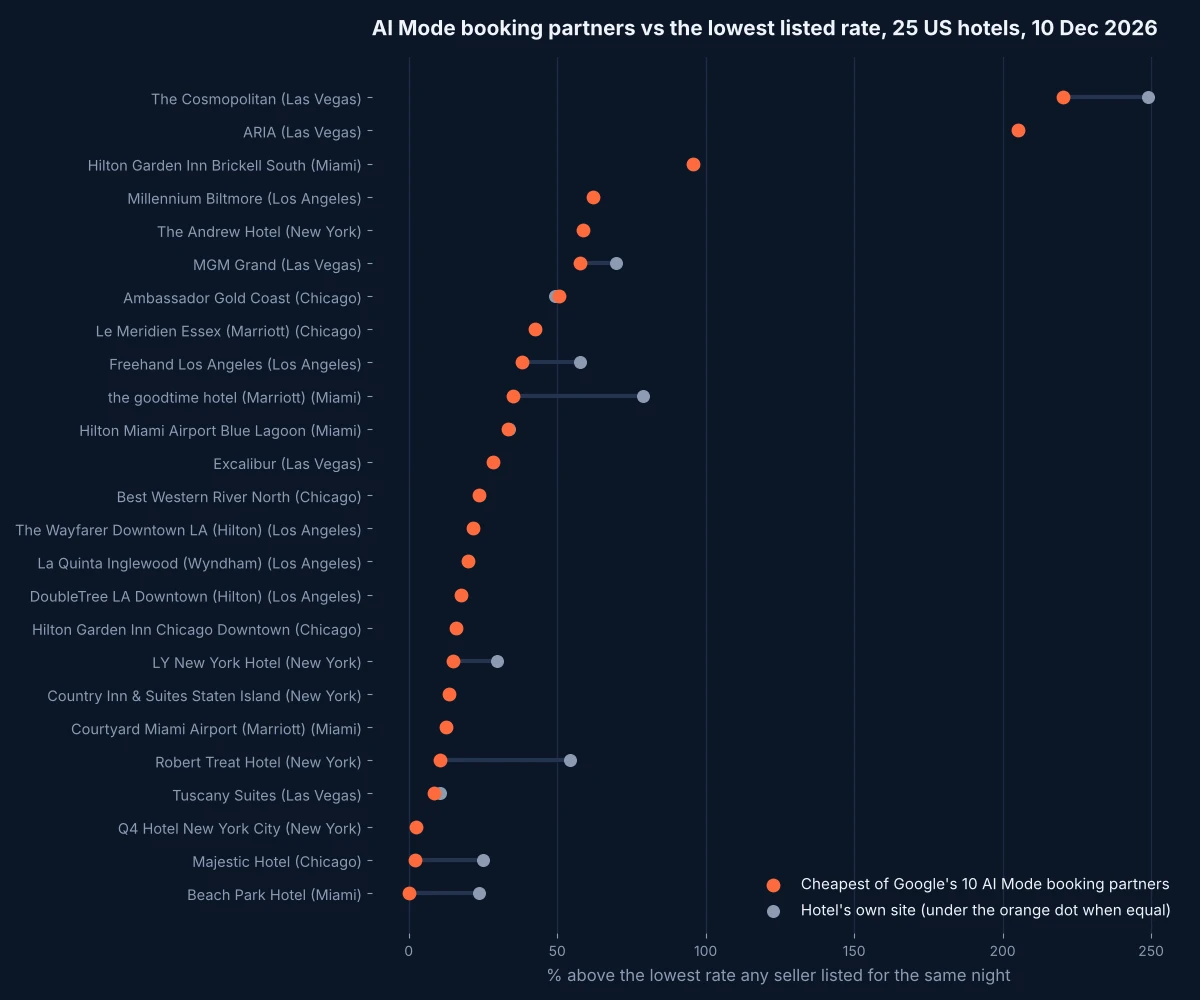
The pattern is consistent across cities. Partner rates rarely lost to the hotel's own site, but a long tail of smaller sellers, metasearch sites and deal sites often listed lower prices than any of the ten partners. In Las Vegas the gap was widest: at ARIA and The Cosmopolitan the cheapest partner rate was more than three times the lowest listed price. Our speculation, which we did not verify, is that some low Las Vegas rates leave out resort fees or carry stricter terms.
| City | Hotels checked | With an official rate | Partner beat hotel site | Partner equal to hotel site | Median partner premium over lowest rate |
|---|---|---|---|---|---|
| New York | 5 | 3 | 2 | 1 | 14% |
| Los Angeles | 5 | 4 | 1 | 3 | 22% |
| Miami | 5 | 5 | 3 | 2 | 33% |
| Chicago | 5 | 5 | 1 | 3 | 24% |
| Las Vegas | 5 | 5 | 3 | 2 | 58% |
| Total | 25 | 22 | 10 | 11 | 24% |
Source: SaaS Link Building analysis of Google Hotels price data, collected 20 November 2026. "Partner" means the cheapest offer from any of Google's ten AI Mode booking partners. The one property where the partner rate was higher than the hotel's site (by $1) was in Chicago.
So the Expedia example in the screenshots, a partner offer above the hotel's own price, was rare in our sample. The bigger gap is between the partners and everyone else. Where the partner rate beat the hotel's own site, it did so by a median of $22.50 a night, but the partner set itself was usually not where the lowest price was.
Why this matters beyond travel
For hotel marketers, a "Continue on Google" button that sits in the listing and keeps the user on Google takes clicks that used to go to a booking site or the hotel's own page. Google's August post notes the hotel or platform remains merchant of record, so the booking still lands with a partner. What changes is that the user may never see the partner's or hotel's site. We have seen the same direction elsewhere: AI Mode sent most flight links to Google's own pages in our AI Mode flight links test, and it showed in-SERP booking cards for home service searches. Outside the US, Google has been adding things to do to its EEA aggregator units.
For SEO teams in other sectors, the hotel flow is a working model of agentic checkout inside Search: a fixed list of integrated partners, Google-side payment, and a button that can replace an outbound link. Visibility in that model depends on being an integrated partner, not on ranking.
What to do
- Independent hotels: check your rates in Google Hotels for a few sample dates. In our pull, the hotel's own site was undercut at every property that listed one, often by sellers outside the partner list.
- Get your own link listed: Google's free booking links let a hotel's site show its room rate in Google hotel results at no cost. Google says ranking uses signals such as price accuracy and landing page experience, and that payment does not affect it.
- Chains: rate parity held at most chain properties we checked, so the AI Mode partner offer and the brand site showed the same price. The open question is which seller Google puts behind "Continue on Google", and Google has not published that.
- Analytics: if the reported button is rolling out, expect fewer referral clicks from Google hotel listings for the same booking volume. Tag partner bookings so you can tell AI Mode reservations apart from site visits.
- Everyone else: track the partner lists Google publishes for AI Mode bookings in your vertical. Being on that list will decide whether you appear in the flow at all.
Methodology
On 20 November 2026 (IST) we pulled Google Hotels results through a SERP data API for "hotels in" New York, Los Angeles, Miami, Chicago and Las Vegas, for check-in on 10 December 2026 and check-out on 11 December 2026, two adults, US location, English, prices in US dollars. In each city we took the first five listings marked as hotels (vacation rentals excluded), giving 25 properties. For each property we retrieved the full list of sellers and recorded each seller's lowest nightly rate as Google displayed it (the field that includes taxes and fees where the seller supplies them), plus Google's flag for the hotel's official site.
"AI Mode partner rate" is the lowest rate among Booking.com, Expedia, Hotels.com, Priceline and Trip.com, plus the hotel's own rate or a Marriott Bonvoy rate where the property belongs to one of the five chain partners (Choice, Hilton, IHG, Marriott, Wyndham). We could not see which partner, if any, Google offers through "Continue on Google" for a given property, so this is a best case for the partner set. Google says the feature covers select properties only. We did not compare room types, cancellation terms or whether every seller's rate includes resort fees. Results reflect a single date, a single search and US desktop results, and prices change by the minute.
Conclusion
Google is bringing hotel booking closer to the first hotel search, with a reported "Continue on Google" button that keeps the reservation inside AI Mode. In our 25-hotel check, Google's ten booking partners almost never charged more than the hotel's own site, but they offered the lowest listed price only once. For hotels, that makes direct rate visibility and accurate pricing in Google's free booking links more important. For everyone else, it is another sign that Google's booking features favour integrated partners over outbound links.
Questions and answers
What is Continue on Google for hotels?
It is the option Google shows next to integrated booking partners so a user can complete a hotel reservation inside AI Mode and pay with Google Pay. Google introduced it on 27 August 2026 and says the hotel or booking platform remains the merchant of record.
Which partners does AI Mode hotel booking use?
Google lists Booking.com, Choice Hotels International, Expedia, Hilton, Hotels.com, IHG Hotels & Resorts, Marriott International, Priceline, Trip.com and Wyndham Hotels & Resorts.
Where is AI Mode hotel booking available?
Google's 16 November 2026 post says the feature is available in the US, in English, for select properties.
Has Google confirmed the button in regular hotel listings?
No. The placement in standard Search hotel listings was reported by Search Engine Roundtable on 19 November 2026 from user screenshots. Google's own posts describe the button inside AI Mode.
Were AI Mode partner rates cheaper than booking direct?
In our 20 November check of 25 US hotels, the cheapest partner rate was lower than the hotel's own site at 10 of 22 properties, equal at 11 and $1 higher at one. It was the lowest listed rate at only one of 25.
More releases
-
Industry news
Microsoft Confirms Ads in Bing AI Overviews; Its 21% Purchase Claim Uses 2024 Data
Microsoft confirmed on 19 November that ads now run beside AI Overviews on Bing in every market except China, through existing Performance Max and AI Max campaigns. The confirmation came 20 days after the first sighting, and the only performance figure offered comes from December 2024 Edge data.
-
Studies
67 of 425 Top Sites Using Hreflang Break Google's Rules; 7 Still Use es-419
A crawl of the top 2,000 domains on 19 November 2026 found 425 homepages using hreflang, and 67 of them broke at least one rule in Google's documentation: unsupported codes such as es-419 and en-uk, missing self-references, relative URLs or alternates that never link back.
-
Studies
Does a Keyword Business Name Still Win Google Maps? 81% of 800 Listings Use One
We pulled 800 Google Maps listings for eight services in five US cities. A business name containing the search term was associated with a gain of about 1.2 positions, while being four times closer to the searcher was worth about 3. Google allows only real-world names.
Tell us the site and the goals.
Rankings in Google and visibility in AI answers, from one monthly plan. One call is enough to say which one fits. Email works just as well.