Do Exact-Match Domains Still Rank? Only 3 of 28 Multi-Word EMDs Made Google's Top 10
Exact-match domains topped Google for 11 of 80 keywords in our 3 November test, but the name did not do the work: no live exact-match .com with under 1,000 referring domains ranked, and only 3 of 28 multi-word EMDs reached the top 10. Google's leaked documents list a demotion, not a boost.
 Vibhu Dhariwal
Cofounder & CTO, Digital Gratified
- Published
- Section
- Studies
- Reading time
- 12 minutes
Ras Al Khaimah, United Arab Emirates, .
Do exact-match domains still give a site a head start in Google? We tested the question on 3 November 2026 by pulling the top 10 US Google results for 80 keywords, checking whether the matching .com for each keyword is a live site, and counting the links behind every one of those domains. Of the 47 exact-match .com sites that are live, 15 reached the top 10 for their own keyword. Of the 28 that match a two- or three-word phrase, only 3 did.
Google's position is on the record. Its SEO Starter Guide says keywords in a domain name "have hardly any effect beyond appearing in breadcrumbs." Yet exact-match domains (EMDs) still change hands for large sums, and the 2024 leak of Google's internal API documentation shows a field built specifically to demote some of them. This investigation sets out the theory, the evidence on both sides and what our own data shows.
Key findings
- Exact-match domains held the top spot for 11 of 80 keywords, among them hotels.com, cars.com, apartments.com, dictionary.com and weather.com.
- Outside the top two positions they almost vanished. 16 of the 20 exact-match results we found sat at position 1 or 2; positions 3 to 10 held just 4 of 568 results.
- Single words did far better than phrases. 12 of 19 live one-word EMDs ranked for their keyword, against 3 of 28 multi-word EMDs such as carinsurance.com, creditcards.com and bestwebhosting.com.
- No live exact-match .com with fewer than 1,000 referring domains ranked. All 15 that made the top 10 had more than 1,000; all 22 below that line missed. Having links was not enough on its own: creditcards.com, with 20,713 referring domains, did not appear for "credit cards."
- Google's leaked documentation includes an
exactMatchDomainDemotionfield, which points to a mechanism for pushing some EMDs down, not up.
The theory, and who holds it
The idea is old and simple: if your domain is the search phrase, Google treats you as more relevant for it. Before 2012 many SEOs built small sites on keyword domains for exactly that reason. The belief has not gone away, partly because domain sellers still market keyword names on search value. A Media Options article on the value of exact-match domains, published in October 2025, says EMDs "have long been a powerful tool for improving visibility and ranking."
The everyday evidence people point to is real enough. Search for "hotels" and Hotels.com ranks first. Search "cars" and Cars.com holds the first two places. The question is whether the name causes those rankings or simply belongs to a business that would rank anyway.
What Google has said
Google has addressed keyword domains on the record several times.
- September 2012: the EMD update. Google's Matt Cutts announced on Twitter on 28 September 2012 a change to reduce low-quality exact-match domains in results, adding that it affected 0.6% of English-US queries to a noticeable degree, as Search Engine Roundtable reported at the time. Wikipedia's timeline of Google Search lists the update in its 2012 entries.
- July 2015: new domain endings. When hundreds of new generic top-level domains launched, Google's Search Central blog said keywords in a TLD do not give any advantage or disadvantage in search. A keyword ending such as .guru adds no relevance on its own.
- Today: the SEO Starter Guide. The current starter guide tells site owners to pick a name that suits the business, because domain keywords alone have hardly any ranking effect.
Google's John Mueller has repeated the point in Reddit replies. In 2022 he wrote there is "no secret (or public) SEO-bonus" for keywords in the domain name, as Search Engine Journal reported. Google's Gary Illyes made a similar point in October, calling keywords in a URL or domain a very small ranking signal, as we reported in our explainer on Google's URL guidance.
What the leaked documents show
The 2024 leak of Google's Content Warehouse API documentation, which Google confirmed as authentic on 29 May 2024, lists more than 14,000 attributes. One of them sits in the CompressedQualitySignals model: exactMatchDomainDemotion, described as a page quality signal converted from a value named QualityBoost.emd.boost.
Two points matter. First, the field is a demotion. It sits next to other demotion fields such as babyPandaDemotion and navDemotion, which fits the 2012 update's stated aim of reducing low-quality EMDs. Second, the documentation describes what is stored, not how much weight it carries or whether it was still in use when the documents leaked. Google has never explained the field. Any claim about how strongly it acts is speculation, and we label it as such.
What the leak does not contain, as far as we can find, is a field that boosts a page because its domain matches the query. If an EMD advantage exists, it is not visible in the documentation as a named signal.
Our test: 80 keywords, 728 results
We chose 80 US commercial and informational keywords where a matching .com domain plausibly exists: insurance and finance terms, travel, retail, software, home services and reference queries. For each, we recorded the organic top 10 on Google US, then checked whether the exact-match .com (for example carinsurance.com for "car insurance") resolves to its own site. Full details are in the Methodology.
| What we counted | Result |
|---|---|
| Organic results collected | 728 across 80 keywords |
| Results on an exact-match domain | 20 (2.7%), on 17 keywords |
| Keywords where an exact-match domain ranked first | 11 of 80 |
| Results whose domain contains the full phrase plus other words (for example 1800flowers.com) | 47 (6.5%) |
| Exact-match .com domains that are live sites of their own | 47 of 80 |
| Exact-match .com domains that redirect to another brand | 11 of 80 |
| Exact-match .com domains that did not respond | 22 of 80 |
| Live EMDs in the top 10 for their own keyword | 15 of 47 |
The 11 redirects are telling in their own right. Owners of flowers.com, mattress.com, giftbaskets.com and lifeinsurance.com send visitors to a different brand's site (1800flowers.com, mattressfirm.com, gourmetgiftbaskets.com and northwesternmutual.com). Businesses that own these names chose not to build on them.
The evidence for the theory
Taken at face value, part of our data supports the believers. Exact-match domains took the top spot for 11 of the 80 keywords, a high hit rate for a group of sites that makes up under 3% of all results. Where they rank, they tend to rank first: hotels.com for "hotels", cars.com for "cars", cheapflights.com for "cheap flights", perfume.com for "perfume" and glasses.com for "glasses."
One-word EMDs also did well as a group. 12 of the 19 live one-word EMDs reached the top 10 for their keyword. If the name were irrelevant, a skeptic might ask, why do so many of these sites sit at the top?
The evidence against it
The same data points more strongly the other way.
The name alone did not get any site onto page one. We pulled referring-domain counts from a backlink index for all 47 live EMDs. Every one of the 15 that ranked had more than 1,000 referring domains. None of the 22 below 1,000 ranked, including hvacrepair.com (53), cheapcarinsurance.com (70) and bestwebhosting.com (90), each of which matches its query exactly. The median ranking EMD had 6,805 referring domains; the median that missed had 582.
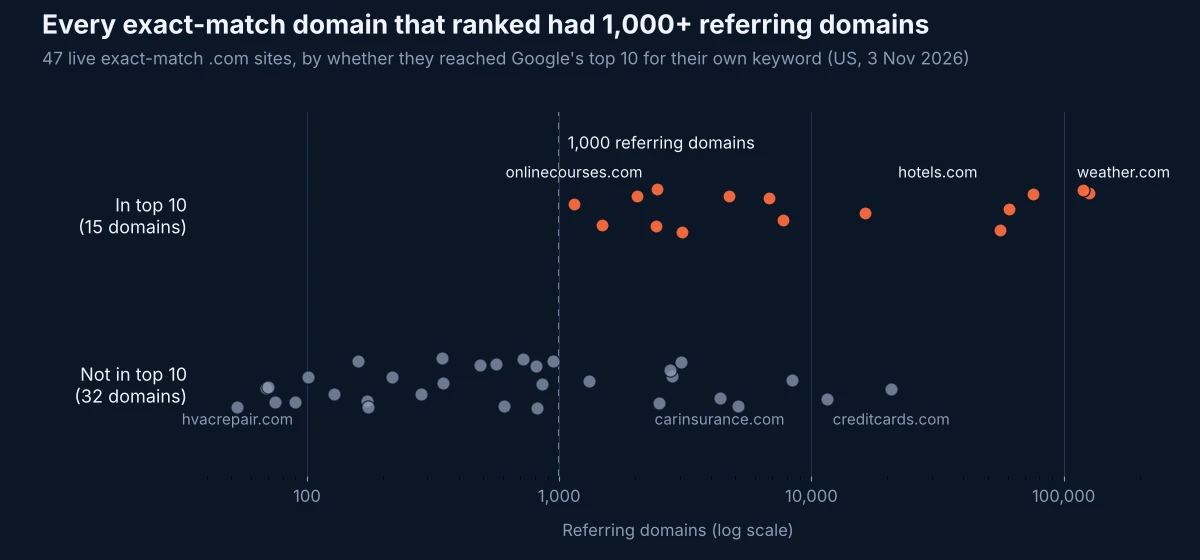
Links were necessary but not sufficient. Ten EMDs above 1,000 referring domains still missed, including creditcards.com (20,713), furniture.com (11,496), translate.com (8,363), shoes.com (5,101) and carinsurance.com (4,321). If an exact match added a meaningful relevance lift, a domain with 20,000 linking sites and the precise query in its name should not be absent from a top 10 led by card issuers and networks.
Phrases failed where words succeeded. Only 3 of 28 multi-word EMDs ranked: petinsurance.com (position 2), cheapflights.com (1) and onlinecourses.com (2). The one-word winners are mostly household brands whose name happens to be a word; people search "cars" partly because they mean Cars.com. That is brand demand, which Google has every reason to serve, not a reward for the string itself.
The pattern looks navigational. 16 of 20 exact-match results sat in position 1 or 2, and just 4 appeared anywhere from 3 to 10. A ranking factor that adds relevance would be expected to lift sites across the page. A cluster at the very top is what you would expect when Google reads a one-word query as a search for a well-known site. That is our inference, not something Google has stated.
Our earlier 40-search brand test found platforms such as YouTube and Reddit winning generic queries over household brands, and our review of court records and ranking data on links found links still matter more than Google says. The EMD data fits both: authority decides, and a keyword name rides on it.
A warning about rank-tracking data
Our first attempt at this test used a different SERP data feed, and it produced results we could not trust. For "hotels" it returned one booking site in seven of nine organic positions and left Hotels.com out of the top 10. A second feed, which we used for every figure above, showed Hotels.com first. Across all 80 keywords, the two feeds disagreed on the first organic result 60 times, and for 17 keywords they shared no domains at all in the top 10.
We cannot say which feed matched what a typical searcher saw, and we discarded the first set. But the gap shows how easily a domain study can reach the wrong answer. It is the same problem we documented in our repeat-fetch test of poisoned SERPs, where 12 of 24 repeat fetches shared fewer than half their top-10 domains with the others. Anyone running ranking-factor studies, including on EMDs, should check results against a second source before publishing.
Verdict: debunked
The claim that an exact-match domain helps a site rank is debunked as a practical ranking tactic.
- Google has said repeatedly, most recently in its starter guide, that keywords in a domain name have hardly any ranking effect, and it targeted low-quality EMDs with a dedicated update in 2012.
- Google's leaked documentation names a demotion for some EMDs and no matching boost.
- In our data, no live exact-match .com ranked without substantial link authority, and plenty with that authority still failed. Multi-word EMDs, the type most often bought for SEO, ranked for their keyword just 3 times in 28.
Two limits apply. Our sample is a single day, 80 keywords and one country, so it cannot rule out a small effect too weak to see at this scale. And referring domains are only a proxy for authority; brand searches, clicks and content quality all overlap with them. What the data does show is that no live exact-match .com in our sample ranked on its name alone.
What this means for SEO teams
- Do not pay a premium for a keyword domain expecting rankings. Google's starter guide says to pick the name that is best for your business; memorability or brand fit can justify a keyword name, rankings on their own do not.
- Treat thin EMD sites as a risk. A demotion field exists in the leaked documentation and the 2012 update targeted low-quality EMDs. A small keyword-domain site with little content is the profile both describe.
- Budget for authority, not names. In our data the dividing line was links and brand demand. A brandable domain with real coverage will beat a keyword domain without it.
- Check redirect EMDs you own. Eleven of the 80 names here simply redirect to another site. If you hold keyword domains, a redirect to the most relevant page is a reasonable use; a doorway site built on them is not.
- Validate SERP data before acting on it. If two tools disagree on who ranks first for a head term, investigate before drawing conclusions about any ranking factor.
Methodology
Keywords. 80 US English keywords chosen by the newsroom across insurance and finance, travel, retail, software and online services, home services, reference and long-tail commercial phrases ("best vpn", "cheap car insurance"). The list was set before collection and not changed afterwards.
Rankings. We collected Google US desktop organic results (google.com, English, location United States) for each keyword with a SERP API between 09:40 and 09:46 UTC on 3 November 2026, giving 728 organic results (some pages returned fewer than 10). Ads, local packs and other features were excluded. A first collection with a different SERP API between 09:19 and 09:37 UTC was discarded after spot checks found implausible results; it is used only for the feed comparison above.
Matching. We reduced each result to its registrable domain and compared the name, without the ending and with spaces and hyphens removed, to the keyword. "Exact" means the name equals the keyword, allowing a simple singular or plural (carrentals.com for "car rental"). "Partial" means the name contains the full keyword plus other characters. Government domains such as weather.gov count as exact matches in the results table.
Live checks. On 3 November 2026 we requested the exact-match .com for each keyword over HTTPS, following redirects. A domain counted as live when it answered on its own host, including when it blocked or errored on our automated request (HTTP 403, 429 or 503) or redirected within its own domain. It counted as a redirect when it sent us to a different domain, and as no response when the request failed or timed out. Some "no response" domains may be live sites that refuse automated requests.
Authority. Referring-domain counts for the 47 live EMDs came from a commercial backlink index on 3 November 2026. They measure linking domains in that index, not Google's own link graph.
Conclusion
Exact-match domains still sit at the top of some of Google's biggest generic searches, which is why the myth survives. But in our 80-keyword test every live exact-match .com that ranked was backed by a large link profile, most one-word winners were established brands, and phrase domains bought for their keywords almost never reached page one. Google's documentation, statements and leaked data all point the same way.
For SEO teams the practical takeaway is to choose a domain for the business and spend the budget on what decided rankings in this test: authority and demand.
What do you think?
Have you moved a site onto, or off, an exact-match domain and tracked rankings before and after? We would like to compare your numbers with ours.
Questions and answers
Does an exact-match domain help you rank in Google?
Google says it does not in any meaningful way: its SEO Starter Guide says keywords in a domain name have hardly any effect beyond appearing in breadcrumbs. In our 3 November 2026 test of 80 keywords, 15 of 47 live exact-match .com sites ranked in the top 10 for their own keyword, and every one of them had more than 1,000 referring domains.
What was the Google EMD update?
In September 2012 Google's Matt Cutts announced an algorithm change to reduce low-quality exact-match domains in search results, saying it affected 0.6% of English-US queries to a noticeable degree.
What is exactMatchDomainDemotion?
It is a field in the CompressedQualitySignals model of Google's Content Warehouse API documentation, which leaked in 2024 and which Google confirmed as authentic on 29 May 2024. The documentation describes it as a page quality signal converted from QualityBoost.emd.boost. Google has not explained how it is used or how much weight it carries.
Do keyword domain endings like .guru help rankings?
No. In July 2015 Google said keywords in a top-level domain do not give any advantage or disadvantage in search, and that its systems treat new generic endings like .com and .org.
More releases
-
Studies
Google Corrected All 30 Typos We Tested; AI Overviews Kept the Same Sources in 20 of 24
Google returned a spelling correction for all 30 misspelled searches in our 3 November test and showed corrected results for 29. Where both versions cited sources, AI Overviews cited identical domains in 20 of 24 pairs, while organic results shifted about as much as rerunning the correct query.
-
Industry news
French Publishers Take AI Overviews to Brussels; Press Got 3 of 218 Citations in Our Test
Five French publisher groups have asked the European Commission to examine Google's AI Overviews and AI Mode, adding evidence to its December 2025 probe. Our 31-search check of google.fr found an AI Overview on every query, with press sites supplying 3 of 218 citations and YouTube 53.
-
Explainers
23 of 489 Top Sites Still Use NoArchive or NoCache, Tags Bing Drops for AI on 1 March
Bing will stop reading NoArchive and NoCache as AI controls on 1 March 2027, replacing them with separate AI Training and AI Grounding preferences. Our 2 November check of the Tranco top 1,000 found 23 of 489 sites still use the old tags, 11 aimed at Bingbot alone, including the BBC and The Guardian.
Tell us the site and the goals.
Rankings in Google and visibility in AI answers, from one monthly plan. One call is enough to say which one fits. Email works just as well.