Is Google Burying Independent Review Sites? They Took 14 of 31 No. 1 Spots in Our Test
Independent review sites say Google pushed them out of product search. Our pull of 31 "best [product]" searches on 26 November found specialist review sites held 14 No. 1 spots, level with media brands, while retailers and forums took 45.9% of page one and specialists were missing from 7 searches.
 Vibhu Dhariwal
Cofounder & CTO, Digital Gratified
- Published
- Section
- Studies
- Reading time
- 14 minutes
Ras Al Khaimah, United Arab Emirates, .
Independent product review sites have spent more than two years arguing that Google pushed them out of search in favour of big media brands, retailers and forums. Google says its systems "treat all results equally based on their helpfulness", a line from the ranking principles page it added to Search Central on 24 November 2026, the same day its November core update finished rolling out. To test the claim, we pulled Google's US results for 31 "best [product]" searches on 26 November, classified all 246 organic results, measured how many sites link to each ranking domain, and read the affiliate links on 119 ranking pages.
The short answer: specialist review sites held 14 of the 31 No. 1 positions, exactly as many as legacy media publishers, and six of those 14 belonged to sites with fewer than 1,000 linking domains. But they were missing entirely from page one for 7 of the 31 products, including air purifiers, the category at the centre of the best-known complaint. And the bigger squeeze on everyone came from retailers and forums, which together held 45.9% of page one.
Key findings
- No. 1 spots were split evenly. Specialist review sites ranked first for 14 of 31 searches, media publishers for 14 and retailers for 3.
- Small sites still win. 20 specialist sites with fewer than 1,000 referring domains took 21 page-one positions, 9 of them in the top three and 6 at No. 1.
- Media wins are concentrated. The 14 media No. 1 results came from just six brands; the 14 specialist No. 1 results came from 13 different sites.
- Specialists vanished in some categories. For 7 of 31 searches (air purifier, air fryer, electric kettle, electric toothbrush, office chair, space heater and standing desk) no specialist review site appeared on page one at all.
- Retailers and forums took the most room. Sellers held 70 of 246 results and forums and video 43, a combined 45.9%; in positions two and three alone they held 36 of 62.
- Google's own affiliate rule is loosely followed, without visible cost. Specialist pages marked 49.2% of their direct affiliate links rel="sponsored", against 77.8% on media pages. A page whose 28 affiliate links carried no rel value at all ranked No. 1 for "best running shoes".
The theory, and who holds it
The modern version of the complaint dates to February 2024, when the air purifier review site HouseFresh published How Google is killing independent sites like ours. Its author, Gisele Navarro, who runs the site with her husband, argued that large publishers were ranking for "best air purifier" style queries with lists built from marketing copy and retailer listings, while sites that bought and tested products were losing their positions. The piece was widely shared, and later reporting gave it numbers: an AFP report from July 2024 said HouseFresh's daily Google referrals fell from about 4,000 to about 200 after Google's March and April 2024 changes.
The theory has three parts that are often run together. First, that Google's systems favour large, well-linked media brands for commercial queries regardless of how much testing goes into a page. Second, that Google treats affiliate monetisation itself as a negative signal when it appears on smaller sites. Third, that the space left by independent reviewers went to forums, video and retailers rather than to better reviews. Our data can speak to all three, though only for one day and one country.
What Google says on the record
Google's documentation does not describe affiliate sites as a target, and in several places it says the opposite. The spam policies page, updated on 23 November 2026, states that "Not every site that participates in an affiliate program is a thin affiliate" and lists original product reviews, rigorous testing and ratings and product comparisons as examples of good affiliate pages. The policy it calls thin affiliation is narrower: pages that copy merchant descriptions and reviews without original content, or that repeat the same template across a network of sites.
The reviews system documentation says Google aims to reward reviews built on insightful analysis and original research by experts or enthusiasts, and to demote thin content that simply summarises products. Google's guide to writing high quality reviews lists "a blogger that provides independent opinions" alongside merchants and news staff as legitimate review authors, and notes that reviews often use affiliate links.
On the links themselves, Google's position has been the same since July 2021. A Search Central post by search quality analyst Duy Nguyen, published on 26 July 2021, said "using affiliate links to monetize a website is fine", but asked sites to qualify those links with rel="sponsored" and warned that sites failing to do so could face manual or algorithmic action.
Google has also acted against the large publishers the theory says it protects. Its March 2024 announcement introduced the site reputation abuse policy, aimed at third-party content hosted on established sites mainly to borrow their ranking power, with enforcement from 5 May 2024. In the same post Google said the March 2024 core update would cut low-quality, unoriginal content in results by 40%, and an April update to the post put the final figure at 45%. The spam policies page now gives examples of where it would and would not act, including an affiliate article with no named author that sits apart from the rest of a business publication's content. We covered how that policy now works differently in Europe in our report on EEA site reputation penalties being lifted.
Evidence for the theory
The category that started it is still closed to specialists. For "best air purifier", page one held two Home Depot category pages, a retailer that sells purifiers, an HVAC contractor's blog, a YouTube video and three syndicated or general news pages from AOL, Newsweek and Yahoo. No specialist review site ranked. HouseFresh, the site that raised the issue, was not on page one for the query. Six other product searches showed the same pattern.
Media brands win No. 1 spots in clusters. The 14 No. 1 results held by media publishers came from six brands: the New York Times (4), Consumer Reports (3), Serious Eats (2), Bon Appetit (2), Forbes (2) and Conde Nast Traveler (1). The specialist No. 1 results were spread across 13 sites. That concentration is what critics mean when they say a handful of publishers own commercial search, and it is visible here.
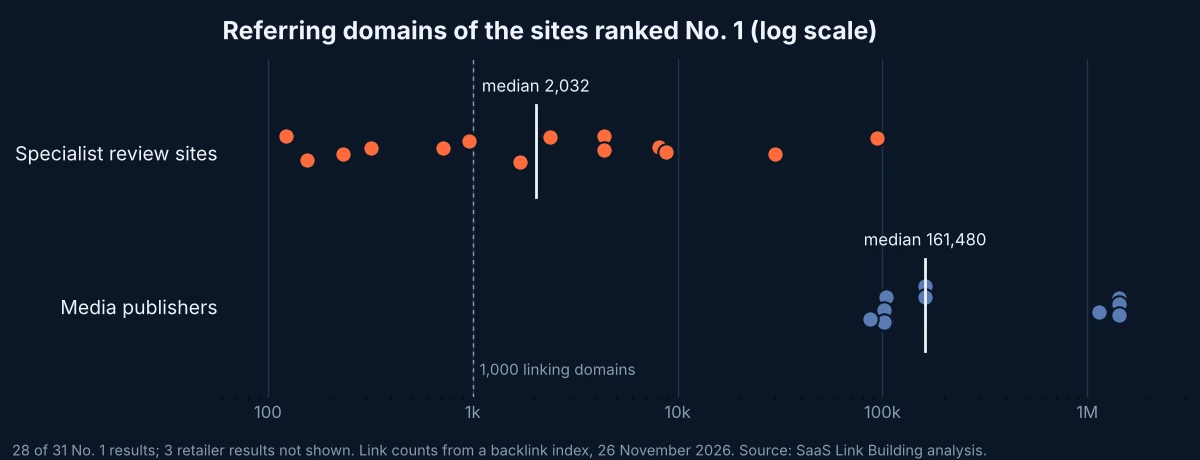
The link gap is enormous. The media domains at No. 1 had a median of 161,480 referring domains in the backlink index we queried. The specialist sites at No. 1 had a median of 2,032. Media sites carry about two orders of magnitude more links, and links remain part of how Google ranks pages. We examined that question separately in our investigation into whether Google favours big brands.
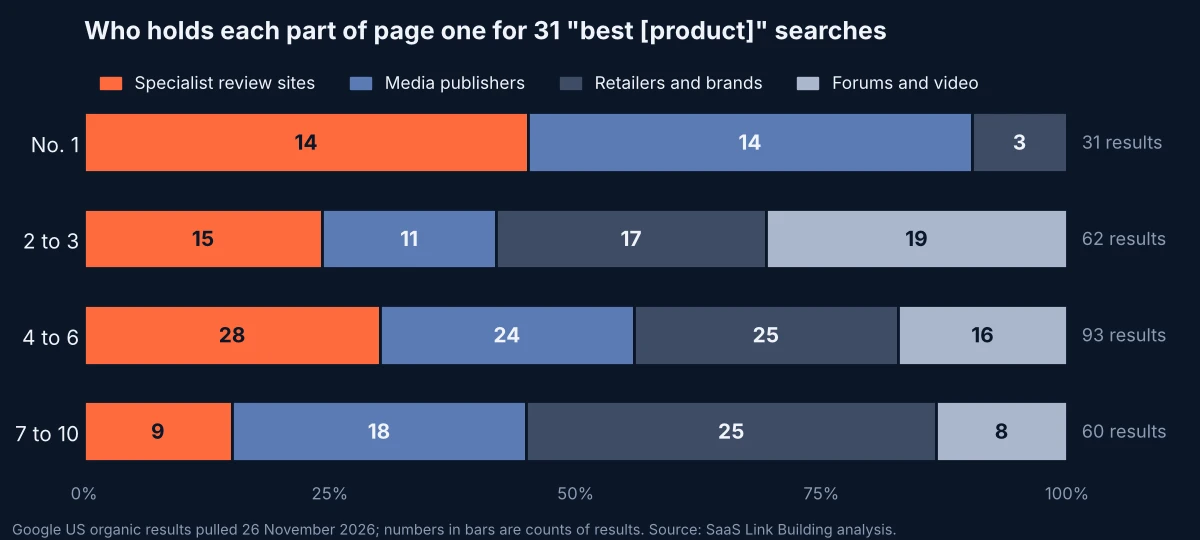
Forums and retailers took the middle of page one. Positions two and three are where an independent site displaced from first place would expect to land. Across the 31 searches, retailers held 17 of those 62 positions and forums and video held 19. Reddit appeared 20 times on page one and YouTube 15 times. Google told AFP that people often want to learn from others' experiences, and said its 2024 changes were meant to show fewer results that seem written for search engines rather than people. Whatever the intent, the space for any review page, independent or corporate, is smaller than it was.
Evidence against the theory
Specialists matched media at No. 1. In this sample, specialist review sites won as many first places as legacy media (14 each) and more top-three positions (29 of 93 against 25). They appeared somewhere on page one for 24 of the 31 searches and in the top three for 19. That is not what a systemic demotion of independent reviewers would look like.
Small sites with few links still reach the top. Six searches were won by specialists with fewer than 1,000 referring domains: "best electric bike" (122 linking domains), "best robot vacuum" (156), "best dehumidifier" (232), "best water filter pitcher" (318), "best hiking boots" (715) and "best pressure washer" (954). If Google ranked commercial queries mainly on brand size or link volume, these sites should not be first.
HouseFresh still ranks for one of its categories. For "best dehumidifier", HouseFresh's tested guide sat in second place, directly behind a single-topic dehumidifier site, with Consumer Reports fifth. It was the only one of our 31 searches where HouseFresh reached page one; it was absent for both "best air purifier" and "best humidifier".
Media pages are affiliate pages too. Of the 60 media pages we could read, 45 carried affiliate or tracked retail links, against 43 of 59 specialist pages. Among the editorial pages we read, Google is not choosing between affiliate and non-affiliate content: most media and specialist pages ranking for these terms are monetised the same way.
The affiliate link test
The second part of the theory, that Google penalises affiliate monetisation on smaller sites, can be checked against Google's own stated rule. If Google acted firmly on untagged affiliate links, pages that ignore the 2021 guidance should struggle to rank. We read the server HTML of every page we could fetch and counted two kinds of monetised links: direct links to affiliate networks or to retailers with a tracking tag, and in-house redirect links such as /go/ or /out/ paths that most affiliate sites use.
| Measure | Media publishers | Specialist review sites |
|---|---|---|
| Ranking pages read | 60 of 67 | 59 of 66 |
| Pages with affiliate or tracked retail links | 45 | 43 |
| Direct affiliate links found | 1,341 on 34 pages | 950 on 37 pages |
| Direct links marked rel="sponsored" | 77.8% | 49.2% |
| Direct links marked sponsored or nofollow | 96.6% | 83.7% |
| Pages tagging none of their direct affiliate links | 4 of 34 | 6 of 37 |
| In-house redirect links found | 1,114 | 356 |
| In-house redirect links marked sponsored or nofollow | 100% | 24.7% |
Source: SaaS Link Building analysis of server HTML from Google US page-one results, collected 26 November 2026. Links added by JavaScript after page load are not counted.
Media publishers follow Google's tagging guidance more closely. But the six specialist pages that tagged none of their direct affiliate links did not rank poorly: they sat at positions 1, 3, 3, 4, 5 and 6. The No. 1 result for "best running shoes" carried 28 affiliate links through Rakuten, Amazon and Partnerize, none with a rel value. On this evidence, untagged affiliate links on smaller sites are not being punished in any way visible in rankings. That cuts against the idea that Google singles out independent affiliates, though it also raises the question of how consistently the 2021 policy is enforced.
What AI Overviews cite
AI Overviews appeared with cited sources on 26 of the 31 searches. Of 245 references, 119 pointed back to Google's own product pages. Of the remaining 126, media publishers supplied 49 (38.9%), forums and video 32 (25.4%, of which YouTube supplied 23) and retailers 7. The other 38 (30.2%) went to review sites and independent blogs, 27 of them to specialist sites that also ranked on page one in our sample; 16 of the 26 overviews cited at least one of those. Google's new ranking principles page says AI Overviews are evaluated using the same criteria as web listings, and that their sources are meant to be as helpful as possible for the question.
Verdict: unproven
Our data does not support the strong form of the claim, that Google systematically buries independent review sites in favour of big media. Specialists won as many No. 1 positions as media brands, small sites with a few hundred linking domains won six searches outright, and pages breaking Google's affiliate tagging rule still ranked at the top. The weaker forms of the claim have real support: a small set of media brands collects most media wins, some categories (including the air purifier niche where the complaint began) show no specialist sites at all, and retailers and forums now take close to half of page one.
Our reading, which is interpretation rather than something Google has confirmed: the pressure on independent reviewers is less about Google preferring media brands and more about Google giving fewer page-one positions to editorial review pages of any kind. That would explain why HouseFresh-style sites feel squeezed even when the head-to-head contest with media looks even. A single day's snapshot of 31 head terms cannot prove that, and it says nothing about traffic, which depends on AI Overviews, ads and shopping units above the organic results. Earlier this month we found that small sites' share of 29 SERPs had tripled since 2024, a separate sign that smaller sites have not been shut out.
What this means for SEO teams
- Do not assume the category is closed. Check each target query yourself. In 24 of 31 product searches a specialist site held at least one page-one position, and the referring domain counts of the winners were often modest.
- Audit your affiliate link tags. We saw no ranking penalty for untagged links, but Google's 2021 guidance still allows manual action. Mark direct affiliate links and in-house redirect links rel="sponsored"; on the specialist pages we read, three quarters of in-house redirect links had no tag.
- Plan for retailer and forum results. On many product SERPs the competitor for position two or three is a Home Depot category page or a Reddit thread, not another review site. Original testing data, photos and measurements are what those results do not provide.
- Measure AI Overview citations separately. Review sites and independent blogs earned 30.2% of non-Google citations in this sample. A page can lose organic position and still be cited, or the reverse.
- Re-check after the December core update. Google has preannounced a December 2026 core update; we covered what it said in our report on the preannouncement. Run the same queries again once it completes.
Methodology
On 26 November 2026 we requested Google US English results (gl=us, hl=en) through a SERP API for 31 "best [product]" queries covering home, kitchen, electronics, fitness, outdoor, baby and tools categories. We recorded every organic result on page one, 246 in total (Google returned between 6 and 10 organic results per query). Each result's domain was classified into one of four groups: media publishers (news, magazine and broad lifestyle titles, including Consumer Reports), retailers and brands (sites that sell the product, including manufacturer stores and contractors), forums and video (Reddit, YouTube, Quora, Facebook and other user-generated platforms), and specialist review sites (sites whose main content is product reviews or buying advice and that are not one of the other three). The classification is ours; we did not check corporate ownership.
We fetched the HTML of the 133 media and specialist results, using a standard browser user agent and a headless browser for pages that refused the first request. 119 pages returned usable HTML; 14 were blocked. We counted direct affiliate links (known affiliate network domains, Amazon links with an associate tag and retailer links with tracking parameters) and in-house redirect links (paths such as /go/, /out/ and /recommends/), and read the rel attribute on each. Referring domain counts for 81 domains, covering all 80 media and specialist domains, came from a commercial backlink index on the same day. AI Overview references were taken from the same SERP responses; cited domains that did not rank on page one were grouped by the same rules, with review sites and blogs we had not otherwise classified counted alongside specialist sites. Results reflect one logged-out US snapshot two days after the November 2026 core update completed, and positions vary by location, device and personalisation.
Conclusion
Independent review sites are not being wiped from Google's product results across the board. In our 31-search test they matched legacy media for No. 1 positions, won with link profiles a fraction of the size, and ranked even when they ignored Google's affiliate tagging advice. What they face is a smaller page: fewer editorial slots, with retailers, Reddit and YouTube taking positions that review pages once held, and some categories where no specialist ranks at all. Google's claim that it treats results equally holds up better in this data than its critics suggest; whether it holds up for traffic is a question rankings alone cannot answer.
What do you think?
If you run an independent review site, has your page-one visibility for "best [product]" terms changed since the November 2026 core update, and are retailers and forums or media brands now taking your positions? Share your Search Console data or examples with us.
Questions and answers
Does Google penalise affiliate sites?
Google's spam policies say not every site in an affiliate program is a thin affiliate, and list original reviews, rigorous testing and product comparisons as examples of good affiliate pages. Its thin affiliation policy targets pages that copy merchant descriptions without adding original content.
How should affiliate links be tagged for Google?
In a July 2021 Search Central post, Google asked sites in affiliate programs to qualify affiliate links with rel="sponsored" and said sites that fail to do so could face manual or algorithmic action.
How many No. 1 spots did independent review sites win in this test?
Specialist review sites ranked first for 14 of 31 "best [product]" searches in Google US results collected on 26 November 2026, the same number as media publishers. Retailers held the other 3.
Which searches had no specialist review site on page one?
Seven: best air purifier, air fryer, electric kettle, electric toothbrush, office chair, space heater and standing desk.
What did Google change in March 2024?
Google's 5 March 2024 announcement introduced the site reputation abuse policy, enforced from 5 May 2024, and said the March 2024 core update would cut low-quality, unoriginal content in results by 40%. An April update to the post put the final reduction at 45%.
More releases
-
Updates
Google Local Pack Shows 'No Reviews' for Rated Firms; 0 of 238 Hit in Our Logged-Out Pull
Google's local pack is showing "No reviews" for some businesses that have reviews, Search Engine Roundtable reported on 26 November. Our logged-out pull of 238 listing appearances in 34 Google local result sets across seven US locations found none affected, and review counts matched Maps records in all seven we cross-checked.
-
Explainers
Google Lets Owners Hide Booking Partners; 87 of 114 Book Buttons Led to 21 Platforms
Google now lets Business Profile owners hide third-party booking, appointment and reservation partners with a switch, though removal still runs through the partner. In our pull of 240 salon and barber listings in four US cities, 114 showed a booking button and 87 of those led to one of 21 outside platforms.
-
Studies
Google Says Reuse One Black Friday URL; 26 of 27 Top Retailers Do, but 3 Miss Page One
Google has told merchants since 2020 to reuse one Black Friday URL every year. Our search of 30 US retailers on 26 November found 27 ranking first for their own Black Friday query, 26 of them with a year-free URL, while Kohl's, JCPenney and Dell had no store page in the organic results.
Tell us the site and the goals.
Rankings in Google and visibility in AI answers, from one monthly plan. One call is enough to say which one fits. Email works just as well.