Google Says Reuse One Black Friday URL; 26 of 27 Top Retailers Do, but 3 Miss Page One
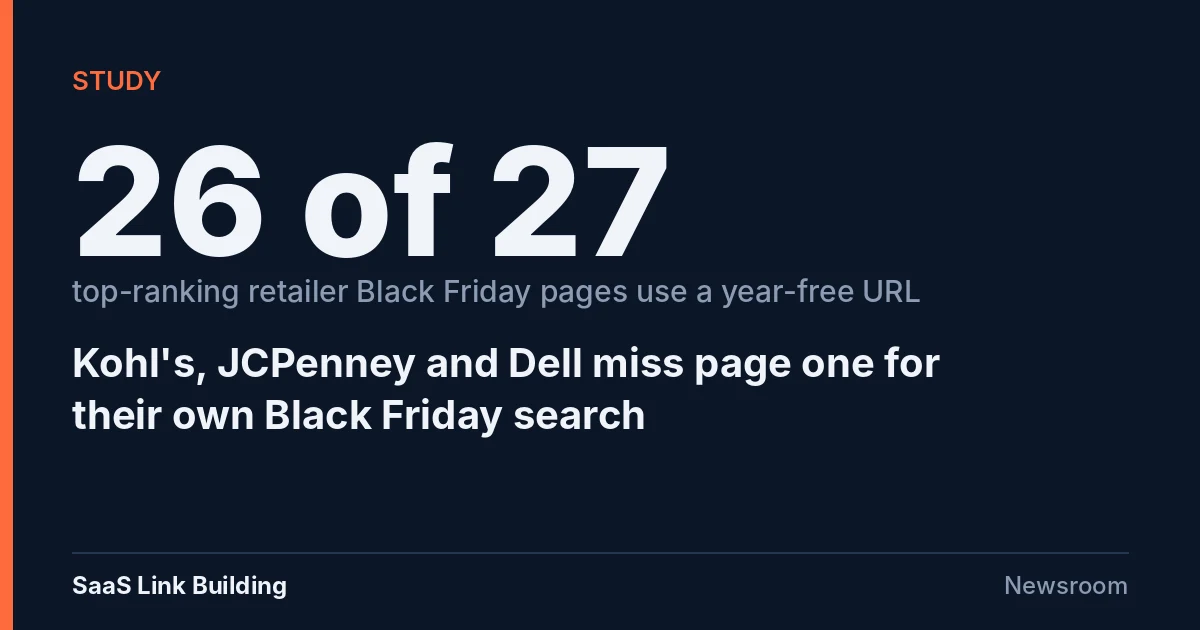
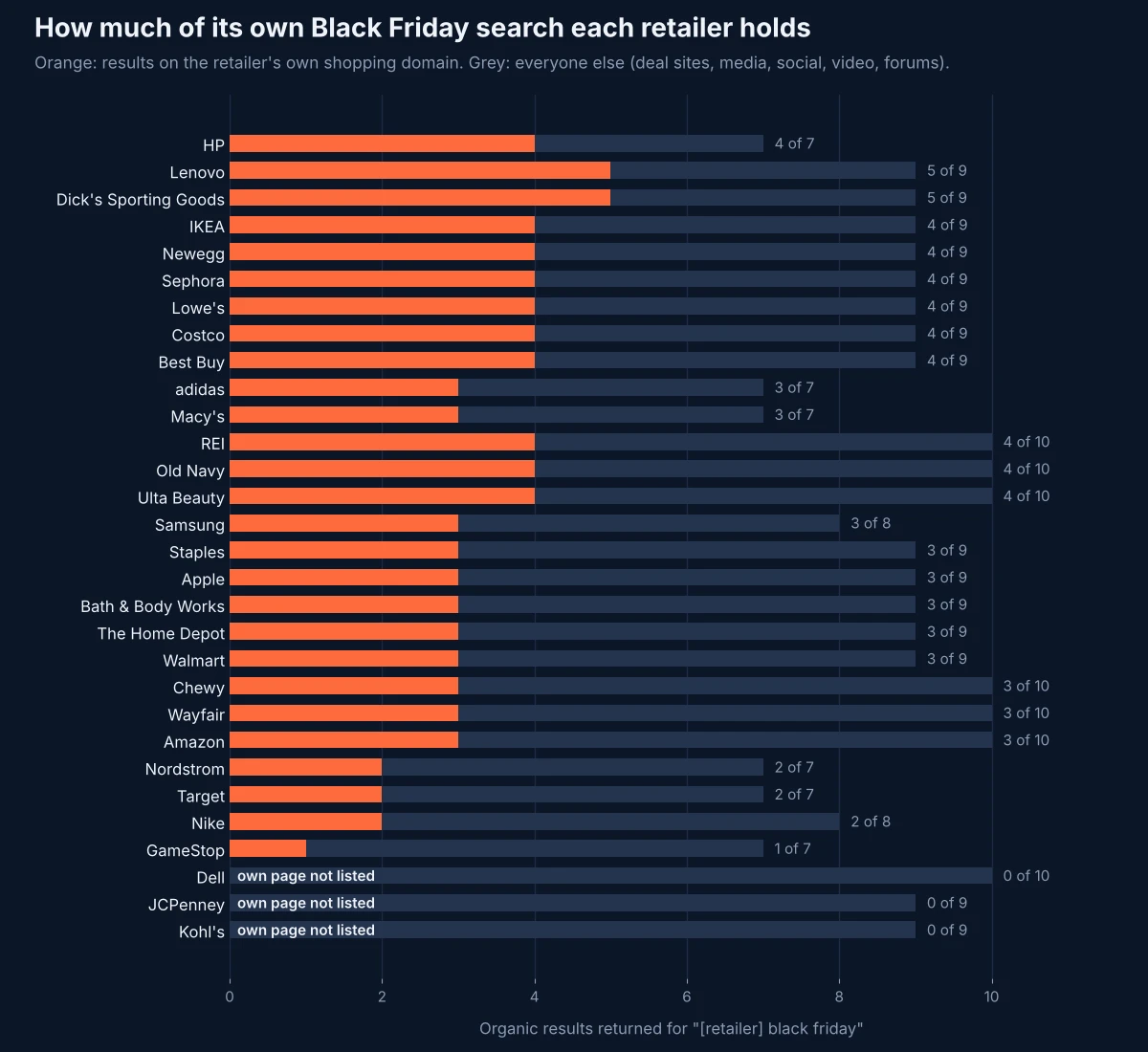
Google has told merchants since 2020 to reuse one Black Friday URL every year. Our search of 30 US retailers on 26 November found 27 ranking first for their own Black Friday query, 26 of them with a year-free URL, while Kohl's, JCPenney and Dell had no store page in the organic results.
 Vibhu Dhariwal
Cofounder & CTO, Digital Gratified
- Published
- Section
- Studies
- Reading time
- 9 minutes
Ras Al Khaimah, United Arab Emirates, .
With Black Friday falling on 27 November, we checked how 30 large US retailers line up against Google's own advice for sale landing pages. In its 2020 best practices for Black Friday and Cyber Monday pages, Google's Search Relations team told merchants to create the page early, link it from the home page and use a recurring URL such as /sale/black-friday rather than a new address with the year in it. A 2021 follow-up on deals pages added that the event description belongs in the page title. On 26 November we searched Google in the US for "[retailer] black friday" for all 30 brands and recorded what ranked.
Key findings
- 27 of 30 retailers ranked first for their own Black Friday search. In every one of those 27 cases the top result was a page on the retailer's own shopping domain.
- 26 of those 27 pages use a URL with no year in it. Newegg is the only exception: its top result sits at /promotions/black-friday/2026/index.html.
- Kohl's, JCPenney and Dell had no page on their shopping domain in the organic results we pulled, even though each has an indexed, year-free Black Friday page that Google returned when we restricted the search to the retailer's domain.
- 15 of the 27 top pages put "2026" in the title, the pattern Google's 2021 post used as its example ("Black Friday 2021 Deals").
- Retailers held 90 of the 263 organic results (34%) across the 30 searches. One deal site, blackfriday.com, appeared in 20 of the 30.
The recurring URL rule mostly holds
Google's 2021 post summed up the earlier advice in one line: "Reuse the same URL each year". The biggest retailers have taken that on board. Amazon uses /blackfriday, Best Buy /black-friday, Walmart /shop/deals/black-friday and Samsung /us/offer/black-friday/. Even unusual structures such as Target's /c/target-black-friday/-/N-5q0f2 or Chewy's /b/black-friday-2731 carry no date, so the same address can serve every November.
Newegg shows the trade-off. Its first result is a 2026 subfolder, but its third, /Black-Friday-Sale/EventSaleStore/ID-42, is a year-free store page titled "Black Friday Deals 2026". A Newegg editorial page with 2025 in its slug also ranked, at No. 7. Dated event pages that stay live can keep ranking next to the current one.
Four retailers rank first with a URL that does not mention Black Friday at all: Dick's Sporting Goods (/s/holiday), Lenovo (/d/deals/doorbusters/), GameStop (/deals) and REI (/promotions/winter-sale). REI is a special case: its own Opt Outside page says the co-op closes on Black Friday, and its sale ran under a holiday name. The other three show that a general deals hub with Black Friday wording in its title can win the query without a dedicated event URL.
Three retailers with the right page, and no ranking
The more surprising result is at the bottom of the chart. For "kohls black friday", seven of the nine organic results were Facebook or Instagram posts, and the only Kohl's address was a 2016 news post on its corporate site. A search restricted to kohls.com put /sale-event/black-friday-deals.jsp first, so the page exists and is indexed. JCPenney's evergreen page, /d/black-friday, was third for the same kind of site-restricted search, but the open search showed a 2016 news story, social posts, deal blogs and a forum thread instead. For "dell black friday", all 10 organic results came from other sites, and every one of the eight that carried a date predated 2026, the oldest from 2017. Dell's homepage links to /en-us/shop/deals/dc/black-friday-deals, which a dell.com search returned first, titled "Black Friday Deals 2026".
We did not see these retailers' ads, shopping units or other paid placements, which may cover the gap commercially. In organic results, though, three of the 30 brands are absent from their own most obvious seasonal query on the day before the event. Robots.txt is not the cause in the cases we could check: of the 21 robots.txt files we could retrieve, including Kohl's and Dell's, none blocked Googlebot from the retailer's Black Friday page.
Titles and homepage links
Google's 2021 post said the page title is often reused in the deals carousel and should include the event description. Twenty-five of the 27 top pages have Black Friday in the title (Lenovo's and REI's do not), and 15 add the year. That does not conflict with the recurring URL rule: the year can change in the title each November while the address stays the same. It is a different rule from the one Google now applies to Merchant Center promotions, where we reported that promotion titles may no longer carry dates.
Homepage links were harder to measure. Many retail sites blocked our headless browser, and only 12 of the 30 homepages rendered fully. Eight of those 12 (Walmart, Ulta Beauty, Dell, HP, Lenovo, Samsung, GameStop and Nike) carried a direct link to the retailer's main Black Friday page. Old Navy and IKEA linked Black Friday banners to general shop-all or best seller pages, Apple's link used a /shop/goto/ forwarding address rather than the ranking URL, and the Home Depot links we captured pointed to filtered versions of its Black Friday category.
All 30 retailers
| Retailer | Own page rank | Retailer page (path) | Year in URL | "2026" in title | Own results |
|---|---|---|---|---|---|
| adidas | 1 | /us/black_friday | No | No | 3 of 7 |
| Amazon | 1 | /blackfriday | No | Yes | 3 of 10 |
| Apple | 1 | /shop/gifts/black-friday-event/terms-conditions | No | Yes | 3 of 9 |
| Bath & Body Works | 1 | /t/black-friday | No | No | 3 of 9 |
| Best Buy | 1 | /black-friday | No | Yes | 4 of 9 |
| Chewy | 1 | /b/black-friday-2731 | No | Yes | 3 of 10 |
| Costco | 1 | /f/-/black-friday/ | No | No | 4 of 9 |
| Dell | Not listed | /en-us/shop/deals/dc/black-friday-deals (indexed, found with a site: search) | No | n/a | 0 of 10 |
| Dick's Sporting Goods | 1 | /s/holiday | No | No | 5 of 9 |
| GameStop | 1 | /deals | No | Yes | 1 of 7 |
| HP | 1 | /us-en/shop/slp/black-friday-sale | No | Yes | 4 of 7 |
| IKEA | 1 | /us/en/campaigns/black-friday/ | No | No | 4 of 9 |
| JCPenney | Not listed | /d/black-friday (indexed, found with a site: search) | No | n/a | 0 of 9 |
| Kohl's | Not listed | /sale-event/black-friday-deals.jsp (indexed, found with a site: search) | No | n/a | 0 of 9 |
| Lenovo | 1 | /us/en/d/deals/doorbusters/ | No | No | 5 of 9 |
| Lowe's | 1 | /l/about/black-friday-events | No | Yes | 4 of 9 |
| Macy's | 1 | /shop/sale/black-friday-deals | No | Yes | 3 of 7 |
| Newegg | 1 | /promotions/black-friday/2026/index.html | Yes | No | 4 of 9 |
| Nike | 1 | /w/black-friday-2phlm | No | Yes | 2 of 8 |
| Nordstrom | 1 | /browse/sale/black-friday | No | No | 2 of 7 |
| Old Navy | 1 | /page/black-friday-cyber-monday-deals | No | Yes | 4 of 10 |
| REI | 1 | /promotions/winter-sale | No | No | 4 of 10 |
| Samsung | 1 | /us/offer/black-friday/ | No | Yes | 3 of 8 |
| Sephora | 1 | /beauty/black-friday | No | Yes | 4 of 9 |
| Staples | 1 | /deals/Black-Friday-Deals/BI1146571 | No | No | 3 of 9 |
| Target | 1 | /c/target-black-friday/-/N-5q0f2 | No | Yes | 2 of 7 |
| The Home Depot | 1 | /b/Black-Friday-Deals/N-5yc1vZ1z1zdoh | No | Yes | 3 of 9 |
| Ulta Beauty | 1 | /promotion/black-friday | No | Yes | 4 of 10 |
| Walmart | 1 | /shop/deals/black-friday | No | No | 3 of 9 |
| Wayfair | 1 | /daily-sales/black-friday | No | No | 3 of 10 |
Who fills the gap
Across the 30 searches, two thirds of the organic results belonged to someone other than the retailer. Deal aggregators were the most consistent: blackfriday.com ranked for 20 brands, usually in the top four, and a second ad-scan site, theblackfriday.com, appeared in six. Social and community platforms took a large share for brands with weaker own-page visibility, including Facebook and Instagram for Kohl's and Reddit for Costco, Sephora and Lenovo. Publishers such as CNET, Yahoo Shopping and The New York Times's Wirecutter ranked for the biggest brands. Our earlier study of generic Black Friday deal searches found many page-one results predating 2026; brand searches show a similar pattern where the retailer's own page is missing.
What to do
- Search your own brand plus the event, logged out and in the main market, the week before the sale. If your page is missing, compare it with what Google returns for a site: search of your domain.
- Keep one address per event. If you have already used year-stamped URLs, redirect last year's address to the evergreen one rather than leaving several event pages live.
- Change the title, not the URL. Update the year and the offer in the title and on-page text each season, as Google's 2021 post suggests.
- Link the page from the homepage with a plain link, not only a banner pointing at a filtered category.
- Publish early. Google's 2020 advice was to create the page well before the sale and ask for a recrawl once it is updated.
- Plan for Cyber Monday and later events too. Several retailers we checked already run separate evergreen pages for Cyber Week or "Black Friday in July".
Our earlier test of whether Google rewards fresh dates is useful background on how much a visible year in the title tends to matter.
Methodology
On 26 November 2026, between about 01:15 and 01:30 UTC, we queried Google through a SERP API using the lightweight Google results endpoint, set to the United States and English, for "[retailer] black friday" for 30 US retailers chosen to cover general merchandise, department stores, home improvement, beauty, apparel, electronics and pet supplies. We recorded each organic result's position, URL and title, and counted a result as the retailer's own if it sat on the retailer's shopping domain (for Old Navy, oldnavy.gap.com); corporate, investor relations and press sites were counted as other. Ads, shopping units, top stories and sitelinks were excluded. The endpoint returned between seven and 10 organic results per query. For Kohl's, JCPenney and Dell we ran an additional site: search to confirm that a Black Friday page was indexed. We fetched robots.txt from each retailer's host with a Googlebot user agent and tested the ranking URL with Python's robots.txt parser; nine hosts returned an access-denied page or nothing, leaving 21 usable files. We rendered retailer homepages in headless Chromium with a desktop browser user agent and collected links whose address or text mentioned Black Friday; 12 of the 30 retailers' homepages rendered with their full navigation. Results are a single snapshot from one location and may differ by user, device and time.
Conclusion
Six years after Google asked merchants to reuse one Black Friday address, nearly every major US retailer we checked has done so, and 27 of 30 rank first for their own Black Friday search. The rule is not enough on its own: Kohl's, JCPenney and Dell all have an indexed, year-free page, and none of the three appeared in the organic results for its brand query the day before the sale. For retailers, the useful check is the simplest one: search your own name and the event, and see who answers.
Questions and answers
What URL does Google recommend for a Black Friday page?
Google's 2020 Search Central post recommends a recurring URL that is used every year and reflects the event, for example /sale/black-friday rather than /sale/2020/black-friday. Its 2021 follow-up repeated the advice to reuse the same URL each year.
Should the year go in a Black Friday page title?
Google's 2021 deals post says to include the event description in the page title and gives "Black Friday 2021 Deals" as an example, because the title is often used in the deals carousel. In our 26 November 2026 check, 15 of the 27 top-ranking retailer pages had 2026 in the title.
Which retailers did not rank for their own Black Friday search?
Kohl's, JCPenney and Dell had no page on their shopping domain in the organic results for "[brand] black friday" in our US pull on 26 November 2026. Each has an indexed Black Friday page that Google returned when we restricted the search to its domain.
How early should a Black Friday landing page go live?
Google's 2020 guidance says to create the page well before the sale so Googlebot has time to discover and index it, to link it from the home page, and to ask Google to recrawl it once it is updated.
More releases
-
Updates
Google Local Pack Shows 'No Reviews' for Rated Firms; 0 of 238 Hit in Our Logged-Out Pull
Google's local pack is showing "No reviews" for some businesses that have reviews, Search Engine Roundtable reported on 26 November. Our logged-out pull of 238 listing appearances in 34 Google local result sets across seven US locations found none affected, and review counts matched Maps records in all seven we cross-checked.
-
Studies
Is Google Burying Independent Review Sites? They Took 14 of 31 No. 1 Spots in Our Test
Independent review sites say Google pushed them out of product search. Our pull of 31 "best [product]" searches on 26 November found specialist review sites held 14 No. 1 spots, level with media brands, while retailers and forums took 45.9% of page one and specialists were missing from 7 searches.
-
Explainers
Google Lets Owners Hide Booking Partners; 87 of 114 Book Buttons Led to 21 Platforms
Google now lets Business Profile owners hide third-party booking, appointment and reservation partners with a switch, though removal still runs through the partner. In our pull of 240 salon and barber listings in four US cities, 114 showed a booking button and 87 of those led to one of 21 outside platforms.
Tell us the site and the goals.
Rankings in Google and visibility in AI answers, from one monthly plan. One call is enough to say which one fits. Email works just as well.