Google Lets Owners Hide Booking Partners; 87 of 114 Book Buttons Led to 21 Platforms
Google now lets Business Profile owners hide third-party booking, appointment and reservation partners with a switch, though removal still runs through the partner. In our pull of 240 salon and barber listings in four US cities, 114 showed a booking button and 87 of those led to one of 21 outside platforms.
 Vibhu Dhariwal
Cofounder & CTO, Digital Gratified
- Published
- Section
- Explainers
- Reading time
- 8 minutes
Ras Al Khaimah, United Arab Emirates, .
Google has given Business Profile owners a switch to hide third-party booking, appointment and reservation partners from their listings. The change was announced on LinkedIn on 23 November by Google's Lisa Landsman, Search Engine Roundtable reported, and Google's help page on managing local business links now describes the switch step by step. It follows the control Google added a month earlier for restaurant food ordering and delivery partners.
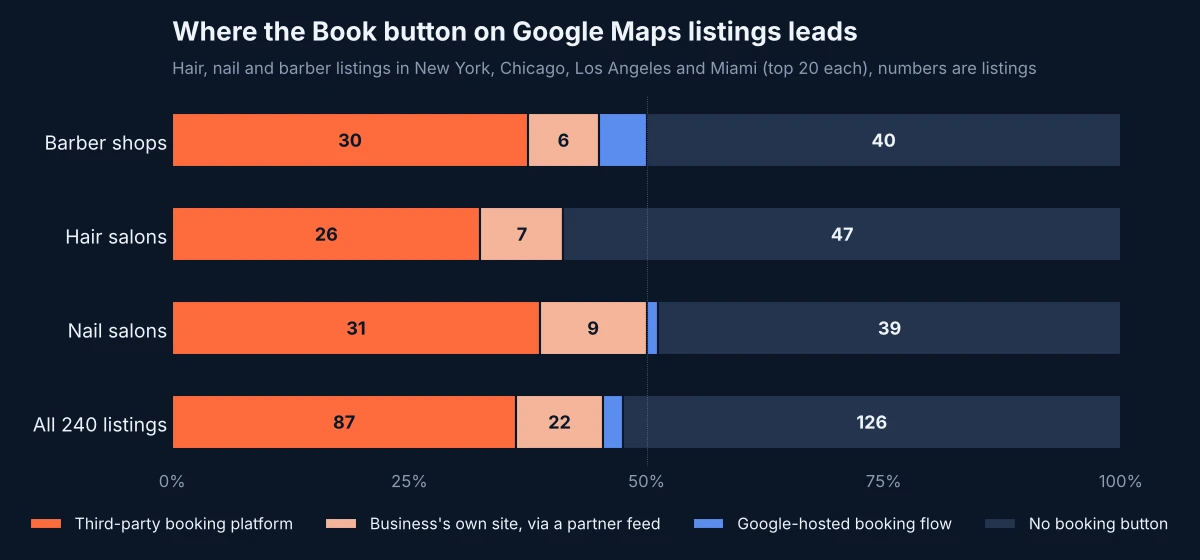
To see how many listings the switch could touch, we pulled the top 20 Google Maps results for hair salons, nail salons and barber shops in New York, Chicago, Los Angeles and Miami on 26 November. Of those 240 listings, 114 showed a booking button. Every one carried a marker of Google's booking partner system, and 87 of them sent customers to one of 21 third-party booking platforms.
What changed
Google's help pages now separate two kinds of booking link, and the owner controls each one differently:
- Third-party partner links can be hidden, not deleted. In the Booking section of the profile (Edit profile, then Booking, on Google Maps), owners turn off the switch next to a provider and select Confirm. Turning it back on restores the link.
- Removal still runs through the partner. Google says owners cannot delete a third-party provider from their profile settings. They must use the partner's opt-out link, support form or account portal, and partners are required to process opt-outs within 5 business days. If one does not, Google points owners to its third-party violation report.
- Hiding stops new bookings only. Google's page on setting up bookings through a provider says existing customer bookings and reminders stay active after a provider is switched off, but new bookings stop.
- Waitlists are a separate switch. For restaurants, a provider turned off under Waitlists still appears under Bookings, and the reverse.
- Custom links work as before. Owners can add up to 10 links per category, mark one as "Business preferred" and edit or remove their own links directly. Google notes that these links cannot be managed through the Business Profile API or spreadsheet upload.
How booking buttons reach a listing
Most booking buttons are not added by the business at all. They arrive through Reserve with Google, the program in which booking software companies connect their merchants to Google through its Actions Center. Google's help page says links of this kind "can automatically appear" on a profile through third-party partners, so a button can show up without the owner adding it.
The links carry a marker. Google's conversion tracking documentation for appointment partners says every action link Google generates gets a unique rwg_token parameter, which partners store for up to 30 days and send back when a booking completes. Google says this reporting keeps an integration healthy and "can influence the ranking on certain pages." The same documentation asks partners to report a merchant_changed value when a booking is completed with a different merchant than the one Google referred. Owners who would rather not route bookings through a marketplace-style app now have a direct way to hide it.
In our pull, 109 of the 114 booking buttons carried an rwg_token, and the other 5 opened a booking flow hosted on google.com. None looked like a plain link added by hand.
What the data shows
Booking buttons appeared on 40 of 80 barber listings, 41 of 80 nail salons and 33 of 80 hair salons. Square's appointment pages were the most common destination, followed by Booksy, which accounted for 11 of the 40 barber buttons on its own.
| Booking platform (link domain) | Barber shops | Hair salons | Nail salons | Total |
|---|---|---|---|---|
| squareup.com | 9 | 4 | 5 | 18 |
| booksy.com | 11 | 4 | 0 | 15 |
| vagaro.com | 1 | 5 | 3 | 9 |
| getsquire.com | 6 | 1 | 0 | 7 |
| boulevard.io | 1 | 5 | 0 | 6 |
| zenoti.com | 0 | 1 | 4 | 5 |
| fresha.com | 0 | 1 | 3 | 4 |
| setmore.com | 0 | 0 | 4 | 4 |
| 13 other platforms | 2 | 5 | 12 | 19 |
| All third-party platforms | 30 | 26 | 31 | 87 |
Source: our Google Maps pull of 240 US listings on 26 November 2026; see Methodology. Buttons that led to the business's own domain or to a Google-hosted page are excluded from this table.
The remaining 27 buttons split two ways. Twenty-two pointed to the business's own website but still carried Google's partner token, which suggests a booking tool embedded on the owner's site and fed to Google by its vendor. Five opened Google's own appointment page, where the provider is not named in the link.
Restaurants are harder to audit from outside. Of 80 restaurant listings we pulled in the same four cities, 30 showed a reservation button that pointed to a Google-hosted dining page, so the partner behind it was not visible in the link. For 14 of those 30, the listing's separate reservations link named Resy (7) or OpenTable (7). Owners will see the provider names in their own Booking section even when searchers do not.
Position made little difference. Booking buttons appeared on 15 of the 36 listings ranked in the top three, 43 of the 84 ranked fourth to tenth and 56 of the 120 ranked 11th to 20th.
Worked examples
A barber shop that moved from Booksy to Square. If both partners still feed the listing, searchers may see two booking options and pick the app the shop no longer checks. The owner hides Booksy with the switch, sets the Square link or the shop's own page as "Business preferred", then asks Booksy to remove the merchant so the connection is removed rather than only hidden. Existing Booksy appointments stay on the books, so the shop still needs to honour them.
A restaurant that uses its own reservations page. If Google shows a reservation partner the restaurant pays per cover, the owner can hide that partner under Bookings, check Waitlists separately, and add the restaurant's own reservations URL as a custom link. Google's provider page notes that bookings performance data is not available for custom links, so the restaurant gives up Google's booking report for that link and should tag it with UTM parameters to keep measuring it in analytics.
What to do
- Audit the Booking section before the holiday rush. List every provider shown, confirm each still holds live availability for the business, and switch off any the business has stopped using.
- Keep at least one working route. Hiding every partner without adding a custom link removes the button entirely. Google keeps adding booking features elsewhere in Search and Maps, from AI Mode's home service booking cards to Ask Maps looking for appointments on a user's behalf.
- Set a preferred link. Where several links remain, mark the one the business wants used first as "Business preferred".
- Request removal in writing and date it. The 5 business day deadline gives agencies a clear point at which to file Google's third-party violation report.
- Recheck after a week. Google says a newly added provider shows up within a week, so verify changes on Maps and Search rather than assuming they are live.
- For multi-location brands, plan for manual work. Links are edited one profile at a time, since Google says they are not available through the API or bulk upload.
Methodology
On 26 November 2026, between 05:21 and 05:23 UTC, we pulled Google Maps search results through a SERP data API for four queries (hair salon, nail salon, barber shop and restaurant), each centred on the downtown coordinates of New York, Chicago, Los Angeles and Miami at zoom level 14, in English, with a depth of 20 results. That gave 320 listings: 240 service listings and 80 restaurants. For each listing we read the booking link field and the contact link field returned with the result. We classified a booking link as the business's own site when its registered domain matched the listing's website domain, as Google-hosted when it pointed to google.com/maps/reserve, and otherwise as a third-party platform, grouped by registered domain (with as.me counted under acuityscheduling.com). We checked each booking link for the rwg_token parameter. Restaurant links that pointed to other Google-hosted pages (29 listings) were not classified. The pull is one snapshot from one location per city and will vary by device, user and time. We also read the two Google Business Profile help pages and the Actions Center documentation linked above on the same day.
Conclusion
The new switch gives owners direct control over a part of their listing that previously needed Google or the booking partner to change. In our sample, nearly half of salon and barber listings showed a booking button, and three in four of those buttons led to an outside platform rather than to the business itself.
The control is narrower than it looks: a hidden provider is still connected, existing bookings continue, and full removal depends on the partner acting within five business days. For local SEO teams, the job is now a routine one: check which partners each profile shows, decide which should stay, and keep one booking route the business actually monitors.
Questions and answers
How do I hide a third-party booking partner on my Google Business Profile?
Google's help page says to open your Business Profile and select Booking (on Google Maps, select Edit profile, then Booking), turn off the switch next to the third-party provider and select Confirm. Turning the switch back on shows the provider again.
Does hiding a booking provider delete it from my profile?
No. Google says owners cannot manually delete third-party booking or reservation providers from their profile settings. To remove one, contact the provider through its opt-out link, support form or account portal. Providers are required to process opt-out requests within 5 business days, and if they do not, Google says to report a third-party violation.
What happens to existing appointments when I switch a provider off?
Google's page on setting up bookings through a provider says existing customer bookings and reminders stay active, but new bookings through that provider stop.
Can I still add my own booking link?
Yes. Google allows up to 10 links per category for bookings, reservations and orders, and lets owners mark one as "Business preferred". Google notes that bookings performance data is not available for custom links and that local business links cannot be managed through the Business Profile API or spreadsheet upload.
What is the rwg_token parameter on booking links?
Google's Actions Center documentation says Google adds a unique rwg_token to each action link it generates. Booking partners store it for up to 30 days and send it back to Google when a booking is completed, as part of conversion tracking.
More releases
-
Updates
Google Local Pack Shows 'No Reviews' for Rated Firms; 0 of 238 Hit in Our Logged-Out Pull
Google's local pack is showing "No reviews" for some businesses that have reviews, Search Engine Roundtable reported on 26 November. Our logged-out pull of 238 listing appearances in 34 Google local result sets across seven US locations found none affected, and review counts matched Maps records in all seven we cross-checked.
-
Studies
Is Google Burying Independent Review Sites? They Took 14 of 31 No. 1 Spots in Our Test
Independent review sites say Google pushed them out of product search. Our pull of 31 "best [product]" searches on 26 November found specialist review sites held 14 No. 1 spots, level with media brands, while retailers and forums took 45.9% of page one and specialists were missing from 7 searches.
-
Studies
Google Says Reuse One Black Friday URL; 26 of 27 Top Retailers Do, but 3 Miss Page One
Google has told merchants since 2020 to reuse one Black Friday URL every year. Our search of 30 US retailers on 26 November found 27 ranking first for their own Black Friday query, 26 of them with a year-free URL, while Kohl's, JCPenney and Dell had no store page in the organic results.
Tell us the site and the goals.
Rankings in Google and visibility in AI answers, from one monthly plan. One call is enough to say which one fits. Email works just as well.