Amazon and Meta Talk Muse Access; Amazon Alone of 61 Retailers Bars ChatGPT-User
Amazon and Meta are discussing access for Meta's Muse shopping agent, Fortune reported on 25 November. Our fetch of 80 large retailers' robots.txt files found Amazon is the only one of 61 readable files that bars ChatGPT-User from its whole site, alongside seven other user-triggered agents. Muse has no token to block.
 Vibhu Dhariwal
Cofounder & CTO, Digital Gratified
- Published
- Section
- Studies
- Reading time
- 8 minutes
Ras Al Khaimah, United Arab Emirates, .
Amazon and Meta have held several meetings about letting Meta's Muse shopping agent back into Amazon's store, with search results and advertising the main sticking points, according to a Fortune report on 25 November summarised by The Next Web. Neither company commented and no timeline has been set. We fetched the robots.txt files of 80 large online retailers on 26 November. Of the 61 we could read, Amazon is the only one that disallows OpenAI's ChatGPT-User fetcher from its whole site, and it bars eight user-triggered AI agent tokens by name. Muse is not one of them, because Muse has no token to block.
Key findings
- Amazon stands alone. Its robots.txt disallows 99 user-agent tokens from the entire site, including ChatGPT-User, Claude-User, Perplexity-User, MistralAI-User, Manus-User, Meta-ExternalFetcher, GoogleAgent-Shopping and GoogleAgent-Mariner.
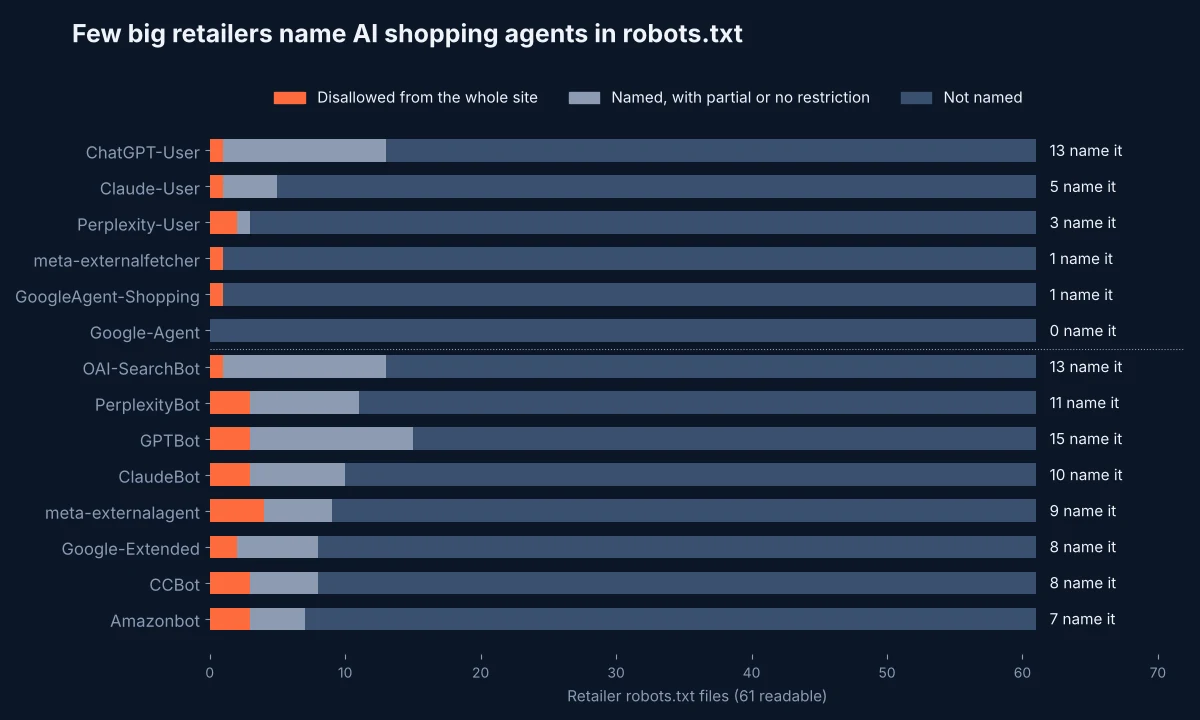
- Most retailers say nothing. 41 of the 61 readable files name none of the 18 AI crawler and agent tokens we tested. 13 name at least one user-triggered agent, and most of those set narrow path rules or an explicit allow.
- Muse's partners are silent. Walmart's file names no AI token at all, and neither do four Shopify-powered brand stores in our sample. Best Buy did not return its file to our requests.
- The fetchers Amazon names may not obey it. OpenAI, Perplexity, Meta and Google each say in their documentation that their user-triggered fetchers may skip or generally ignore robots.txt.
- 19 retailers blocked our requests outright. 13 answered a plain request for robots.txt with HTTP 403, four timed out or reset the connection, and two served an access-denied page or a login redirect.
Why Muse is not in anyone's robots.txt
Amazon blocked Muse in September, less than two weeks after it launched. Amazon told Axios it had not authorised Muse to access customer accounts, scrape data or process transactions, and Fortune reported that Amazon said Muse's access would violate the conditions of use its customers accept. Neither report describes a robots.txt rule, and none could do the job: Meta's own Muse security post of 8 September says the agent's browsing "will appear as your activity", and it names no user-agent token.
Muse does carry a cryptographic identity on some requests. We fetched its Web Bot Auth key directory again on 26 November: it still lists two Ed25519 keys, including the key ID we recorded on 15 November in our guide to verifying Muse's signatures. Retailers can act on that through signature checks and bot management, not robots.txt.
What Amazon's robots.txt blocks
The live file runs to 439 lines and carries a Last-Modified header of 9 October 2026. It names 99 user-agent tokens, and every one of them is disallowed from the whole site. Alongside the user-triggered agents, it covers the main AI training and AI search crawlers (GPTBot, OAI-SearchBot, ClaudeBot, Claude-SearchBot, PerplexityBot, meta-externalagent, Meta-WebIndexer, CCBot), several Google-related tokens (Google-Extended, GoogleOther, Google-NotebookLM, Gemini-Deep-Research and Google-CloudVertexBot), and three Copilot tokens. Googlebot and Bingbot are not named.
Two of the Google entries point to names Google does not document. Amazon disallows GoogleAgent-Shopping and GoogleAgent-Mariner, but Google's user-triggered fetchers page lists neither. The agent Google does document there, Google-Agent, is not in Amazon's file, and it is not in any of the other 60 files either. We reported on the same gap when Google published its guide to allowing Google-Agent.
How the other retailers compare
| Retailer group | Files read | Name any AI token | Name a user-triggered agent | Disallow a user-triggered agent site-wide |
|---|---|---|---|---|
| Amazon | 1 | 1 | 1 | 1 (8 tokens) |
| Muse partners (Walmart; Best Buy unreadable) | 1 | 0 | 0 | 0 |
| Shopify-powered brand stores | 4 | 0 | 0 | 0 |
| All other retailers in the sample | 55 | 19 | 12 | 1 (Instacart, Perplexity-User) |
| Total | 61 | 20 | 13 | 2 |
Source: SaaS Link Building fetch of retailer robots.txt files, 26 November 2026. AI tokens tested: 9 user-triggered agent tokens and 9 crawler tokens, listed in the Methodology.
Where retailers do name ChatGPT-User, they mostly fence off account and checkout paths rather than the store. CVS disallows /druginfo for it, Ulta disallows sign-in and account paths, and eBay groups it with Claude-User under rules for keyword URLs. Ashley Furniture, Harbor Freight and HP give it an explicit Allow: /.
Instacart takes the opposite approach to Amazon. Its wildcard group disallows the whole site for any bot it does not name, then lets named agents in: ChatGPT-User gets Allow: / with a few blocked paths, while Perplexity-User is disallowed. Because of that wildcard, every user-triggered token Instacart does not name, including Meta-ExternalFetcher and Google-Agent, falls under its site-wide block.
Site-wide blocks of crawlers are also rare. Six of the 61 retailers disallow at least one of GPTBot, ClaudeBot, meta-externalagent, Google-Extended, CCBot or Amazonbot from the whole site. Amazon's own Amazonbot is blocked site-wide by eBay, Chewy and IKEA. That fits the pattern we found in our earlier check of 43 retailers' AI bot rules.
Robots.txt may not stop these fetchers anyway
The operators of the user-triggered agents Amazon names describe robots.txt as optional for this kind of traffic, because a person asked for the page:
- OpenAI: its crawler documentation says of ChatGPT-User, "Because these actions are initiated by a user, robots.txt rules may not apply."
- Perplexity: its bots page says Perplexity-User "generally ignores robots.txt rules".
- Meta: its crawler documentation says Meta-ExternalFetcher "may bypass robots.txt" because the fetches are requested by users.
- Google: the user-triggered fetchers page says these fetchers "generally ignore robots.txt rules".
Anthropic is the exception among the operators we checked. Its help article says Anthropic's bots honour robots.txt directives, though its entry for Claude-User does not mention robots.txt specifically.
So Amazon's eight user-agent rules are best read as a public statement of policy. Enforcement, for Muse and for any agent that skips robots.txt, depends on the terms of use and on detection at the network edge.
Why the talks matter for search
The Next Web's summary of the Fortune report says Amazon's concerns include Muse shopping without users seeing Amazon's ads, an advertising business worth $68.6bn, and doubts about the quality of the search results Muse would show. It also cites Forter data that Muse handled 51% of agent-made orders in the week to 22 November. Amazon CEO Andy Jassy told analysts on 29 October that outside shopping agents are "still not great", according to Fortune.
For SEO teams this is a product discovery question. If a deal lets Muse search Amazon's catalogue, Amazon listings could appear in an agent's recommendations without the Amazon search page, and the sponsored placements on it, ever being shown. Walmart, a named Muse partner, places no AI agent restrictions in its robots.txt at all.
What retailers and SEO teams can do
- Decide agent policy separately from crawler policy. Blocking GPTBot or meta-externalagent controls training. ChatGPT-User, Perplexity-User and Meta-ExternalFetcher fetch pages for a person in real time, often on product pages. Treat them as a separate line in your policy. Our study of AI crawler blocking on top sites covers the crawler side.
- Do not rely on robots.txt to keep agents out. Four of the five operators we checked say their user-triggered fetchers may not follow it. If you need to restrict them, do it in bot management, with rate limits on cart, checkout and account paths.
- Use documented names. Rules for GoogleAgent-Shopping or GoogleAgent-Mariner match no agent Google documents. Google-Agent is the documented token, and Google says that fetcher generally ignores robots.txt.
- Verify signed agents. For Muse, follow the Signature-Agent header to its key directory rather than pinning keys, since Muse moved its signing identity once already in November.
- Check that your own robots.txt is reachable. 13 retailers in our sample answered a robots.txt request with a 403. If your bot protection does the same to crawlers you want, they will treat the response according to their own rules, which you should confirm in their documentation.
Methodology
On 26 November 2026, between 17:15 and 17:25 UTC, we requested /robots.txt over HTTPS from 80 large online retailers we selected across department stores, marketplaces, electronics, home and furniture, apparel, beauty, pharmacy, grocery, auto parts, hobby and sporting goods, plus five direct-to-consumer brand stores. We used a desktop Chrome user-agent string, tried the www host first, followed redirects and retried failures once. A file counted as readable if it returned HTTP 200 with robots.txt directives; 61 did. We parsed each file into user-agent groups and applied longest-match Allow and Disallow rules for the path /. A token counted as named if a group listed it (case-insensitive), and as disallowed site-wide if its own group's rules blocked /. The 18 tokens tested were ChatGPT-User, Perplexity-User, Claude-User, MistralAI-User, Manus-User, Meta-ExternalFetcher, Google-Agent, GoogleAgent-Shopping, GoogleAgent-Mariner, OAI-SearchBot, PerplexityBot, Claude-SearchBot, GPTBot, ClaudeBot, meta-externalagent, Google-Extended, CCBot and Amazonbot; the chart shows 14 of them. Shopify stores were identified by a powered-by: Shopify response header. We also fetched muse.ai's key directory and the operator documentation linked above on the same day.
Conclusion
Whatever Amazon and Meta agree, it will not show up in a robots.txt file. Muse has no token, and the agents Amazon does name are run by companies that say robots.txt may not apply to them. Amazon is also an outlier: of 61 large retailers, only it shuts ChatGPT-User out of the whole site, and most stores, Muse's partners included, have no agent rules at all. For now, the access question for AI shopping agents is being settled in contracts and bot management, not in the file SEOs usually check first.
Questions and answers
Can robots.txt block Meta's Muse shopping agent?
No. Meta's Muse security post says Muse's browsing will appear as the user's own activity, and it names no user-agent token. Some Muse requests carry Web Bot Auth signatures from muse.ai, which bot management can verify.
Which AI agents does Amazon's robots.txt block?
On 26 November 2026 Amazon's robots.txt disallowed 99 user-agent tokens from its whole site, including ChatGPT-User, Claude-User, Perplexity-User, MistralAI-User, Manus-User, Meta-ExternalFetcher, GoogleAgent-Shopping and GoogleAgent-Mariner. It does not name Googlebot, Bingbot or Google-Agent.
Do ChatGPT-User and other user-triggered fetchers follow robots.txt?
Not reliably. OpenAI says robots.txt rules may not apply to ChatGPT-User, Perplexity says Perplexity-User generally ignores them, Meta says Meta-ExternalFetcher may bypass robots.txt, and Google says its user-triggered fetchers generally ignore it.
Why did Amazon block Muse?
Amazon blocked Muse in September, saying its access would violate the conditions of use customers accept. On 25 November Fortune reported that the companies are in talks, with search results and advertising the main sticking points.
How many large retailers name AI agents in robots.txt?
In our 26 November check, 20 of 61 readable retailer robots.txt files named at least one of 18 AI crawler and agent tokens, 13 named a user-triggered agent, and only Amazon and Instacart disallowed one site-wide by name.
More releases
-
Updates
Google Local Pack Shows 'No Reviews' for Rated Firms; 0 of 238 Hit in Our Logged-Out Pull
Google's local pack is showing "No reviews" for some businesses that have reviews, Search Engine Roundtable reported on 26 November. Our logged-out pull of 238 listing appearances in 34 Google local result sets across seven US locations found none affected, and review counts matched Maps records in all seven we cross-checked.
-
Studies
Is Google Burying Independent Review Sites? They Took 14 of 31 No. 1 Spots in Our Test
Independent review sites say Google pushed them out of product search. Our pull of 31 "best [product]" searches on 26 November found specialist review sites held 14 No. 1 spots, level with media brands, while retailers and forums took 45.9% of page one and specialists were missing from 7 searches.
-
Explainers
Google Lets Owners Hide Booking Partners; 87 of 114 Book Buttons Led to 21 Platforms
Google now lets Business Profile owners hide third-party booking, appointment and reservation partners with a switch, though removal still runs through the partner. In our pull of 240 salon and barber listings in four US cities, 114 showed a booking button and 87 of those led to one of 21 outside platforms.
Tell us the site and the goals.
Rankings in Google and visibility in AI answers, from one monthly plan. One call is enough to say which one fits. Email works just as well.