Does Google Rank Subdomains Lower? They Held 15 of 50 No. 1 Spots in Our Test
Google's documentation says it sometimes treats a subdomain as a separate site, and John Mueller says the choice affects how new content ranks. But in 50 US Google searches pulled on 22 November 2026, subdomain results ranked as well as subfolders and took 15 of 50 top spots. Our verdict: unproven.
 Vibhu Dhariwal
Cofounder & CTO, Digital Gratified
- Published
- Section
- Studies
- Reading time
- 14 minutes
Ras Al Khaimah, United Arab Emirates, .
Few arguments in SEO have run as long as the one over subdomains. The belief that Google ranks content on blog.example.com or help.example.com below the same content in example.com/blog/ shapes site migrations, CMS choices and budget requests every year. Google's own documentation and its Search Advocate John Mueller give a more mixed answer than either camp usually admits. To test the claim, the SaaS Link Building newsroom pulled 50 live US Google results pages on 22 November 2026, classified all 392 organic listings by host, and checked the theory against Google's documentation, Mueller's statements on record and the 2024 leak of Google's internal API reference.
The short version: there is solid primary evidence that Google sometimes treats a subdomain as a separate site, but no evidence in our data that being on a subdomain holds a page back. Subdomains held 15 of the 50 number one positions we recorded.
Key findings
- 84 of 392 organic results (21.4%) sat on a subdomain other than www or m, and 37 of the 50 results pages included at least one.
- Subdomain results averaged position 4.08 against 4.57 for results on a site's main host. Subdomains made up 26% of positions 1 to 3 and 17.4% of positions 7 to 10.
- Like for like, the gap closes: blog content on
blog.subdomains averaged 4.89 (9 results) against 4.90 for/blog/subfolders (91 results). Help and documentation content averaged 3.89 on subdomains (47) and 3.76 in subfolders (25). - Google's ranking systems guide says site diversity normally counts a subdomain and its root domain as one site, but sometimes treats subdomains separately. Its site names documentation treats each subdomain as its own site.
- Asked in 2022 where to place new content, Mueller said the choice would affect how the new content ranks, but framed it as a question of separation, not a penalty.
- Verdict: the claim that subdomains rank worse is unproven. The narrower claim that Google can evaluate a subdomain on its own is likely.
The theory, and who holds it
The theory comes in two strengths. The strong version says Google treats a subdomain as a separate website, so a blog on blog.example.com does not benefit from the links and reputation the main domain has earned, and it ranks lower as a result. The weaker version says subdomains are not penalised as such, but they start with less, so moving content into a subfolder consolidates authority and lifts rankings.
The advice is everywhere. A search for the topic returns page after page of agency and tool vendor guides recommending subfolders, and the question keeps coming back to Googlers. In November 2022 a site owner asked on Mastodon whether new content placed on an established, ranking domain (on www or on a blog subdomain) would rank better than on an entirely new domain. Another SEO in the thread, Simon Cox, replied that it was "highly unlikely to make a difference that you would notice". Mueller's answers in that thread are covered below.
The belief persists for understandable reasons. Subdomains need their own setup in many tools, they often run on a different CMS with weaker internal linking, and migrations from subdomain to subfolder often bundle other fixes. Any of those can move rankings, which makes before and after anecdotes hard to read.
Evidence for the theory
Google's site names system treats each subdomain as a site
Google's site names documentation says site names work at the domain and subdomain level and that "Google Search does not support site names at the subdirectory level". A subdomain such as news.example.com can carry its own site name; example.com/news cannot. This is a display feature, not a ranking signal, but it shows that at least one Google system draws its site boundary at the subdomain.
Site diversity can split subdomains off
Google's guide to its ranking systems describes a site diversity system that generally shows no more than two listings per site in the top results. It says listings from a subdomain and the root domain are normally counted as one site, but adds that subdomains are sometimes handled as separate sites for diversity purposes when Google judges that relevant. So Google confirms in writing that the separation exists in at least one ranking system, case by case.
Mueller: placement will affect rankings of new content
Answering that question about where to put new content, in his November 2022 reply, Mueller said content meant to be tightly connected to the main site belongs on the main site, while a subdomain suits content that should stand on its own. He also listed the technical side effects: Search Console verification, analytics tracking, DNS, hosting, security and content security policies. In a follow-up post the same day he added that he thinks the choice "will affect rankings of the new content", and that outcomes vary depending on whether you want something separated out or seen as part of the main site. That is a Googler on record saying placement matters for new content. The question also weighed a new domain against the existing one, so the remark covers placement in general rather than subdomains alone, but it fits the weaker version of the theory.
The leaked API reference describes host-level site chunks
The internal API reference that leaked in 2024, still browsable in the published Content Warehouse documentation, includes a QualityNsrNsrData model with a siteChunk field. Its description says that in most cases the primary sitechunk is the same as the "HOST_LEVEL_V3" chunked canonical URL of a document, and a separate secondarySiteChunk field provides more granular chunking. Other fields in the same model, such as the link-in, link-out and autopilot scores, are described as values averaged or aggregated per sitechunk.
Speculation: if the main sitechunk is usually host level, a site-wide quality score could be computed for blog.example.com separately from www.example.com. The documentation does not say how these values are used in ranking, how hosts are grouped, or whether the description is current, so this is consistent with the theory rather than proof of it.
Search Console splits subdomains in URL-prefix properties
Google's Search Console help page says a URL-prefix property does not include subdomains, so each subdomain needs its own URL-prefix property unless the site uses a Domain property, which covers all subdomains. This is a reporting boundary, not a ranking one, but it is one reason subdomain content often gets less attention from the teams running it.
Evidence against the theory
Google's default is to group subdomains with the root
The same ranking systems guide that allows for separation starts from the opposite default: site diversity "generally treats subdomains as part of a root domain". Google does not describe separation as a penalty, and it describes it as the exception.
Moving content to a subdomain does not escape a site's problems
Google's 19 November 2024 update to its site reputation abuse policy says that moving content with a manual action to a subdirectory or subdomain within the same domain "doesn't resolve the underlying issue" and may be seen as circumvention. Its spam policies list creating new subdomains or subdirectories to keep violating policies as policy circumvention. The same post says Google has systems to understand whether a section of a site is independent or starkly different from the main content. Our reading, which Google does not state in these words, is that separation is judged by what the content is, not by whether it sits on a subdomain or in a folder.
Mueller framed it as intent, not penalty
Mueller's 2022 posts never say subdomains rank worse. His first answer opens by saying it depends on what you are trying to do, and his follow-up says outcomes vary with the goal, which cuts both ways: separation can help content that should stand apart and hurt content that needs the main site's support.
Our data: no subdomain handicap
Across the 50 results pages we pulled, subdomain listings did slightly better on average than main-host listings, not worse. That headline number is driven by large help centres and documentation hubs, so the fairer test compares like with like.
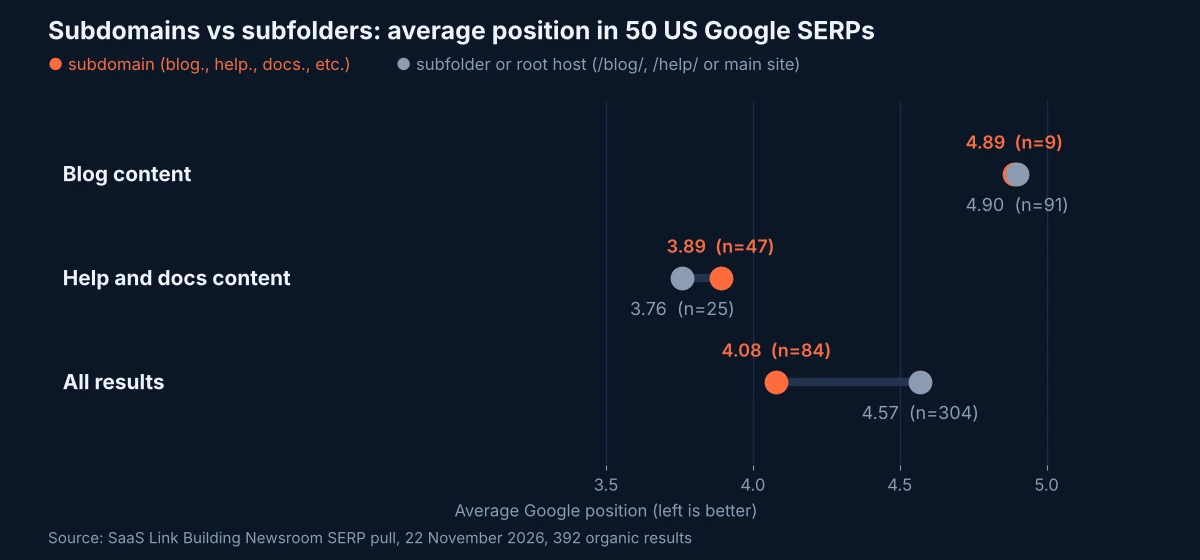
For blog content the two averages are effectively identical (4.89 and 4.90), and the share reaching the top three is close (3 of 9 subdomain blogs, 29 of 91 blog subfolders). For help and documentation content, subfolders were 0.13 positions better on average, a gap far too small to read anything into with 72 results. The blog subdomain sample is small, and that is itself a finding: across all 50 queries, nine blog subdomain results appeared against 91 blog subfolder results, so most companies that rank with blog content have already put it in a folder.
| Query set | Searches | Organic results | On a subdomain | Share | Searches with one or more |
|---|---|---|---|---|---|
| Business and marketing how-to | 20 | 158 | 22 | 13.9% | 16 |
| Developer and technical | 18 | 142 | 33 | 23.2% | 13 |
| Product support how-to | 12 | 92 | 29 | 31.5% | 8 |
| All | 50 | 392 | 84 | 21.4% | 37 |
Source: SaaS Link Building Newsroom SERP pull, 22 November 2026. Subdomain excludes www and m, and excludes four user blogs on shared publishing platforms.
Product support queries leaned hardest on subdomains, which is what you would expect when the best answer is the vendor's own help centre. Of the 15 subdomain results at position one, the hosts included support.google.com (four times), support.microsoft.com, support.apple.com, developer.mozilla.org, docs.docker.com and developers.cloudflare.com. These are strong brands answering questions about their own products, which shows that a subdomain is no barrier to the top spot, though it does not prove a smaller site would see the same result.
Site diversity in practice
We also looked for results pages where one registrable domain took more than the two listings site diversity normally allows. Six of the 50 pages had one.
| Query | Domain | Listings | Hosts used | Positions |
|---|---|---|---|---|
| docker compose environment variables | docker.com | 5 | docs, forums | 1, 2, 4, 7, 9 |
| how to set up a slack workflow | slack.com | 5 | root only | 1, 2, 3, 4, 6 |
| how to merge pdf files | youtube.com | 5 | www only | 2, 3, 5, 7, 8 |
| how to add a signature in outlook | microsoft.com | 4 | learn, support | 1, 2, 3, 4 |
| how to share a google calendar | google.com | 4 | developers, knowledge.workspace, support | 1, 2, 3, 5 |
| redis cache eviction policies | redis.io | 4 | root only | 1, 2, 4, 5 |
Source: SaaS Link Building Newsroom SERP pull, 22 November 2026.
Three of the six cases spread listings across subdomains, and three came from a single host. Google's guide says it may show more than two listings when that is especially relevant, and these are mostly product queries where the brand is the obvious source. Subdomains were not needed to break the two-listing pattern, which argues against the idea that splitting content onto subdomains is a reliable way to take more of a results page. We covered how often one platform exceeds the limit in our earlier site diversity test on YouTube.
Verdict: unproven, with a real caveat
The strong claim, that Google ranks subdomains lower because they are subdomains, is unproven. None of the Google documentation we reviewed says it, Mueller did not say it in the posts above, and in our 50 results pages subdomain content ranked as well as comparable subfolder content and won 15 number one spots.
The narrower claim, that Google can evaluate a subdomain as a separate site, is likely. Google's documentation confirms it for site names and, case by case, for site diversity. Mueller says the choice will affect rankings of new content. The leaked reference points to host-level site chunks in Google's site quality data, though how that is used is unknown. What none of this shows is a fixed direction: separation can mean a new subdomain starts without the main site's support, or it can keep a weak section from being judged with a strong one.
Our test has limits. It is observational, it covers 50 English-language US searches on one day, and the subdomains that rank are mostly large, well-linked help and documentation hubs. It cannot show what would happen if a given blog moved from a subdomain to a folder. That would need before and after data on the same site, which is exactly where most published case studies mix the move with other changes. For a related look at how Google may score whole sites, see our investigation into whether Google scores whole sites.
What this means for SEO teams
- Decide on intent first. Follow Mueller's framing: content that supports the main product and should borrow its reputation belongs in a folder; content that should stand alone, such as a separate community, a regional business or user-generated content, can justify a subdomain.
- Do not migrate for a ranking bump alone. A subdomain to subfolder move means redirects, recrawling and a settling period. Our coverage of what site moves can and cannot fix applies here too. If you do move, change one thing at a time so you can tell what worked.
- Fix the usual subdomain weaknesses. Link to subdomain content from the main navigation and from related pages, keep templates and quality consistent, and make sure the subdomain is in your sitemap setup.
- Use a Domain property in Search Console. It covers every subdomain, so blog and help centre performance sits next to the main site instead of in a separate property nobody checks.
- Do not use subdomains to dodge problems. Google says moving content with a manual action to a subdomain does not resolve it and may be treated as circumvention.
- Treat new subdomains like new sites for planning. If Google decides a subdomain stands apart, it may need time to earn signals of its own, a pattern we examined in our Google sandbox investigation.
Methodology
On 22 November 2026 we ran 50 English-language Google searches with US location settings through a SERP API: 20 business and marketing how-to queries, 18 developer and technical queries, and 12 product support queries, chosen because they are the kinds of searches SaaS blogs and help centres target. We recorded every standard organic result returned on page one, 392 in total, and excluded ads, video carousels, People Also Ask and AI Overviews.
Many result links were wrapped in Google redirect URLs. Where the redirect resolved, we used the destination URL (331 results). Otherwise we took the host and path from the displayed URL breadcrumb (54 results) or, for seven listings with no URL shown, from the source label (YouTube, Reddit and similar, all main hosts). We split each host with the public suffix list. A result counted as a subdomain if its host had any label other than www or m in front of the registrable domain. Four user blogs on shared platforms (three on medium.com and one on hashnode.dev) were counted separately and excluded from the subdomain figures. Blog subfolder results were URLs on a main host with "blog" in the path or breadcrumb; help and documentation subfolders had a first path segment such as help, support, docs, kb, learn or developers. Positions are the organic positions reported in the results. Averages are simple means.
Documentation quotes were checked on the live Google pages and the leaked API reference on the day of publication.
Conclusion
None of the Google documentation we reviewed says subdomains rank worse, and our pull of 392 results found no sign that they do. Subdomains held a fifth of page one and 15 of 50 top spots, and like-for-like blog and documentation content ranked about the same whether it sat on a subdomain or in a folder. What Google does say is that it sometimes treats a subdomain as its own site, and Mueller expects the choice to affect how new content ranks.
The practical answer is the unglamorous one: pick the structure that matches how closely the content belongs to the main site, then put the work into linking, quality and measurement. The URL pattern alone is unlikely to be what holds a page back.
What do you think?
Have you moved a blog or help centre from a subdomain to a subfolder, or the other way, without changing anything else at the same time? If you have the before and after Search Console data, tell us what happened to clicks and positions over the following three months.
Questions and answers
Does Google treat subdomains as separate sites?
Sometimes. Google's site names documentation treats each subdomain as its own site, and its ranking systems guide says site diversity normally groups subdomains with the root domain but sometimes treats them as separate sites.
Do subdomains rank worse than subfolders?
There is no evidence that they do. In 50 US Google searches pulled on 22 November 2026, blog content averaged position 4.89 on subdomains and 4.90 in subfolders, and subdomains held 15 of the 50 number one results.
What has John Mueller said about subdomains?
In November 2022, answering a question about where to place new content, Mueller said content tightly connected to the main site belongs on the main site, while a subdomain suits content meant to stand on its own. He added that he thinks the choice will affect rankings of the new content.
Can moving content to a subdomain fix a manual action?
No. Google's November 2024 site reputation abuse update says moving content to a subdomain or subdirectory of the same domain does not resolve the underlying issue and may be treated as circumvention.
Which Search Console property covers subdomains?
A Domain property includes all subdomains. A URL-prefix property does not include subdomains, so each subdomain needs its own URL-prefix property if you use that type.
More releases
-
Studies
104 of 170 Page-One Black Friday Deal Results Predate 2026; One Dates to 2009
Five days before Black Friday, 61% of Google's page-one organic results for 20 "black friday deals" searches carried a pre-2026 date, and only 7 of the 20 No. 1 results were from this year. Retailer and brand deal hubs, the pages Google's recurring-URL advice targets, were the main exception.
-
Explainers
Mueller Says Site Moves Don't Fix Quality; 22 of 70 Old Domains Send Every URL to One Page
Google's John Mueller says a site move does not improve a site's quality. Our redirect test of 70 old domains found the mechanics often fail too: 22 send every URL to one page, 8 chain more than three redirects, and one blog URL loops forever.
-
Industry news
Google Says Schools Can't Have Search Without AI; Its Web Filter Dropped AI on 20 of 20
New York, Los Angeles and Chicago schools are weighing other search engines after Google said K-12 students cannot get Search without AI Overviews. Google's own Web filter shows the split already exists: in our 20 homework searches it removed the AI Overview from all 20 results pages, along with every People also ask box.
Tell us the site and the goals.
Rankings in Google and visibility in AI answers, from one monthly plan. One call is enough to say which one fits. Email works just as well.