Google Says Schools Can't Have Search Without AI; Its Web Filter Dropped AI on 20 of 20
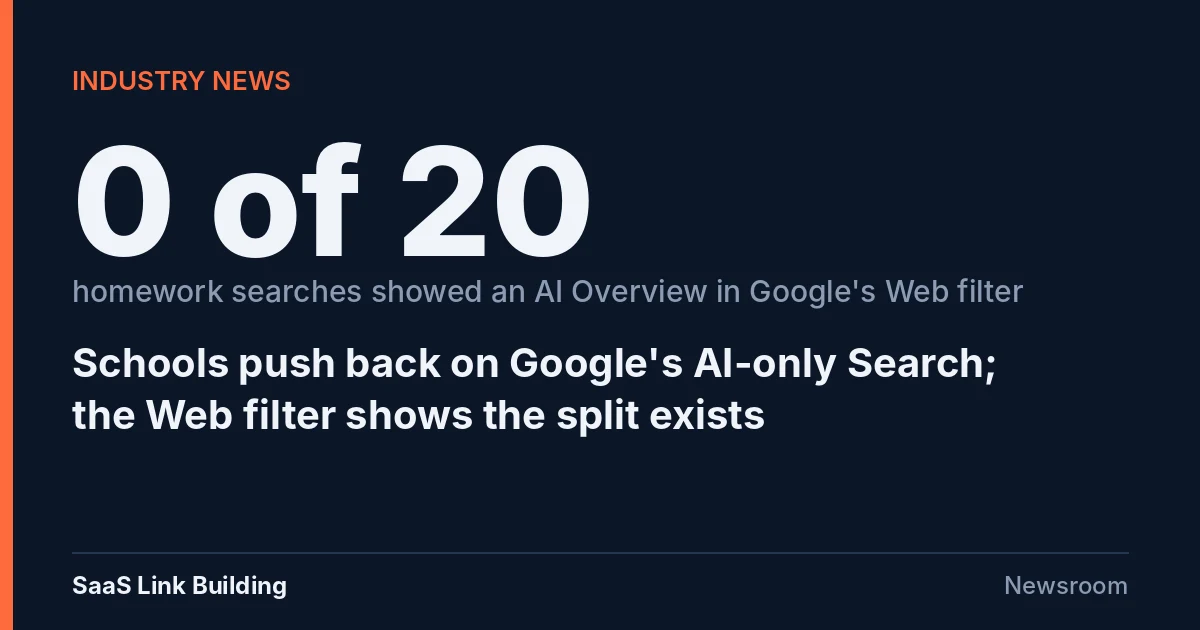
New York, Los Angeles and Chicago schools are weighing other search engines after Google said K-12 students cannot get Search without AI Overviews. Google's own Web filter shows the split already exists: in our 20 homework searches it removed the AI Overview from all 20 results pages, along with every People also ask box.
 Vibhu Dhariwal
Cofounder & CTO, Digital Gratified
- Published
- Section
- Industry news
- Reading time
- 8 minutes
Ras Al Khaimah, United Arab Emirates, .
Three of the four largest US school districts are pushing back on Google's position that schools cannot give students Google Search without AI Overviews. New York City, Los Angeles and Chicago public schools are weighing other search engines, a story first reported by The New York Times on 18 November and followed up by Fortune on 21 November. The dispute traces back to Google's 3 November education announcement, which switches Search and Gemini off for K-12 student accounts until administrators turn them on.
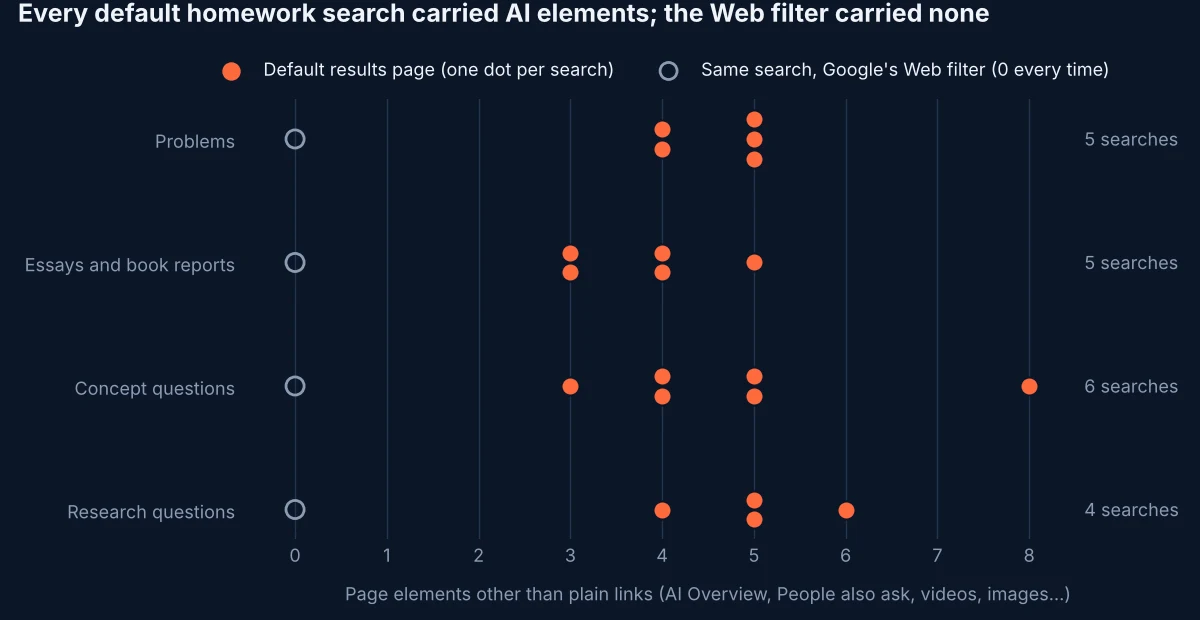
Google already ships a version of its results page without AI Overviews: the Web filter. To measure the gap, we ran 20 typical homework searches on US desktop Google on 22 November, once on the default results page and once with the Web filter. The default page showed an AI Overview on all 20. The Web filter showed one on none, and dropped every other module too.
What changed since Google's announcement
- The original policy. In a 3 November post on Google's Keyword blog, Google said access to Gemini, Gemini Notebook, Gemini in Classroom and Google Search will be "entirely off for K-12 student accounts until school administrators explicitly turn them on." EdSurge reports the change takes effect in early 2027.
- The catch. Schools can enable Search without the standalone Gemini tools, but not Search without AI Overviews or AI Mode, according to Digital Trends. Fortune quotes Chris Phillips, Google's vice president for education, saying "Search and AI are deeply integrated."
- New York City. Schools Chancellor Kamar Samuels said the district would look at other search options if Google does not change its position. Fortune reports the district has about 1.3 million Chromebooks, 500,000 of them assigned to students, and has already disabled the Gemini chatbot and AI Mode on student devices.
- Chicago. Chicago Public Schools told families it wants Google Search without the AI component and will otherwise look at other search tools. About 30 protesters gathered outside Google's West Loop office on 11 November, Fortune reports.
- Los Angeles. LAUSD is blocking generative AI for students on district devices this school year, affecting about 378,000 students, and told EdSurge it has disabled AI Overviews and will keep evaluating. It has not said how.
- Miami-Dade. The fourth of the four largest districts did not respond to Fortune. It offers Gemini for Education to about 100,000 high school students.
Districts are also working around Google. EdSurge reports that Fairfax County Public Schools built a browser plug-in that hides AI answers, a Michigan district's technology director published a free extension that removes AI Overviews and AI Mode, and the web filtering company Securly said on 4 November that its filter blocks both. Digital Trends notes that Bing and DuckDuckGo let schools switch off AI-generated answers. Bing's version is a URL parameter, as we found when we examined Bing's AI-off extension and its noAI=1 flag.
What Google's own help page says
Google's AI Overviews help page states that the features cannot be turned off and describes AI Overviews as a core part of Search. The same page points users to the Web filter, which it says shows only text-based links, without features like AI Overviews. The page does not mention school, Workspace or K-12 accounts, and Google has not said whether administrators could make the Web filter the default for students.
Our check: the default page versus the Web filter
We used 20 searches of the kind students type: 5 pasted maths and science problems, 5 essay and book report requests, 6 concept questions and 4 research questions.
| Query type | AI Overview, default page | AI Overview, Web filter | People also ask, default | Elements beyond links, default (avg) | Organic links, default vs Web filter |
|---|---|---|---|---|---|
| Problems (5) | 5 of 5 | 0 of 5 | 5 of 5 | 4.6 | 41 vs 50 |
| Essays and book reports (5) | 5 of 5 | 0 of 5 | 5 of 5 | 3.8 | 40 vs 50 |
| Concept questions (6) | 6 of 6 | 0 of 6 | 6 of 6 | 4.8 | 43 vs 60 |
| Research questions (4) | 4 of 4 | 0 of 4 | 3 of 4 | 5.0 | 25 vs 40 |
| All 20 | 20 of 20 | 0 of 20 | 19 of 20 | 4.55 | 149 vs 200 |
Three findings stand out.
The split already exists. Every default page carried an AI Overview, and every Web filter page returned ten plain organic links with nothing else: no AI Overview, no People also ask, no videos, no images, no answer box. However closely Google has woven AI into Search, the results page can be served without the AI layer today, to anyone who clicks the filter.
AI reaches past the overview. People also ask boxes appeared on 19 of the 20 default pages, with 76 questions between them. Our SERP data labelled the expanded answer to all 76 as AI Overview content. A district that strips the top AI Overview with an extension but leaves these boxes in place would still show students AI-written answers further down the page.
Problems load their overviews separately. Six of the 20 overviews, including four of the five pasted problems, arrived in a second, deferred request rather than with the page. That matters for anyone measuring AI Overview exposure with a crawler: a single fetch can undercount overviews on exactly the queries schools worry about most.
Our check covers signed-out searches, not school-managed student accounts, which we cannot test. It shows what the two views of Google look like, not what a student will see after the 2027 change.
Context: why the Web filter matters to the antitrust argument
Fortune reports that former FTC chair Lina Khan said Google is using its search monopoly to push schools into AI, and that Fordham Law professor Zephyr Teachout called Google's claim that it cannot separate AI Overviews from Search not credible, raising possible tying concerns. Those are their arguments, not findings. Our data speaks to one narrow factual point: a results page without AI Overviews is a working Google product today, one Google's help page offers to every user.
This is the second development since our 3 November report on Google switching off Search for K-12 accounts, when AI Overviews appeared on all 40 homework searches we ran and answered every pasted problem we could load in full.
What this means for SEO teams
- Prepare for school traffic to move engines. LAUSD's technology chief told Digital Trends the district could change its default search engine "literally overnight." If large districts move student Chromebooks to Bing or DuckDuckGo in early 2027, education publishers will see it in referrals first. Verify your site in Bing Webmaster Tools now and check that Bingbot is not blocked.
- Baseline education traffic by device and hour. Split Search Console data by query type and watch weekday school-hour sessions from Chromebooks in analytics, so a shift is visible when it comes.
- Treat People also ask as AI territory. In our sample, every expanded People also ask answer came from AI Overview content. Pages built to win those boxes are now feeding AI answers, not classic featured excerpts.
- Measure the Web filter view too. If some schools steer students to the Web filter or to extensions that hide AI, the plain ten-link page becomes the one that counts for that audience. Track your positions in both views for your core education queries.
- Do not assume one fetch shows the overview. Deferred AI Overviews on problem queries mean exposure audits need a second request. Homework queries are also unusually saturated: 20 of 20 here, against 77% across all query types in our 150-search AI Overviews study.
Methodology
We collected 20 Google results pages in the default view and 20 in the Web filter view (google.com, United States, English, desktop, location set to Chicago, Illinois) with a SERP API between 01:18 and 01:20 UTC on 22 November 2026, signed out. The query set had 5 pasted problems (algebra, calculus, kinematics, a chemical equation and pH), 5 essay and book report requests, 6 concept questions and 4 research questions. For each page we recorded whether an AI Overview was present (inline or as a deferred block), the number of organic results, and every other page module the SERP data returned, such as People also ask, inline videos, images, answer boxes and related searches. People also ask answers were counted as AI Overview content when the SERP data typed them that way. We did not compare which sites ranked in the two views, because the default pages hold fewer organic slots and several modules that also contain links.
Conclusion
Google's line to schools is that Search and AI cannot be separated. New York, Los Angeles and Chicago are testing that line by preparing to leave, and Google's own Web filter shows a results page without AI Overviews already exists: it removed the overview, and every other module, on all 20 homework searches we ran.
What remains unknown is whether Google will let districts make that view the default for student accounts before the early 2027 switch. For education publishers, the safe course is to prepare for students arriving from more than one search engine, and from more than one version of Google.
Questions and answers
Can schools turn off AI Overviews in Google Search for students?
Not as a separate setting. Google's 3 November announcement makes Search and Gemini off by default for K-12 student accounts until administrators turn them on, but schools that enable Search get AI Overviews and AI Mode with it, according to reporting by Digital Trends and Fortune. Google's AI Overviews help page says the features cannot be turned off.
Which school districts are pushing back on Google?
New York City, Los Angeles and Chicago public schools are weighing other search engines, as first reported by The New York Times on 18 November. Fortune reports that Miami-Dade, the fourth of the four largest US districts, did not respond to questions.
Does Google's Web filter remove AI Overviews?
Yes. Google's help page says the Web filter shows only text-based links without features like AI Overviews. In our check of 20 homework searches on 22 November 2026, the Web filter showed no AI Overview on any of them, against 20 of 20 on the default results page.
When does Google's K-12 change take effect?
EdSurge and Fortune report that the default-off controls for K-12 student accounts start in early 2027. Google said on 3 November that it will share specifics with schools in the coming months, ahead of the changes rolling out.
More releases
-
Studies
104 of 170 Page-One Black Friday Deal Results Predate 2026; One Dates to 2009
Five days before Black Friday, 61% of Google's page-one organic results for 20 "black friday deals" searches carried a pre-2026 date, and only 7 of the 20 No. 1 results were from this year. Retailer and brand deal hubs, the pages Google's recurring-URL advice targets, were the main exception.
-
Studies
Does Google Rank Subdomains Lower? They Held 15 of 50 No. 1 Spots in Our Test
Google's documentation says it sometimes treats a subdomain as a separate site, and John Mueller says the choice affects how new content ranks. But in 50 US Google searches pulled on 22 November 2026, subdomain results ranked as well as subfolders and took 15 of 50 top spots. Our verdict: unproven.
-
Explainers
Mueller Says Site Moves Don't Fix Quality; 22 of 70 Old Domains Send Every URL to One Page
Google's John Mueller says a site move does not improve a site's quality. Our redirect test of 70 old domains found the mechanics often fail too: 22 send every URL to one page, 8 chain more than three redirects, and one blog URL loops forever.
Tell us the site and the goals.
Rankings in Google and visibility in AI answers, from one monthly plan. One call is enough to say which one fits. Email works just as well.