Google Will Switch Off Search for K-12 Students; AI Overviews Solved 8 of 8 Test Problems
Google will turn off Search and Gemini for K-12 student accounts until schools opt in, and is piloting a Guided Learning mode that coaches homework instead of answering it. In our 40 homework searches, AI Overviews appeared on every one and gave the final answer to all 8 problems that fully loaded.
 Vibhu Dhariwal
Cofounder & CTO, Digital Gratified
- Published
- Section
- Studies
- Reading time
- 8 minutes
Ras Al Khaimah, United Arab Emirates, .
Google will switch off Search, Gemini, Gemini Notebook and Gemini in Classroom for K-12 student accounts until a school administrator turns them back on, and it is building a Guided Learning mode into Search that walks students through homework instead of handing them the answer. Chris Phillips, Google's VP and General Manager of Education, announced both changes on 3 November in a post on Google's Keyword blog. Guided Learning in Search starts as a pilot in select US schools later this month.
To see what students get from Google today, before either change lands, we ran 40 typical homework searches on US desktop Google on 3 November: 16 pasted maths, physics and chemistry problems, 12 essay and book report requests, and 12 "explain this concept" questions. An AI Overview appeared on every one. On the eight pasted problems where the full overview loaded, Google stated the correct final answer in all eight, usually in the first sentence.
What Google announced
- Default off for students. Access to Gemini, Gemini Notebook, Gemini in Classroom and Google Search will be "entirely off for K-12 student accounts" until administrators explicitly enable them, according to the announcement. Google says it will share specifics with schools in the coming months, before the change rolls out. It gave no date.
- Guided Learning in Search. When Google's systems detect that a student account is looking for certain kinds of homework help, Search will coach the student step by step. Google's examples are a pasted physics problem and a request for help writing a book report.
- Pilot first. The Search pilot begins in select US schools later in November, with expansion to other districts planned over the following months.
- Classroom now. Guided Learning is available globally in Google Classroom from 3 November, tied to teacher-assigned activities.
Google published a 29-page AI in Education report alongside the post. It cites research showing that nearly 40% of US middle and high school students worry they generate fewer of their own ideas when using AI, and a randomized controlled trial in which Gemini's Guided Learning produced maths gains equivalent to one to two years of typical progress.
The announcement does not say how Search will identify a student account outside a school's Google Workspace domain, whether Guided Learning replaces AI Overviews for those accounts, or whether it changes which web results appear. Google has not stated any change for adults or for students searching while signed out.
Our test: what a homework search returns today
We grouped results by query type and by the kind of site Google showed. Organic counts cover page-one web results; citation counts cover the source links inside the AI Overviews that loaded their reference lists.
| What we counted | Pasted problems (16) | Essays and book reports (12) | Concept questions (12) |
|---|---|---|---|
| Searches with an AI Overview | 16 of 16 | 12 of 12 | 12 of 12 |
| Google's own solver or formula box | 6 of 16 | 0 of 12 | 1 of 12 |
| Searches with a Facebook post in the top 10 | 11 of 16 | 3 of 12 | 0 of 12 |
| Top organic source type | Answer and solver sites, 42.5% | Answer and essay sites, 33.7% | Schools, government and nonprofits, 35.3% |
| Schools, universities, government and nonprofits in organic results | 3.1% | 9.5% | 35.3% |
| Top AI Overview citation type | Only 9 citations in total | Study guides, 42.0% of 69 | Video, 34.5% of 116 |
Three patterns stand out.
Problems get answers, with few sources. On all 16 pasted problems the AI Overview loaded in a separate request, and we were able to retrieve the full text for 8 of them before the request expired. All eight gave the correct final answer: x = 5, x = 2 or 3, 5 m/s², 3 seconds, 3x² + 2, 2 moles, x = 6 and y = 4, and 120 km/h. Seven of the eight stated it before showing any working. Six of the eight carried no source links at all. Every one ended by offering to keep going, for example by solving another problem or converting the units. That is close to the reverse of the effortful, step-by-step problem solving Google says Guided Learning is designed to encourage.
Answer sites rank, but AI Overviews rarely cite them. Homework answer, essay bank and solver sites held 29.6% of all organic results across the 40 searches, the largest group. Inside the AI Overviews they supplied 6.2% of citations. Video platforms went the other way: 12.1% of organic results, but 34.0% of citations, almost all of them YouTube.
Social posts fill the problem SERPs. Public Facebook group posts appeared in the top 10 for 11 of the 16 pasted problems and ranked first for four of them. Q&A sites such as Quora and Brainly were also common. Schools, universities and education nonprofits supplied just 4 of the 127 organic results on those searches.
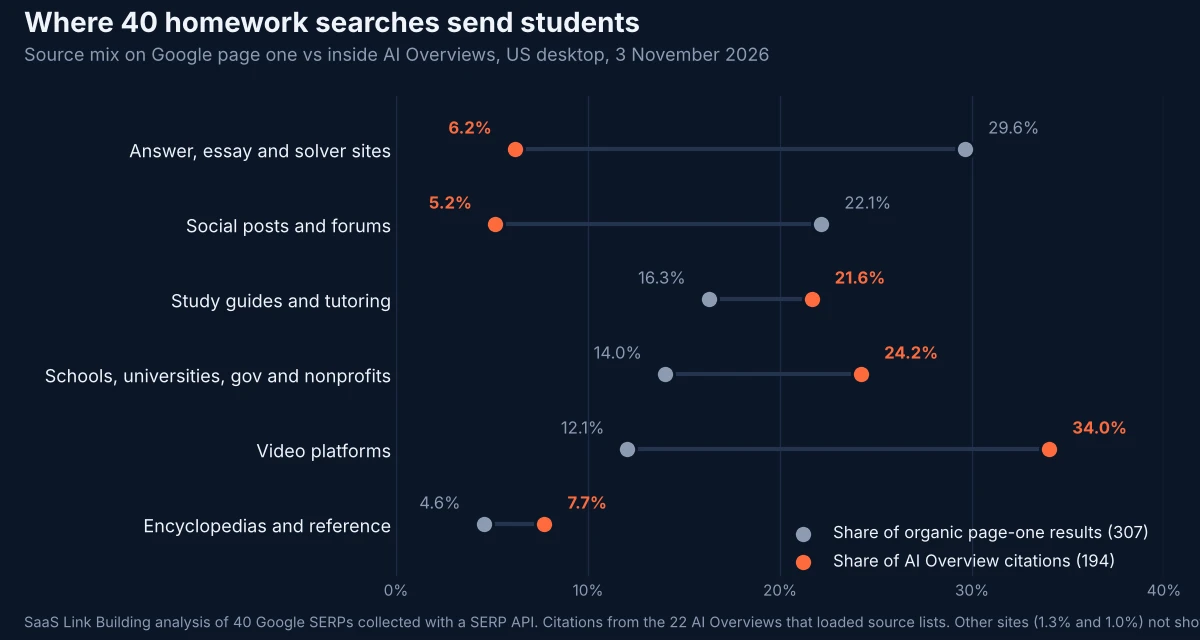
The YouTube share matches what we found in an earlier, broader sample: in our 30-query YouTube citation study, YouTube supplied 34% of 271 AI Overview citations. The 40-of-40 overview rate is also well above the 77% we measured across all query types in our 150-search AI Overviews study.
Who could be affected, and what is still unknown
Google has not said how many students use school-managed accounts for homework, so the size of the effect cannot be measured yet. What follows is our reading of the announcement against today's results pages, and it is speculation until Google publishes details.
- Default-off access. If a district does not enable Search, a student signed in to a K-12 account would not reach Google Search through that account at all. Education publishers that depend on school Chromebook traffic would see that in referrals only after rollout, and only if districts leave the switch off.
- Answer-first sites. Pages built around a worked final answer are the type Guided Learning is designed to hold back. If Search coaches student accounts instead of showing an answer, those pages may matter less to that audience. Google has not said whether organic results change for those accounts.
- Explainer pages and video. Concept explanations from schools, nonprofits and YouTube already dominate the overview citations for "explain this" queries. Nothing in the announcement suggests that changes.
What this means for SEO teams
- Segment education traffic now. If you run an education, test prep or study site, set a baseline today. Split Search Console performance by query type (problem, essay, concept) and track school-hour traffic in analytics, so you can see the effect when districts start making choices.
- Watch the pilot districts. Google has not named them. Once it does, compare referral trends from those regions with others.
- Invest in the explanation, not just the answer. Pages that teach the method with diagrams, practice questions and video are what AI Overviews already cite for concept queries in our sample. A page that only states a final answer competes with an overview that does the same thing in its first sentence.
- Check how your snippets are shown. AI Overviews often rewrite the text under a citation. Our citation snippet study shows how often that happens and what to look for.
Methodology
We collected 40 Google results pages (google.com, United States, English, desktop) with a SERP API between 17:19 and 17:26 UTC on 3 November 2026. The query set had 16 pasted problems with known answers (algebra, calculus, kinematics, forces, stoichiometry and pH), 12 essay, book report and literature study requests, and 12 concept questions in science, history, maths and economics. We counted page-one organic web results (307 in total) and the source links inside AI Overviews. All 40 pages showed an AI Overview. For 20 of them, including all 16 problems, the overview loaded in a second request that expires within minutes; we re-ran those problem queries and retrieved full overviews for 8 of the 16. Citation shares therefore cover the 22 overviews that returned reference lists (194 links). We classed each domain into one of seven types by hand: answer, essay and solver sites; social posts and forums; study guides and tutoring; schools, universities, government and nonprofits; video platforms; encyclopedias and reference; and other. A final answer counted as correct only when it matched the known solution.
Conclusion
Google is about to change the default for K-12 school accounts: Search and Gemini off until a school says otherwise, and a homework mode that coaches students instead of going straight to the answer. Today's results pages show the behaviour it says it wants to change. AI Overviews appeared on all 40 homework searches we ran and answered every pasted problem we could load in full, usually before any working.
For publishers, the open questions are when the change rolls out, how many districts enable Search, and whether Guided Learning changes which pages a student sees. Until Google answers them, the sites best placed are the ones that already teach the method rather than just the result.
Questions and answers
Is Google turning off Search for students?
For K-12 student accounts, yes. Google says access to Google Search, Gemini, Gemini Notebook and Gemini in Classroom will be entirely off for K-12 student accounts until school administrators explicitly turn them on. It will share specifics with schools in the coming months, before the change rolls out, and has not given a date.
What is Guided Learning in Google Search?
Guided Learning is a mode for student accounts that walks a student through a homework problem or topic step by step instead of giving the answer directly, according to Google's 3 November announcement. Google's examples are a pasted physics problem and a request for help writing a book report.
When does Guided Learning come to Search?
Google says a pilot starts in select US schools later in November 2026, with expansion to other school districts in the following months. Guided Learning became available globally in Google Classroom on 3 November.
Do AI Overviews answer homework questions today?
In our check of 40 US desktop homework searches on 3 November 2026, an AI Overview appeared on all 40. For the 8 pasted problems whose full overview loaded, all 8 gave the correct final answer, and 7 stated it before showing any working.
Which sites do AI Overviews cite for homework searches?
Across the 22 overviews in our sample that returned source lists, video platforms (almost all YouTube) supplied 34.0% of 194 citations, schools, universities, government and nonprofit sites 24.2%, and study guides and tutoring sites 21.6%. Homework answer, essay and solver sites held 29.6% of organic results but only 6.2% of citations.
More releases
-
Industry news
Google Moved Brand AI Overviews to the Right Column on 22 of 51 Brand Searches We Checked
Google is now showing AI Overviews for brand-name searches in the desktop right column beside the knowledge panel. In our 3 November pull of 60 US brand searches, 51 had an AI Overview and 22 of those sat in the right column, mostly for retail, restaurant and travel brands rather than software.
-
Studies
Do Exact-Match Domains Still Rank? Only 3 of 28 Multi-Word EMDs Made Google's Top 10
Exact-match domains topped Google for 11 of 80 keywords in our 3 November test, but the name did not do the work: no live exact-match .com with under 1,000 referring domains ranked, and only 3 of 28 multi-word EMDs reached the top 10. Google's leaked documents list a demotion, not a boost.
-
Studies
Google Corrected All 30 Typos We Tested; AI Overviews Kept the Same Sources in 20 of 24
Google returned a spelling correction for all 30 misspelled searches in our 3 November test and showed corrected results for 29. Where both versions cited sources, AI Overviews cited identical domains in 20 of 24 pairs, while organic results shifted about as much as rerunning the correct query.
Tell us the site and the goals.
Rankings in Google and visibility in AI answers, from one monthly plan. One call is enough to say which one fits. Email works just as well.