Google Moved Brand AI Overviews to the Right Column on 22 of 51 Brand Searches We Checked
Google is now showing AI Overviews for brand-name searches in the desktop right column beside the knowledge panel. In our 3 November pull of 60 US brand searches, 51 had an AI Overview and 22 of those sat in the right column, mostly for retail, restaurant and travel brands rather than software.
 Vibhu Dhariwal
Cofounder & CTO, Digital Gratified
- Published
- Section
- Industry news
- Reading time
- 8 minutes
Ras Al Khaimah, United Arab Emirates, .
Google has started showing AI Overviews for brand-name searches in the right-hand column of desktop results, the space usually held by a brand's knowledge panel. Practitioners on X flagged the layout on 31 October, and Search Engine Roundtable reported it on 2 November with screenshots for searches such as Apple, Zillow and Coke. Google has not commented on the change, and the Google Search Status Dashboard lists no new ranking update since the September spam update finished on 8 October.
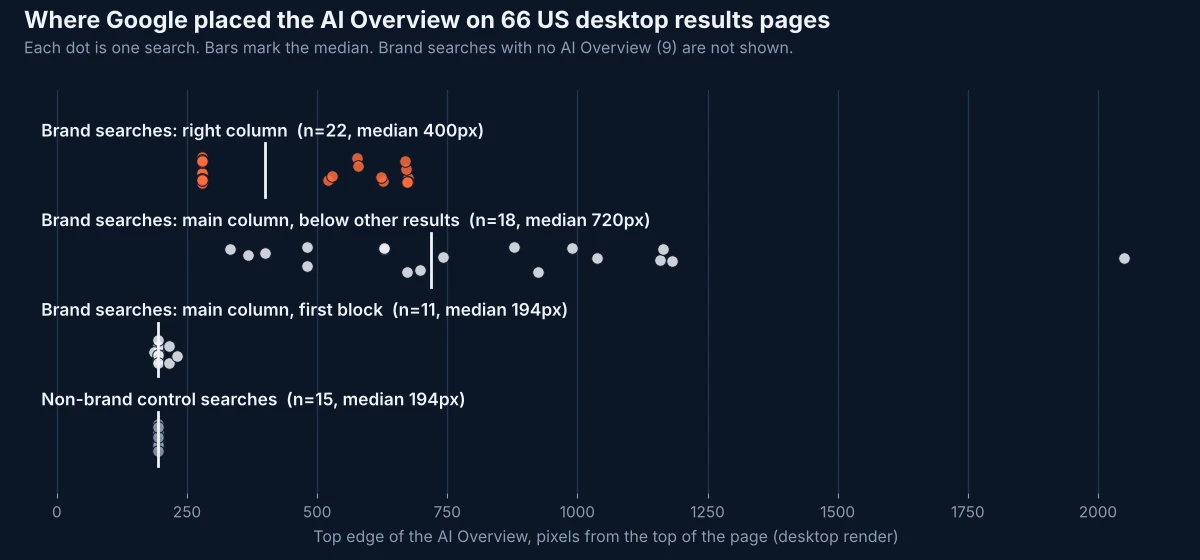
Screenshots show that the layout exists, not how common it is. So on 3 November we pulled 75 live US desktop results pages: 60 one-word or two-word brand searches across seven sectors, plus 15 non-brand informational searches as a control. We recorded where each AI Overview was drawn on the page. On the brand searches with an AI Overview, Google put it in the right column 22 times out of 51.
Key findings
- 51 of 60 brand searches (85%) showed an AI Overview. Of those 51, 22 (43%) sat in the right column, 18 (35%) sat in the main column below other results, and 11 (22%) were the first block in the main column.
- The right column needs a knowledge panel. All 22 right-column overviews appeared on pages where a knowledge panel was detected in the same column, starting 101 to 496 pixels below the top of that panel. None of the 16 brand searches without a knowledge panel got a right-column overview.
- Right-column overviews were short. Every one measured 128 pixels tall in the render, against 384 to 400 pixels for every main-column overview on a brand search.
- Consumer brands moved; software brands mostly did not. All 4 restaurant chains and 9 of 14 retail and consumer goods brands got the right-column version. Only 2 of 16 software and SaaS brands did.
- The control group never moved. All 15 non-brand searches showed an AI Overview as the first block of the main column, and none showed a knowledge panel.
- Brand sites lost some citations. The brand's own domain was among the cited sources in 16 of 22 right-column overviews, against 28 of 29 main-column overviews on brand searches.
Where the AI Overview landed, by sector
| Sector (brands checked) | Right column | Main column, below other results | Main column, first block | No AI Overview |
|---|---|---|---|---|
| Retail and consumer goods (14) | 9 | 2 | 1 | 2 |
| Restaurants (4) | 4 | 0 | 0 | 0 |
| Travel and hotels (6) | 3 | 0 | 1 | 2 |
| Tech, apps and platforms (13) | 3 | 8 | 1 | 1 |
| Software and SaaS (16) | 2 | 7 | 7 | 0 |
| Car makers (4) | 1 | 0 | 1 | 2 |
| Banks and payments (3) | 0 | 1 | 0 | 2 |
| All brands (60) | 22 | 18 | 11 | 9 |
Source: SaaS Link Building analysis of 60 US English desktop Google results pages collected on 3 November 2026. Sector labels are ours.
The right-column group reads like a list of household consumer names: Walmart, Target, Costco, Home Depot, IKEA, McDonald's, Starbucks, Chipotle, Coca-Cola, Airbnb, Delta and Apple among them. Software brands split almost evenly between an overview at the top of the page (Shopify, Stripe, HubSpot, Figma, Dropbox, Zendesk, Atlassian) and one pushed below other results (Salesforce, Slack, Zoom, Notion, Canva, Asana, Intercom). Mailchimp and Grammarly were the only software brands in the right column.
Six of the nine brand searches with no AI Overview at all were banks, car makers or hotel chains: Chase Bank, Wells Fargo, Toyota, Honda, Marriott and Hilton. Uber, Sephora and Adidas were the other three.
What changed since September
This is the second layout shift for brand overviews in five weeks. On 30 September, Search Engine Roundtable reported that Google had begun showing AI Overviews on a large share of brand-name searches, with most of them placed below the brand's own homepage result or further down the page rather than at the top. Our sample suggests that pattern has partly given way: 22 of the 51 overviews we found had left the main column entirely, while 18 still sat below other results there.
The main-column overviews that were not first on the page had a median of three blocks above them (range one to six), such as the brand's homepage and its social media profiles. Their top edge sat at a median of 720 pixels down the page, compared with 194 pixels for the control searches. Placement, like coverage, depends on the kind of query: our October test of AI Overviews across 150 searches found coverage varied sharply by query type.
Google's guide to AI features in Search says AI Overviews were designed to appear on queries where they add benefit beyond the standard results, and that no special optimisation is needed to appear in them. It says nothing about page placement. Google's knowledge panel help page describes panels as automatically generated snapshots for entities in the Knowledge Graph, which fits our finding that the right-column overview only appeared where Google already recognised the brand as an entity with a panel.
What the sources tell us
The right-column overviews leaned on reference sites. Wikipedia was cited in 17 of the 22 (77%), against 18 of 29 main-column brand overviews (62%). YouTube went the other way: it appeared in 10 of 22 right-column overviews and 25 of 29 main-column ones. That fits our earlier finding that YouTube is a near-constant AI Overview source on general searches, and suggests the shorter panel format draws on a narrower, encyclopedic set of sources. Five of the six right-column overviews that skipped the brand's own site cited Wikipedia, business directories, social profiles or news sites instead; the sixth (Zillow) returned no parsed sources.
The 128-pixel height deserves caution. It was identical across all 22 right-column cases, which suggests a fixed, collapsed preview that expands on click rather than a full overview. That is our reading of the render, not something Google has described.
What this means for SEO teams
- Search your own brand on desktop, logged out, in each market you serve. Record whether the overview sits in the right column, above your homepage result or below it. The placement in our sample depended on the brand, not just the query type.
- Check what the overview says and cites. In 6 of 22 right-column cases the brand's own site was not cited at all. If the summary relies on directories or outdated profiles, fix those sources first: Wikipedia, LinkedIn, Facebook and company investor or about pages appeared repeatedly in the citations we collected.
- Keep your knowledge panel accurate. Every right-column overview sat inside or beside a knowledge panel. Google's help page says entities featured in a panel can send it direct feedback, so use that route if facts about your company are wrong.
- Watch branded click-through in Search Console. A right-column overview leaves the main column to your homepage and site links, which may help branded clicks; a main-column overview above your homepage may hurt them. Compare branded query CTR for the weeks before and after 31 October before drawing conclusions.
- Do not read this as a ranking change. Nothing in our data shows brand homepages losing position, and Google has logged no update. This is a layout change in how the AI Overview is shown. Our test of whether Google favours big brands covers the ranking side.
Methodology
On 3 November 2026, between about 13:20 and 13:21 UTC, we collected 75 Google results pages through a SERP data API, using US location, English language and a desktop device, with the AI Overview loaded and the on-page coordinates of every result block recorded. The sample was 60 bare brand-name searches (for example "walmart", "hubspot", "delta airlines") chosen across seven sectors, and 15 non-brand informational searches (for example "what is inflation", "how to boil eggs") as a control. Each page was collected once.
We classed an AI Overview as right column if its left edge sat at 900 pixels or more from the left of the page. Main-column overviews were classed as the first block if no other main-column result started above them, and otherwise as below other results. Cited sources were taken from the overview's reference list; we counted a brand's own domain as cited if any reference domain contained the brand name. Sector labels are our own. A single collection from one location and one device is a snapshot: Google tests layouts constantly, and results for the same brand can differ by user, location and time.
Conclusion
Google's right-column AI Overview for brand searches is real and already common in the US: it appeared on 22 of the 51 brand searches in our sample that showed an overview, always alongside a knowledge panel and always as a short, fixed-height block. It was concentrated among consumer, restaurant and travel brands, while most software brands still saw the overview in the main column, either at the top or below their own results.
Google has not said whether this is a test or a permanent design. For brand owners, the practical work is the same either way: know where your overview appears, check what it says, and make sure the sources it relies on, from Wikipedia to your knowledge panel, are accurate.
Questions and answers
Has Google confirmed the right-column AI Overview for brand searches?
No. Google has not commented on the layout, and its Search Status Dashboard lists no new ranking update since the September 2026 spam update finished on 8 October. Practitioners first flagged the layout on X on 31 October.
How common is the right-column AI Overview on brand searches?
In our sample of 60 US English desktop brand searches collected on 3 November 2026, 51 showed an AI Overview and 22 of those (43%) were in the right column. 18 sat in the main column below other results and 11 were the first block on the page.
Which brands are most likely to get the right-column version?
In our sample, all 4 restaurant chains and 9 of 14 retail and consumer goods brands got it, against 2 of 16 software and SaaS brands. Every right-column overview appeared on a page with a knowledge panel, and none of the 16 brand searches without a knowledge panel got one.
Does the right-column AI Overview cite the brand's own website?
Less often than main-column versions in our sample: the brand's own domain was cited in 16 of 22 right-column overviews, against 28 of 29 main-column overviews on brand searches. Wikipedia was cited in 17 of the 22 right-column overviews.
Did non-brand searches change too?
Not in our control group. All 15 non-brand informational searches we checked showed the AI Overview as the first block of the main column, with no knowledge panel.
More releases
-
Studies
Google Will Switch Off Search for K-12 Students; AI Overviews Solved 8 of 8 Test Problems
Google will turn off Search and Gemini for K-12 student accounts until schools opt in, and is piloting a Guided Learning mode that coaches homework instead of answering it. In our 40 homework searches, AI Overviews appeared on every one and gave the final answer to all 8 problems that fully loaded.
-
Studies
Do Exact-Match Domains Still Rank? Only 3 of 28 Multi-Word EMDs Made Google's Top 10
Exact-match domains topped Google for 11 of 80 keywords in our 3 November test, but the name did not do the work: no live exact-match .com with under 1,000 referring domains ranked, and only 3 of 28 multi-word EMDs reached the top 10. Google's leaked documents list a demotion, not a boost.
-
Studies
Google Corrected All 30 Typos We Tested; AI Overviews Kept the Same Sources in 20 of 24
Google returned a spelling correction for all 30 misspelled searches in our 3 November test and showed corrected results for 29. Where both versions cited sources, AI Overviews cited identical domains in 20 of 24 pairs, while organic results shifted about as much as rerunning the correct query.
Tell us the site and the goals.
Rankings in Google and visibility in AI answers, from one monthly plan. One call is enough to say which one fits. Email works just as well.