Google AI Overviews Named 57 Promo Codes in 12 of 20 Brand Coupon Searches
Google's AI Overviews appeared on all 20 US "[brand] promo code" searches we ran on 20 November, and 12 of them listed specific codes, 57 in total. Every overview that named codes also cited a coupon or deal site, while brand pages took a larger share of citations than of organic listings.
 Vibhu Dhariwal
Cofounder & CTO, Digital Gratified
- Published
- Section
- Studies
- Reading time
- 8 minutes
Ras Al Khaimah, United Arab Emirates, .
Google's AI Overviews now answer "promo code" searches by listing the codes themselves. In a check we ran on 20 November 2026, an AI Overview appeared on all 20 US Google searches for "[brand] promo code" across software, retail, food delivery and travel brands, and 12 of those 20 overviews named specific codes, 57 in total. The test follows reports on 19 and 20 November that Google, ChatGPT and other AI engines have started handing out coupon codes directly, a format that could keep shoppers from ever reaching the coupon and affiliate sites that publish those codes.
The behaviour was first flagged on X by SEO consultants Glenn Gabe and Metehan Yesilyurt and written up by Search Engine Roundtable on 20 November. Those reports were built on a handful of hosting queries and screenshots. We wanted to know how widespread the pattern is in Google Search, which kinds of brands it hits, and whose pages Google cites when it does it.
Key findings
- 20 of 20 searches returned an AI Overview, so coupon intent is now firmly inside Google's AI answer layer.
- 12 of 20 overviews named at least one specific promo code, and together they listed 57 codes. DoorDash (10 codes), Hostinger (8) and Uber Eats (7) drew the longest lists.
- Food delivery was the most exposed vertical: 4 of 5 brands had codes in the overview (21 codes). Retail was the least: 2 of 5 brands (6 codes).
- Every one of the 12 overviews that listed codes also cited at least one coupon or deal site, so the codes are drawn at least partly from the same sites that may now lose the click.
- 19 of 20 overviews cited the brand's own site. The exception was Grammarly, whose overview cited nine third-party pages and no Grammarly page.
- Reddit was cited in 9 of the 20 overviews, and three codes in the Hostinger and NordVPN answers had "reddit" in the code string itself.
Who gets cited when Google hands out the code
We classified each of the 149 references in the 20 overviews, and each of the 177 organic listings on the same page-one results, into five groups: the brand's own pages, coupon and deal sites (including cashback and student discount programmes), publishers, social and video platforms, and other sites. The comparison shows where AI Overviews shift visibility relative to the classic blue links.
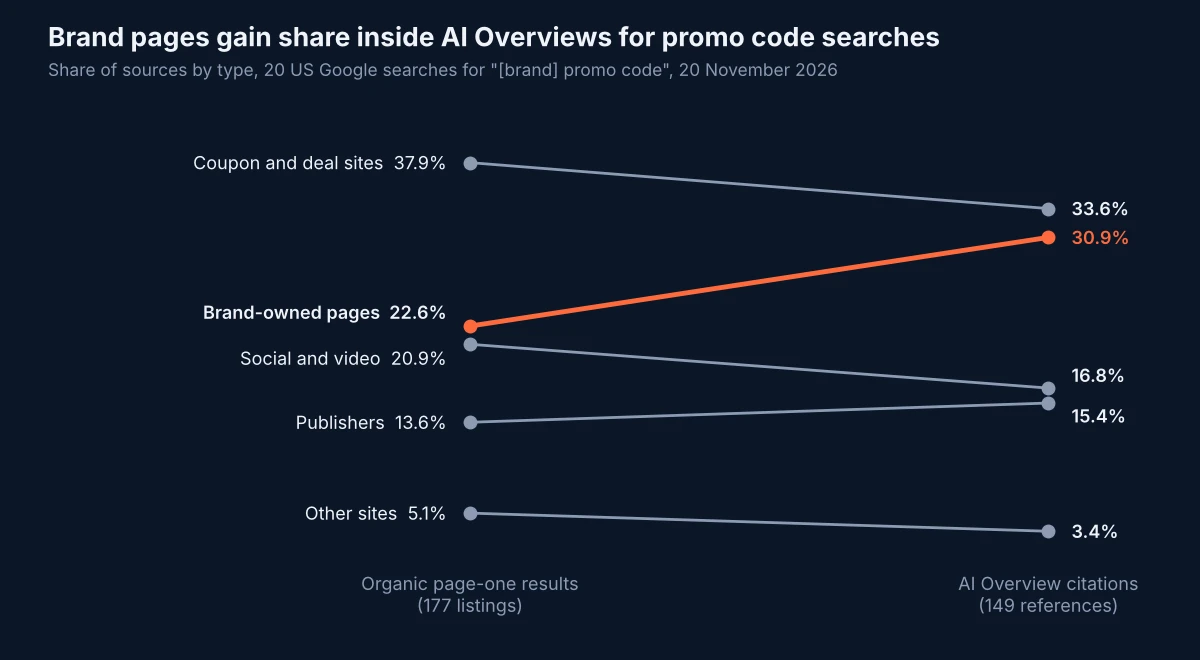
Coupon and deal sites remain the largest single source group inside the overviews, but their share is lower than on the organic page, while brand-owned pages gain roughly eight percentage points. Publishers' share is almost unchanged, and social and video platforms lose ground slightly. In plain terms, the overview leans more on the brand's own promotions pages than the organic results do, then fills the gaps with codes it has found on coupon sites, Reddit threads and video descriptions.
Brand by brand
| Brand | Vertical | Codes named in AI Overview | References cited | Brand-owned references | Coupon or deal site references |
|---|---|---|---|---|---|
| DoorDash | Food delivery | 10 | 12 | 6 | 2 |
| Hostinger | Software | 8 | 5 | 1 | 1 |
| Uber Eats | Food delivery | 7 | 7 | 2 | 1 |
| Priceline | Travel | 6 | 7 | 1 | 2 |
| Hertz | Travel | 6 | 7 | 3 | 3 |
| NordVPN | Software | 4 | 8 | 3 | 2 |
| Best Buy | Retail | 4 | 6 | 1 | 3 |
| Squarespace | Software | 3 | 6 | 3 | 1 |
| Canva | Software | 3 | 9 | 2 | 5 |
| Domino's | Food delivery | 3 | 8 | 2 | 4 |
| Sephora | Retail | 2 | 10 | 3 | 3 |
| HelloFresh | Food delivery | 1 | 8 | 3 | 1 |
| Nike | Retail | 0 | 7 | 4 | 2 |
| Adidas | Retail | 0 | 8 | 2 | 4 |
| Macy's | Retail | 0 | 6 | 3 | 3 |
| Bluehost | Software | 0 | 6 | 1 | 0 |
| Grammarly | Software | 0 | 9 | 0 | 4 |
| Instacart | Food delivery | 0 | 7 | 4 | 3 |
| Expedia | Travel | 0 | 7 | 1 | 3 |
| Hotels.com | Travel | 0 | 6 | 1 | 3 |
Codes counted are distinct code strings presented as usable. Expired codes the overview explicitly marked as ended (Adidas, Sephora) are excluded. Source: SaaS Link Building analysis of live Google results, 20 November 2026.
What the overviews actually said
The 8 overviews that named no code were not empty. Most steered users to sign-up offers, student and military discounts, or the brand's own deals page, and several said outright that the brand rarely issues public codes. Bluehost's overview said most of its discounts apply automatically at checkout. The Adidas overview said no public sitewide code was listed for 20 November and named two earlier codes only to say they had expired.
Where codes did appear, the overviews often mixed sources of very different reliability in one list. The DoorDash answer placed codes it attributed to DoorDash account offers next to codes it described as "reported" by coupon aggregators. The Hostinger answer listed eight codes with a caveat that eligibility and expiration differ by code, while citing a Reddit thread and a coupon site alongside Hostinger's own coupons page. Hertz was the cleanest case: its overview listed six promo and discount codes, and three of its seven references were Hertz pages.
Answers also shifted between fetches. When we re-ran the Instacart query to recheck the text, Google returned a different overview with different wording. That variability is one reason a single screenshot is weak evidence in either direction.
Context: Google's long road with coupon content
Coupon pages have been a recurring flashpoint in Google Search. Google's spam policies on site reputation abuse use coupon sections hosted on publisher sites as a worked example, and enforcement of that policy still shapes which coupon pages rank, as we found when Google lifted site reputation penalties in the EEA. Merchants can also hand Google their promotions directly through the Merchant Center promotions data specification, which includes a coupon code attribute, and Google tightened those rules this month when it banned dates in promotion titles.
What is new is that the AI Overview now does the coupon site's job on the results page. Google has not published a statement about promo codes in AI Overviews, and we found no Google documentation describing it. It is also unclear whether any of the codes in our sample were checked by Google before display. Our earlier work showed AI Overviews already rewrite citation snippets as AI summaries, so a user may see a code without ever seeing the page it came from.
What this means for SEO teams
- Brands: keep a crawlable, current promotions or coupons page with codes in plain text, expiry dates and eligibility rules. In our sample, brand pages were cited in 19 of 20 overviews, and the overviews that named no third-party code usually leaned on the brand's own offer page instead.
- Brands with no public codes: say so on your own site. For Canva, Best Buy and Grammarly, the overview said public codes are rare, which is better than a list of stale aggregator codes that fail at checkout.
- Merchants in Merchant Center: submit promotions through the promotions data source so Google has a first-party record of valid codes and dates.
- Coupon and deal publishers: expect click-through on "[brand] promo code" queries to fall where the overview names codes. Track those queries separately in Search Console and watch for impressions holding steady while clicks drop.
- Affiliate and content sites: code lists alone are now easy for an AI answer to absorb. Verification history, success rates and plan-specific advice are harder to replicate in a two-line summary.
Methodology
On 20 November 2026 we pulled live Google results through a SERP API for 20 queries in the form "[brand] promo code", using United States location, English language and desktop settings. Brands were chosen to span four verticals: software and hosting (Hostinger, Bluehost, NordVPN, Grammarly, Squarespace, Canva), retail (Nike, Adidas, Sephora, Macy's, Best Buy), food delivery and meal kits (DoorDash, Uber Eats, Instacart, HelloFresh, Domino's) and travel (Expedia, Hotels.com, Priceline, Hertz). For each query we recorded whether an AI Overview appeared, the full overview text, every reference in the overview and the source name of every organic page-one listing. A code was counted when the overview presented a specific code string as usable; expired codes the overview marked as ended were excluded, and text-message keywords were not counted. Sources were classified manually by source name into five groups. We did not test whether any code works. AI Overviews vary by user, time and location, and one query (Instacart) returned different text on a second fetch, so these results describe one snapshot rather than a stable rate.
Conclusion
Google is already answering coupon searches inside AI Overviews at scale: every query in our sample triggered one, and most named codes. The overviews lean harder on brands' own promotions pages than the organic results do, yet they still borrow heavily from coupon sites, Reddit and video descriptions to fill out their lists, often without any sign that the codes were checked.
For brands, the practical response is to publish the authoritative version of their offers. For coupon publishers, the risk is clear: a format built on the click now competes with an answer that hands over the code first.
Questions and answers
Do Google AI Overviews show coupon and promo codes?
Yes, in our test. On 20 November 2026, all 20 US Google searches we ran for "[brand] promo code" returned an AI Overview, and 12 of those overviews named specific promo codes, 57 codes in total.
Which sources do AI Overviews cite for promo code searches?
Across the 149 references in our 20 overviews, coupon and deal sites made up 33.6% and brand-owned pages 30.9%, followed by social and video platforms (16.8%) and publishers (15.4%). Brand pages were cited in 19 of the 20 overviews.
Has Google confirmed it is showing promo codes in AI Overviews?
No. We found no Google statement or documentation about promo codes in AI Overviews. The behaviour was reported by SEO practitioners on 19 November 2026 and is visible in live results.
How can a brand influence which promo codes appear in AI Overviews?
Google has not said how codes are selected. In our sample, overviews cited brand pages in 19 of 20 cases, so keeping a crawlable promotions page with current codes, expiry dates and terms gives Google an authoritative source. Merchants can also submit promotions, including coupon codes, through the Google Merchant Center promotions data specification.
More releases
-
Updates
Google Adds an AI Mode Sidebar to Its Homepage; Search Button Held in 30 of 30 Checks
Google began rolling out a collapsible sidebar of recent AI searches on its desktop homepage on 19 November 2026, Robby Stein said. Two days later, all 30 signed-out sessions we loaded across 20 locales still showed the classic Google Search button, with no sidebar or AI Mode button.
-
Studies
Google Calls '7 Tips' Posts Commodity Content; They Held 39% of Page One in Our Test
Google is telling brands to stop publishing generic "Top 10" tips posts, but its results still reward them. Across 30 US tips searches on 21 November, numbered lists held 90 of 233 page-one organic results and a third of AI Overview citations, and a page titled exactly like Google's own commodity example ranked first.
-
Industry news
Google Adds Target, Experian and H&R Block to Search Apps; Help Page Lists 0 of 8
Google is adding Target, Albertsons, Safeway, Shaw's, Experian and H&R Block as Connected Apps in Search and the Gemini app, with Angi and Thumbtack to follow. Its Search help page lists none of the eight yet, and in our 16-search test a partner's own site ranked in the organic top 10 on 10.
Tell us the site and the goals.
Rankings in Google and visibility in AI answers, from one monthly plan. One call is enough to say which one fits. Email works just as well.