AI Overviews Reach 88.5% of French Keywords; YouTube Took 78 of 344 Citations in Our Test
Four months after Google launched AI Overviews in France, an Ahrefs study puts them on 88.5% of tracked French desktop keywords and estimates a net 24.4% click-through loss. Our own pull of 40 google.fr searches found an overview on 38, with YouTube supplying 22.7% of 344 citations against 3.2% of the organic links beside them.
 Vibhu Dhariwal
Cofounder & CTO, Digital Gratified
- Published
- Section
- Studies
- Reading time
- 8 minutes
Ras Al Khaimah, United Arab Emirates, .
Google's AI Overviews now appear on 88.5% of tracked French desktop keywords, according to an Ahrefs study published on 26 November 2026, four months after Google launched AI Overviews and AI Mode in France on 22 July. The same study estimates that keywords showing an overview lost a net 24.4% of their click-through rate between June and October. To see where the remaining clicks are being sent, we pulled 40 French-language searches on google.fr on 28 November and compared every AI Overview citation with the organic results on the same page.
Key findings
- 38 of 40 searches (95%) showed an AI Overview. Only "comment faire une demande de carte grise" and "comment calculer un pourcentage" returned none.
- The 38 overviews carried 344 citations, a median of 9 each and a maximum of 13.
- YouTube supplied 78 citations (22.7%) and appeared in 32 of the 38 overviews. It held only 9 of the 285 standard organic links on the same pages (3.2%).
- 145 of the 344 cited URLs (42.2%) also ranked as a standard organic result on the first page. For ordinary web pages, leaving out social and video platforms, the figure rises to 143 of 248 (57.7%).
- Eight overviews shared no URL with the organic results below them, including one that answered a different question from the one the blue links answered.
What the Ahrefs study found
The Ahrefs analysis compared 31,612 French keywords between June and October 2026, using keywords that never showed an overview as a control group. Keywords that went on to show one fell from an average CTR of 2.53% to 1.964% in October, while the control group rose 2.6%. Applying that trend, the study puts expected CTR at about 2.596% and the net effect at minus 24.4%.
The loss was not confined to the top spot. Position 1 fell 21.4% observed, from 11.06% to 8.69%, and position 5 fell 48.9%. By intent, the study reports a net loss of about 25% for informational and navigational queries and about 20% for commercial and transactional ones. Its prevalence series shows how fast the feature spread after launch: 10.6% of tracked desktop keywords in July, 45.9% in August, 58.0% in September, 70.8% in October and 88.5% by 25 November. The authors caution that the 25% figure is an average, not a forecast for any single page.
Our sample is far smaller and was not built to measure CTR, but it points the same way on reach: an overview on 95% of the queries we chose. Google's French launch post says the summaries appear only when its systems judge an AI response useful; on everyday how-to, health, money and shopping queries, that bar was cleared almost every time.
YouTube is the biggest single beneficiary
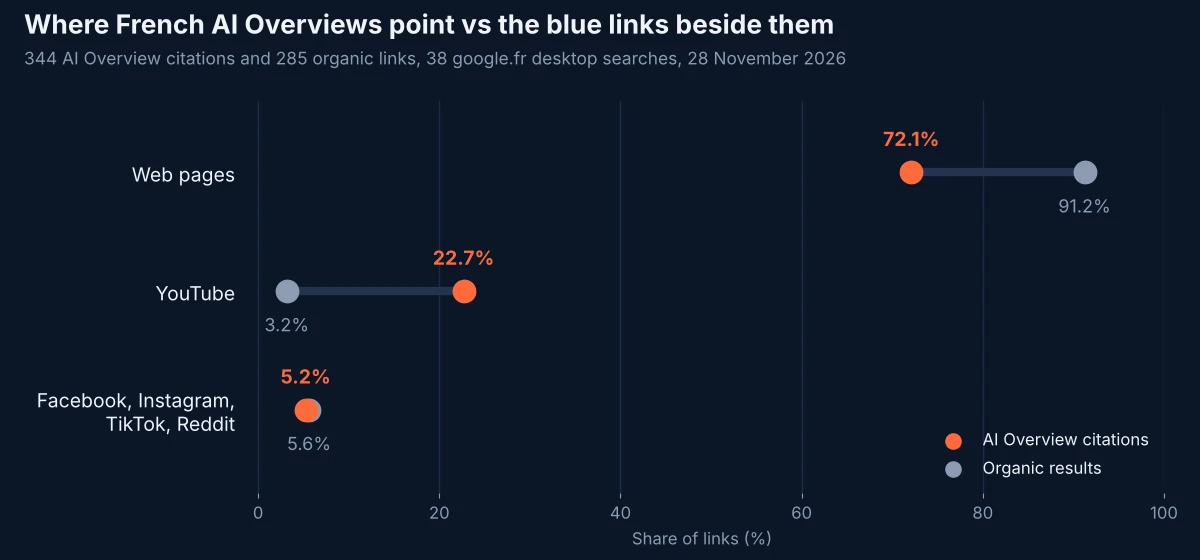
Video dominated how-to answers. The overview for "comment apprendre à nager adulte" cited 13 sources, 7 of them YouTube videos and one a TikTok clip. "Comment changer une roue de voiture" cited 10 sources, 6 from YouTube, while the organic results on that page contained no YouTube link at all. Across the sample, only 1 of the 78 YouTube videos cited in overviews also appeared as a standard organic result. Our organic count covers the standard blue links only, so videos shown in Google's separate video and short video panels are not included; the gap reflects where the overview sends people compared with the classic ten links, not whether YouTube was on the page.
The pattern matches our October pull, when YouTube appeared in all 30 overviews we pulled and supplied 34% of citations. Facebook, Instagram, TikTok and Reddit together took 18 French citations (5.2%), close to their 5.6% share of organic links.
How closely citations follow the rankings
| Query group | Searches | With overview | Citations | Also in organic results | YouTube share |
|---|---|---|---|---|---|
| How-to | 12 | 12 | 120 | 39 (32.5%) | 28.3% |
| Commercial ("meilleur", "quel ... choisir") | 8 | 8 | 76 | 35 (46.1%) | 25.0% |
| Facts, tech and travel | 8 | 7 | 52 | 29 (55.8%) | 23.1% |
| Admin and money | 7 | 6 | 50 | 20 (40.0%) | 14.0% |
| Health | 5 | 5 | 46 | 22 (47.8%) | 13.0% |
| Total | 40 | 38 | 344 | 145 (42.2%) | 22.7% |
Table: AI Overview citations matched to first-page standard organic results by exact URL. Source: SaaS Link Building google.fr pull, 28 November 2026.
Google's new attribution and factuality documentation explains part of the gap: the model may run related searches, which Google calls query fan-out, to retrieve pages that cover different parts of the question. That offers one explanation for citations of pages that do not rank for the query typed. We covered that document when it appeared, in our report on how AI Overviews pick their sources.
Two cases show how far the overview can drift from the blue links. For "c'est quoi le PER", all 8 organic results explained the price-earnings ratio, while the overview answered about the plan d'épargne retraite, the French retirement savings plan, and cited 7 pages on that topic instead. For "que voir à Lyon en 2 jours", one of the 9 citations was Google's own help page on how Google Weather works.
Health queries did not hold the feature back. All 5 health searches showed an overview, even though the same Google document says the system is designed not to show an AI response when it could pose safety risks or lack reliable consensus on sensitive topics. Public bodies did well in these answers: 24 citations across the sample pointed to French government domains, the national health insurer ameli.fr or a regional health agency.
What this means for SEO teams
- Treat French traffic forecasts as reset. With overviews on close to nine in ten tracked keywords, a pre-July baseline is no longer a fair comparison. Benchmark French pages against August onward, and separate queries that show an overview from those that do not.
- Check video for every how-to page that matters. In our sample, how-to overviews drew 28.3% of their citations from YouTube. If a competitor's video is cited and your article is not, a short video on the same steps is the most direct route into that answer.
- Do not assume ranking equals citation. 199 of the 344 citations (57.8%) pointed to URLs that were not among the first-page standard organic results. Pull the overview for your priority queries and log which of your URLs it cites, not only where they rank.
- Watch for query reinterpretation. The PER example shows an overview can answer a different reading of an ambiguous query. If your page targets one meaning, make that meaning explicit in titles and opening paragraphs.
- Pin location when you test. Overviews are sensitive to where the searcher appears to be (see Methodology). Run checks with an explicit French city to see what French users see.
For a wider look at the click question, see our investigation into whether AI Overviews cut clicks more than Google admits.
Methodology
On 28 November 2026 we ran 40 French-language queries through a SERP API using google.fr, French interface language, country France and desktop results. Queries covered how-to tasks (12), commercial comparisons (8), facts, tech and travel (8), administrative and money questions (7) and health (5). Where an overview loaded asynchronously, we retrieved it through a second request with the page token returned. For each overview we recorded every cited URL, and for each page every standard organic result on page one; video panels, short video panels, People Also Ask and other features were not counted as organic results.
A citation counted as "also in organic results" when its URL matched an organic URL on the same page after removing the protocol, "www.", trailing slashes and query strings (except the video ID on YouTube links). YouTube, Facebook, Instagram, TikTok and Reddit links were classed by domain. Government citations were counted by domain (gouv.fr, ameli.fr and ars.sante.fr). For "quel vélo électrique choisir" the first organic pull returned unrelated results, so we repeated the organic pull for that query.
One query showed how location affects the result. Run without a pinned location, "combien coûte un permis de conduire" returned an overview in which at least 7 of 15 citations were Dubai or UAE driving licence pages, while the organic results stayed French. Rerun with Paris as the location, all 9 citations were French pages; we used the Paris run. The other 39 queries were run with the country set to France but no city. This is a 40-query snapshot from one day, not a statistical sample of French search, and overviews vary between requests.
Conclusion
Four months after launch, AI Overviews show on most French searches, and the Ahrefs CTR data puts the cost to the pages beneath them at roughly a quarter of their clicks. Our pull adds the other half of the picture: the links inside the overview point heavily to YouTube and, for more than half of citations, to URLs outside the first page of standard results.
For French publishers, who have already taken their complaint about AI Overviews to Brussels, as we reported in our story on French publishers' Brussels complaint, the data suggests a first-page ranking alone is now a weaker route to a click than it was before July.
Questions and answers
How common are AI Overviews in France?
An Ahrefs study published on 26 November 2026 found AI Overviews on 88.5% of tracked French desktop keywords by 25 November. In our pull of 40 google.fr searches on 28 November, 38 showed an overview.
How much did AI Overviews reduce click-through rates in France?
The Ahrefs study estimated a net CTR loss of 24.4% for keywords that showed an AI Overview between June and October 2026, after adjusting for a 2.6% rise in a control group of keywords without one.
When did Google launch AI Overviews in France?
Google launched AI Overviews and AI Mode in France on 22 July 2026, according to its French blog.
How often did French AI Overviews cite YouTube in your test?
YouTube supplied 78 of 344 citations (22.7%) and appeared in 32 of the 38 overviews we pulled, against 9 of 285 standard organic links (3.2%) on the same pages.
Why do AI Overviews cite pages that do not rank for the query?
Google's documentation on attribution says the model may run related searches, known as query fan-out, to retrieve pages that address different parts of the question. In our test, 42.2% of cited URLs also appeared as first-page organic results.
More releases
-
Industry news
Google AI Mode Camera Takes 10 Photos per Query; 5 of 15 Photo Answers Cited No Sources
Google's AI Mode camera now lets users attach up to 10 photos to one question, a change Google has not announced. In our 24-subject test, photo answers listed 107 sources against 64 for typed questions, but 5 of 15 photo answers cited nothing, and 68% of photo citations hid behind Google redirects.
-
Explainers
Google Tells Sites to Drop 404s From Sitemaps; 49 of 485 Top Sites Still List Them
Google moved its 404 advice into Search Central on 27 November, telling site owners to remove deleted URLs from sitemaps, not to block them in robots.txt and that a 410 generally means less frequent crawling. Our sample of 9,427 sitemap URLs on 485 top sites found dead pages listed on 49 of them.
-
Updates
Google Says Nested Sitemap Indexes Don't Work; Its Own Sitemap Nests 6 of 24
Google's sitemap documentation now states that a sitemap index can list only individual sitemaps and that nested index files are not supported. Our crawl of the top 1,000 Chrome UX Report origins found 16 of 296 sites using indexes still nest them, including Google, whose root sitemap lists 6 indexes among 24 entries.
Tell us the site and the goals.
Rankings in Google and visibility in AI answers, from one monthly plan. One call is enough to say which one fits. Email works just as well.