Google Tells Sites to Drop 404s From Sitemaps; 49 of 485 Top Sites Still List Them
Google moved its 404 advice into Search Central on 27 November, telling site owners to remove deleted URLs from sitemaps, not to block them in robots.txt and that a 410 generally means less frequent crawling. Our sample of 9,427 sitemap URLs on 485 top sites found dead pages listed on 49 of them.
 Vibhu Dhariwal
Cofounder & CTO, Digital Gratified
- Published
- Section
- Explainers
- Reading time
- 8 minutes
Ras Al Khaimah, United Arab Emirates, .
Google moved its 404 advice out of the Search Console Help Center and into Search Central on 27 November, consolidating it into one section of its crawling documentation. The Search Central documentation changelog says the crawling errors troubleshooting guide now covers when to ignore 404 errors, how 404 URLs affect crawl budget, removing dead URLs from sitemaps, and two pitfalls: blocking 404 pages in robots.txt and redirecting them to the home page. The old Help Center address now answers with a 301 to the new section. To see whether large sites follow the sitemap advice, we sampled 9,427 URLs from the XML sitemaps of 485 top-ranked sites on 27 and 28 November. 225 of them (2.4%) returned a 404 or 410, spread across 49 sites.
What changed in Google's guidance
The new section, headed "Decide whether to fix 404 errors in Search Console", sits under the soft 404 part of the troubleshooting guide and embeds the 28 October Search Central video in which Gary Illyes and Cherry Sireetorn Prommawin told site owners to let dead pages return a 404. It sets out five points:
- Unknown URLs are normal. 404s for addresses that never existed, such as mistyped links or URL-like strings Google extracted, can generally be ignored. A commonly mistyped URL that draws real traffic should be redirected to the right page.
- Known 404 URLs don't drain crawl budget. Unlike 5xx errors and 429 responses, 404 and 410 codes do not lower a site's crawl capacity limit.
- Update your sitemaps. Remove a deleted URL from any sitemap that still lists it. Google adds that its crawlers may keep checking a URL occasionally after it returns a 404.
- Don't block 404 URLs with robots.txt. Google has to crawl a removed URL to see the status code and drop the page from its index.
- Don't redirect removed pages to your home page or serve placeholder content; Google treats both as soft 404s.
Much of this echoes the video embedded above it. Two details stand out. The first is the explicit instruction to prune sitemaps. The second is a line on 410: the guide says a 410 "generally leads to less frequent crawling", while noting that for indexing Google treats 404 and 410 the same. Google's separate HTTP status code documentation, last updated in February, still says all 4xx errors except 429 are treated the same. The two pages are not in conflict (one is about indexing, the other about recrawl frequency), but the troubleshooting guide now gives 410 a practical edge that the status code page does not mention.
Key findings from our sitemap check
- 49 of 485 sites (10.1%) had at least one sampled sitemap URL that returned a 404 or 410, directly or after a redirect.
- 16 sites had five or more dead URLs in a sample of up to 20, and 9 sites had ten or more. The median among the 49 affected sites was two.
- 870 sampled URLs (9.2%) redirected rather than answering directly, on 131 sites. Of those, 42 URLs on 18 sites redirected to the site's home page, the pattern the new guide calls a soft 404.
- 410 is rare: 11 URLs on 3 sites returned it, against 186 direct 404s.
- The robots.txt pitfall barely showed up: 68 sampled sitemap URLs on 11 sites were disallowed for Googlebot, but only 2 of those (on one site) also returned a 404.
How the sampled sitemap URLs answered
| Response to a URL listed in the sitemap | URLs | Share | What Google's guide says |
|---|---|---|---|
| 200 directly | 8,337 | 88.4% | The expected state for a sitemap URL |
| Redirect to another live page | 794 | 8.4% | Sitemaps should list the URLs you want shown in results |
| 404 directly | 186 | 2.0% | Remove deleted URLs from sitemaps |
| Redirect to the home page | 42 | 0.4% | Treated as a soft 404 |
| Redirect that ends in 404 or 410 | 28 | 0.3% | Remove from sitemaps |
| Other 4xx | 21 | 0.2% | Handled like a 404 for indexing |
| 410 directly | 11 | 0.1% | Same as 404 for indexing; generally crawled less often |
| Other redirect or 5xx | 8 | 0.1% | Server errors slow crawling |
The problem is concentrated. A handful of sites account for most dead URLs: Netflix, Dropbox, Yale and Costco each had ten or more of their 20 sampled URLs return a 404. The kinds of pages involved are familiar to anyone who has audited a large sitemap: localized help articles that no longer exist in some languages, expired job listings and filtered category URLs. Netflix's dead URLs were regional title pages, which may depend on where a request comes from (see Methodology).
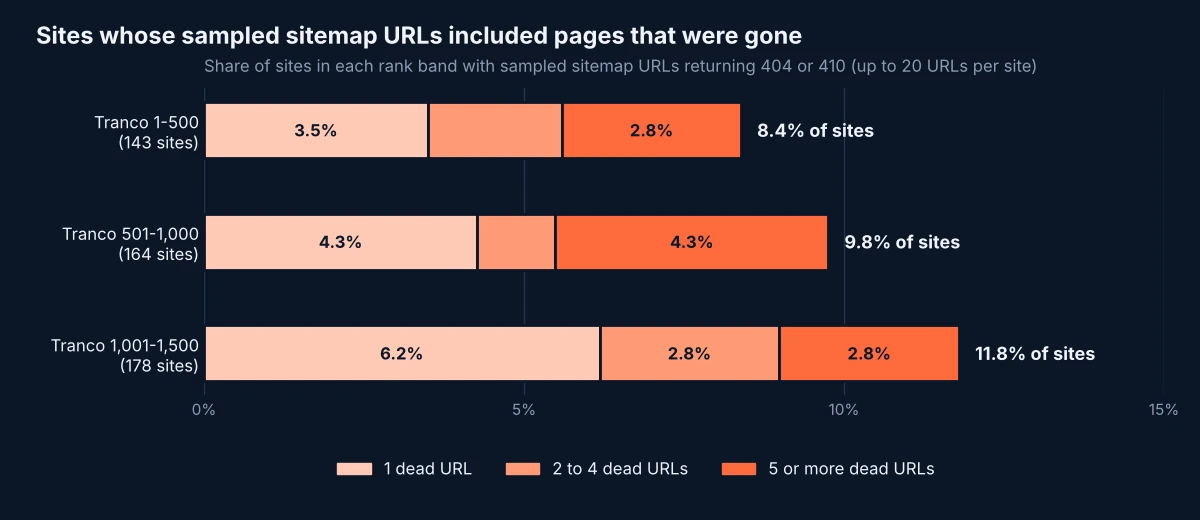
Dead sitemap URLs became slightly more common further down the ranking, from 8.4% of sites in the top 500 to 11.8% in positions 1,001 to 1,500. The samples per band are small, so treat that as a direction rather than a firm gap.
Why the sitemap line matters
Google's sitemap documentation says to include the URLs you want to see in search results and that Google will try to crawl them exactly as listed. A dead URL in a sitemap therefore asks Google to keep fetching a page the site has already removed. The new guide is careful not to overstate the cost: known 404s do not meaningfully consume crawl budget. The bigger cost is clarity: the guide asks site owners to first confirm a 404 page was not removed by mistake or moved to a new URL, and that check is harder when the sitemap itself is full of pages the site meant to delete.
The same 27 November update also moved older sitemap guidance into the documentation, including the rule we covered separately that nested sitemap index files are not supported. Taken together with our earlier look at how top sites use lastmod, the pattern is consistent: Google expects a sitemap to be an accurate list of live, canonical pages, not an archive.
What to do
- Generate sitemaps from the live catalogue, not from a publishing log. Many of the dead URLs we found looked like items removed from a CMS (jobs, help articles) while the sitemap generator kept them. Tie sitemap entries to the same status flag that unpublishes the page.
- Run a status check on every sitemap file. Fetch each listed URL without following redirects. Anything that is not a 200 should either be fixed or removed: 404s and 410s should go, and redirected URLs should be replaced with their destination.
- Remove home page redirects for deleted pages. If a retired URL has no direct replacement, return a 404 or 410 and drop it from the sitemap. Keep 301s for true successors only.
- Use 410 when you want Google to stop checking sooner. The guide now says a 410 generally leads to less frequent crawling. For large-scale removals, such as expired listings, that is a reason to prefer it, though indexing treats the two codes the same.
- Don't hide dead URLs behind robots.txt. Google needs to see the 404 or 410 to drop the page. If you want Google to check removed URLs less often, the guide points to a 410, not a disallow rule.
- Ignore 404s for URLs you never published. The guide is explicit that these are normal. Act only on URLs that were in your sitemap, still get visits, or should never have disappeared. For crawl load problems, the right signal remains a 503 or 429 with Retry-After, not a 404.
Methodology
On 27 and 28 November 2026 we took the first 1,500 domains of the public Tranco top-sites list and requested each homepage over HTTPS with a desktop Chrome user agent. For the 563 sites that returned a 200 homepage, we read robots.txt for Sitemap lines (falling back to /sitemap.xml) and loaded the first sitemap that listed URLs, following up to two child sitemaps when the file was a sitemap index. 511 unique hosts yielded URLs. We sampled up to 20 URLs at random per site and requested each one without following redirects, then followed any redirect to its end. Sites where more than half of responses were bot challenges or blocks (401, 403, 406, 418 or 429) or where fewer than five usable responses remained were excluded, leaving 485 sites and 9,427 URLs; 461 sites had a full sample of 20.
Every URL that returned a 404 or 410 was requested a second time, and all 225 returned the same result. Seven URLs initially recorded as other 4xx errors returned 200 once XML entity escaping (&) in their sitemap entries was decoded, and are counted as 200s. A redirect counted as going to the home page when the final URL was the site's root path. Googlebot access was tested against each site's robots.txt with Python's standard robots.txt parser. All requests came from a single cloud location and not as Googlebot, so sites that vary content by country or user agent (such as streaming catalogues) may answer Google differently. Results describe a random sample of the first sitemap file, not the whole site.
Conclusion
Google's 27 November rewrite turns its spoken advice on 404s into documentation: ignore the ones you did not cause, don't fear them for crawl budget, and don't paper over them with home page redirects or robots.txt blocks. The new, concrete task is sitemap hygiene, and our sample suggests about one top site in ten has dead URLs in its sitemap, a few of them heavily.
For most teams the fix is mechanical: check what each sitemap URL returns, remove the dead ones, and consider a 410 for content that is gone for good.
Questions and answers
Do 404 errors hurt crawl budget?
Google's crawling errors troubleshooting guide, updated on 27 November 2026, says 404 and 410 codes don't lower a site's crawl capacity limit and already-crawled 404 URLs don't meaningfully consume crawl budget. 5xx errors and 429 responses do slow crawling.
Should I remove 404 pages from my XML sitemap?
Yes. The updated guide says to take a deleted URL out of any sitemap that still lists it. In our 27 to 28 November sample, 49 of 485 top sites still listed at least one URL that returned a 404 or 410.
Is 410 better than 404 for removed pages?
For indexing, Google treats them the same. The troubleshooting guide adds that a 410 generally leads to less frequent crawling, so it can help when a site removes many URLs for good. Only 3 sites in our sample returned a 410 for any sampled sitemap URL.
Can I block removed pages in robots.txt?
Google advises against it. Its guide says Google needs to crawl a removed URL to see the 404 or 410 status code and drop the page from the index, and a robots.txt block prevents that.
Should deleted pages redirect to the home page?
No. Google's guide says redirecting nonexistent URLs to an unrelated page such as the home page is treated as a soft 404. Redirect only when there is an equivalent replacement page; otherwise return a 404 or 410.
More releases
-
Updates
Google Says Nested Sitemap Indexes Don't Work; Its Own Sitemap Nests 6 of 24
Google's sitemap documentation now states that a sitemap index can list only individual sitemaps and that nested index files are not supported. Our crawl of the top 1,000 Chrome UX Report origins found 16 of 296 sites using indexes still nest them, including Google, whose root sitemap lists 6 indexes among 24 entries.
-
Industry news
Cloudflare Launches Search for Agents; 5 of the Top 10,000 Sites Answer It After 2 Days
Cloudflare launched Search for Agents on 25 November, giving any customer a one-click AI Search endpoint at /.well-known/search. Two days later, our crawl of the top 10,000 domains found five sites answering it, two on stock settings, and Cloudflare's own blog mixing translated pages into 53% of English results.
-
Studies
Does Google Ignore Canonical Tags? 140 of 149 Top Results Matched Their Own
Google calls the canonical tag a hint, and many SEOs say it ignores it. We checked 32 live US Google searches on 27 November: 140 of 149 ranking pages that declared a canonical were shown at exactly that URL. Most of the overrides we found involved syndicated copies on other domains.
Tell us the site and the goals.
Rankings in Google and visibility in AI answers, from one monthly plan. One call is enough to say which one fits. Email works just as well.