Cloudflare Launches Search for Agents; 5 of the Top 10,000 Sites Answer It After 2 Days
Cloudflare launched Search for Agents on 25 November, giving any customer a one-click AI Search endpoint at /.well-known/search. Two days later, our crawl of the top 10,000 domains found five sites answering it, two on stock settings, and Cloudflare's own blog mixing translated pages into 53% of English results.
 Vibhu Dhariwal
Cofounder & CTO, Digital Gratified
- Published
- Section
- Industry news
- Reading time
- 8 minutes
Ras Al Khaimah, United Arab Emirates, .
Cloudflare has put a site search engine for AI agents behind a single dashboard switch. Search for Agents, announced on the Cloudflare blog on 25 November 2026, builds an AI Search index of a website, serves it at /.well-known/search on the site's own domain, and adds four meta tags to every HTML page so agents can find the endpoint instead of crawling page by page. Our crawl of the 10,000 most popular domains, run about 47 hours after the announcement, found only five live sites answering at that address, and only two of them running Cloudflare's stock setup.
What changed
- One toggle per domain. Owners turn it on under Quick Actions on a domain's Overview page, or through the API. Cloudflare says it is open to every customer, Free plans included with limits, and the developer documentation labels it a beta on all plans.
- Its own crawl. The feature creates an AI Search instance named
search-for-agents-<ZONE_ID>that finds pages through sitemaps and links, up to 100,000 pages and five link hops, refreshed every 24 hours, with subdomains excluded by default. - Retrieval, not answers. The endpoint returns matching passages in Markdown with source references and relevance scores. It does not generate an answer; the agent's own model does that.
- Discovery by meta tag. Cloudflare injects
agent:instructions,agent:endpoint,agent:methodandagent:documentationinto the<head>of HTML responses, and into YAML front matter for sites that also use Markdown for Agents. - A new HTTP method. Besides GET with a
qparameter, the endpoint accepts QUERY requests, which Cloudflare says were standardised as RFC 10008 in June 2026. - The site owner pays. Usage falls under AI Search pricing, which says billing begins on 1 December 2026. Each account gets 1,000 semantic and 1,000 full-text queries a month; beyond that, semantic, vector and hybrid queries cost $0.75 per 1,000.
Who has switched it on
We fetched the homepage of each of the top 10,000 domains in the Tranco list and requested /.well-known/search?q=contact on the host each one resolved to. The table shows how far down the funnel each group got.
| Stage | Domains |
|---|---|
| Top domains requested | 10,000 |
| Homepage returned HTML with HTTP 200 | 5,923 |
| Of those, served through Cloudflare (cf-ray header) | 2,011 |
| Returned HTTP 200 at /.well-known/search | 437 |
| Of those, returned an HTML page rather than search results | 405 |
| Returned Markdown search results | 6 domains (5 distinct sites) |
| Advertised the endpoint with agent: meta tags on the homepage | 5 domains (4 distinct sites) |
| Used Cloudflare's stock instructions and documentation link | 3 domains (2 distinct sites) |
The five sites were Brevo (Tranco rank 2,791), the domain marketplace Atom (3,145), Mintt Studio (reached via nfcube.com, 6,670), the Brazilian classifieds site Chaves na Mão (7,290) and the Indian bus booking site AbhiBus (8,952). All five sit behind Cloudflare.
Only Brevo and Mintt Studio carried Cloudflare's default instruction text and a documentation tag pointing at Cloudflare's developer page. Atom and Chaves na Mão wrote their own instructions (Atom's describes searching domains for sale with live prices; Chaves na Mão's is in Portuguese and asks agents to include a city and state) and point the documentation tag at their own llms.txt files. AbhiBus answered at the path but carried no agent tags on its homepage. Those three look like custom handlers that adopted the same address, though we could not confirm from outside which software produces their responses.
The 405 sites that answered HTTP 200 with an HTML page matter for anyone building an agent: a blind request to /.well-known/search on a typical large site returns a catch-all page, not results. That is one reason Cloudflare advertises the address with meta tags. The path itself is not in IANA's well-known URI registry, which lists no "search" entry.
How the stock endpoint behaves
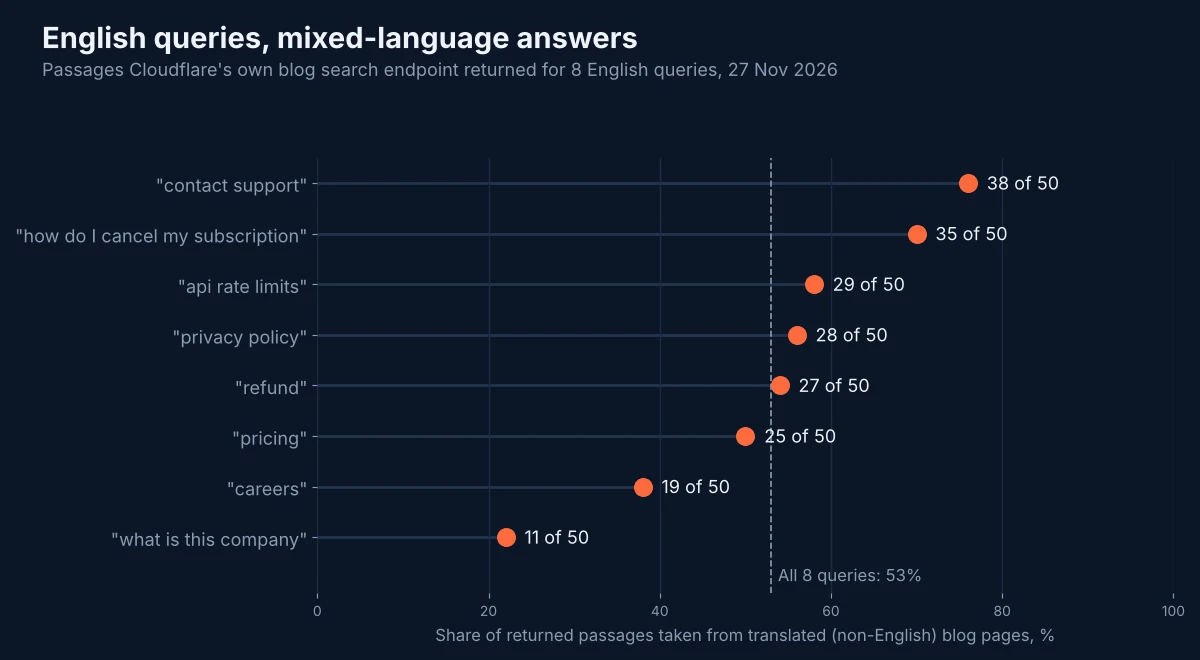
We sent the same eight English queries (pricing, refund, careers, contact support and four others) to the four stock endpoints we could reach: Cloudflare's blog and developer docs, Brevo and Mintt Studio.
- Cloudflare's own sites return far more. The blog and docs endpoints returned 50 passages for every query, against a documented default of 10. Brevo returned between 3 and 10, Mintt Studio between 7 and 10. Median response size was 69.9 KB on the blog and 45.5 KB on the docs, against 17.3 KB on Brevo and 20.5 KB on Mintt Studio.
- Language mixing. On the blog endpoint, 212 of the 400 passages returned for English queries came from translated versions of posts under paths such as /ja-jp/, /ko-kr/ and /zh-cn/. The index treats each translation as a separate document.
- Paths instead of URLs. The docs endpoint labels results with internal file paths such as
docs/billing/.../index.mdrather than page addresses, so an agent quoting it has no canonical URL to cite unless it rebuilds one. The blog, Brevo and Mintt Studio endpoints returned full URLs. - No indexing controls. None of the four stock endpoints sent an X-Robots-Tag header, and none of their robots.txt files mentions the path. The two custom endpoints we tested, Atom and Chaves na Mão, both sent
X-Robots-Tag: noindex.
Context
Search for Agents extends Markdown for Agents, the Cloudflare feature that converts HTML to Markdown when a client asks for it, and it arrives as sites weigh a growing list of agent-facing files. Our October count found just 6 of 699 top sites publishing dedicated agent files, while 20.8% of 514 top sites already published llms.txt files in our check that month. Two of the five early adopters here point agents to an llms.txt file rather than to Cloudflare's documentation.
Cloudflare says requests to the endpoint stay subject to a site's bot management, AI Crawl Control and WAF rules. The company is separately preparing to score verified bots on robots.txt compliance. Cloudflare's announcement names no AI assistant that reads the agent: meta tags. Instead it showed an OpenCode session finding and using the endpoint on its developer docs, and said agents had done "a good job of discovering the search API" there.
What this means for SEO teams
- Decide who answers for your site. An agent that queries the endpoint gets the passages Cloudflare's hybrid retrieval ranks highest, not the page you would choose. Before switching it on, run your top support, pricing and product queries against the instance and read what comes back.
- Clean up multilingual sites first. If you publish translations under locale folders, expect mixed-language results unless you limit the crawl. The blog test above shows how quickly translations crowd English passages.
- Budget for queries. Anyone, or any agent, can call a public endpoint. At the published rates, 100,000 hybrid queries in a month would cost about $74 after the free 1,000. Set bot and rate rules before billing starts on 1 December.
- Keep result URLs out of Google's index. Google indexes plain text files and its crawl budget guidance recommends using robots.txt to block crawling of URLs you do not want on Google surfaces. Adding
Disallow: /.well-known/searchfor Googlebot, or a noindex header as Atom and Chaves na Mão do, costs nothing. Whether Google would index these Markdown responses at all is untested; this is a precaution, not an observed problem. - Do not expect a ranking effect. Google has said nothing about the meta tags or the endpoint, and nothing in Cloudflare's material says Google or Bing use it.
Methodology
On 27 November 2026 between 13:20 and 13:29 UTC we requested the HTTPS homepage of each of the top 10,000 domains in the Tranco list, following redirects, with a desktop Chrome user agent and a 12-second timeout. We recorded the status, content type, server and cf-ray headers, and any meta tags whose name begins with "agent:". We then requested /.well-known/search?q=contact on the final host without following redirects and counted a response as search results when it returned text/markdown starting with "# Search results for" or an equivalent front-matter block. Between 13:30 and 13:33 UTC we sent eight English queries to each live endpoint and recorded result counts, response sizes, headers and robots.txt rules. A translated passage is one whose URL contains a locale folder such as /ja-jp/. Sites that block our requests, use a different path, or enabled the feature after our crawl are not counted.
Conclusion
Cloudflare has made agent-facing site search a one-click option for its customers, but two days in, almost none of the most visited sites have taken it, and the early adopters split between Cloudflare's defaults and their own versions. The stock setup ships without indexing controls, mixes translations into results and, on Cloudflare's own docs, returns file paths in place of URLs.
Sites that want agents to find accurate answers should test the endpoint against their own key queries, set bot and spend limits before billing begins, and block the result URLs from search crawlers until there is evidence either way.
Questions and answers
What is Cloudflare Search for Agents?
A Cloudflare feature announced on 25 November 2026 that creates an AI Search index of a website and serves matching passages in Markdown at /.well-known/search on the site's own domain. It returns retrieved content with source references and relevance scores, not a generated answer.
How do AI agents find the endpoint?
Cloudflare adds four meta tags to the head of every HTML page: agent:instructions, agent:endpoint, agent:method and agent:documentation. Sites that also use Markdown for Agents get the same details as YAML front matter.
What does Search for Agents cost?
It is billed under AI Search pricing, with billing starting on 1 December 2026. Each account includes 1,000 semantic and 1,000 full-text queries a month; beyond that, semantic, vector and hybrid queries cost $0.75 per 1,000 and full-text queries $0.10 per 1,000.
How many large sites use it so far?
In our crawl of the Tranco top 10,000 domains on 27 November 2026, five distinct sites returned search results at /.well-known/search, and only two used Cloudflare's stock instructions and documentation link.
Does Search for Agents affect Google rankings?
Google has not said anything about the endpoint or the agent meta tags, and Cloudflare's announcement does not say Google or Bing use them.
More releases
-
Studies
Does Google Ignore Canonical Tags? 140 of 149 Top Results Matched Their Own
Google calls the canonical tag a hint, and many SEOs say it ignores it. We checked 32 live US Google searches on 27 November: 140 of 149 ranking pages that declared a canonical were shown at exactly that URL. Most of the overrides we found involved syndicated copies on other domains.
-
Studies
Google Edited 106 Search Docs Pages in 2026; Its Changelog Links Just 54 of Them
Google has edited 106 Search Central and crawling documentation pages in 2026 by their own printed dates, but only 54 are linked from a 2026 changelog entry. Our crawl of Google's developer sitemap also found 28 pages whose sitemap lastmod runs ahead of the date the page shows.
-
Industry news
Google's Ranking Hub Spells Out 3 of 10 CMA Fair Ranking Duties Before They Bind
Google's new Search ranking hub, published on 24 November, fully spells out three of the ten obligations in the UK CMA's fair ranking conduct requirement, which takes effect on 17 December. It names no notice periods in days, and the December core update preannouncement clears 15 business days on 15 December.
Tell us the site and the goals.
Rankings in Google and visibility in AI answers, from one monthly plan. One call is enough to say which one fits. Email works just as well.