Google Says Nested Sitemap Indexes Don't Work; Its Own Sitemap Nests 6 of 24
Google's sitemap documentation now states that a sitemap index can list only individual sitemaps and that nested index files are not supported. Our crawl of the top 1,000 Chrome UX Report origins found 16 of 296 sites using indexes still nest them, including Google, whose root sitemap lists 6 indexes among 24 entries.
 Vibhu Dhariwal
Cofounder & CTO, Digital Gratified
- Published
- Section
- Updates
- Reading time
- 7 minutes
Ras Al Khaimah, United Arab Emirates, .
Google on 27 November moved a rule that had lived only in old blog posts and social replies into its official sitemap documentation: a sitemap index file can list only individual sitemaps, and nested sitemap index files (an index that points to another index) "aren't supported". The change is logged in the Search Central documentation updates as guidance ported from blog posts dating back to 2005. When we crawled the sitemap Google itself declares in robots.txt for www.google.com, 6 of its 24 entries were sitemap indexes, the exact pattern the new line rules out.
What changed
The documentation update lists two edits for the day. The first ports "still-relevant guidance from 2005 blog posts" into the sitemaps section. Two points stand out:
- The large sitemaps page now says a sitemap index file can only list individual sitemaps, and that nested sitemap index files are not supported. The page is stamped as last updated on 27 November.
- The build a sitemap page now says an HTML sitemap (a regular page linking to your important pages) can help visitors and search engines, but is not a format you can submit in Search Console.
The second edit expands the crawling errors troubleshooting guide with guidance on when 404 errors can be ignored, how 404 URLs affect crawl budget and which pitfalls to avoid, including blocking 404 pages in robots.txt or redirecting them to the home page. Google says the Search Console Help Center article on the topic now redirects to the Search Central page.
Neither rule is new as practice. Google's John Mueller told a questioner on Twitter in late 2020 that nested sitemap indexes were not supported, as Search Engine Roundtable reported at the time. The sitemaps.org protocol describes an index as a file that lists sitemap files, with a cap of 50,000 entries and 50MB uncompressed, and never describes an index of indexes. What is new is that the limit now sits in Google's reference documentation, where developers and CMS vendors look first.
Key findings from our crawl
To see how often the unsupported pattern appears on large sites, we fetched robots.txt for the 1,000 most popular origins in the Chrome UX Report, followed up to five declared sitemaps per origin and checked what each sitemap index points to.
- 791 of the 1,000 origins returned a robots.txt file, and 420 of those declared at least one sitemap.
- 296 origins declared at least one sitemap index. Of the 899 declared sitemaps we fetched, 508 were indexes and 257 were plain URL sitemaps.
- 16 of the 296 origins (5.4%) had at least one sitemap index whose entries included another sitemap index.
- Across the 6,006 index entries we checked, 120 (2.0%) were themselves indexes, and 192 (3.2%) did not return a valid sitemap at all, mostly 404s, HTML pages or blocked requests.
Those counts are a floor: we checked at most 15 entries per index and five declared sitemaps per origin, so deeper nesting on very large sites would not show up.
Google's own sitemap nests
The most visible example is Google's. The www.google.com robots.txt file points to a single root file, google.com/sitemap.xml, which is a sitemap index with 24 entries. We requested all 24. Thirteen are ordinary URL sitemaps. Six (the Ads, AdSense, Chromebook, Photos, Shopping and Maps sections) are sitemap indexes that list further sitemaps. Five do not return a sitemap: the Slides, Sheets and Calendar entries return 404, the Flights entry redirects to an "unsupported" page and the Grants entry 301-redirects to a nonprofits page.
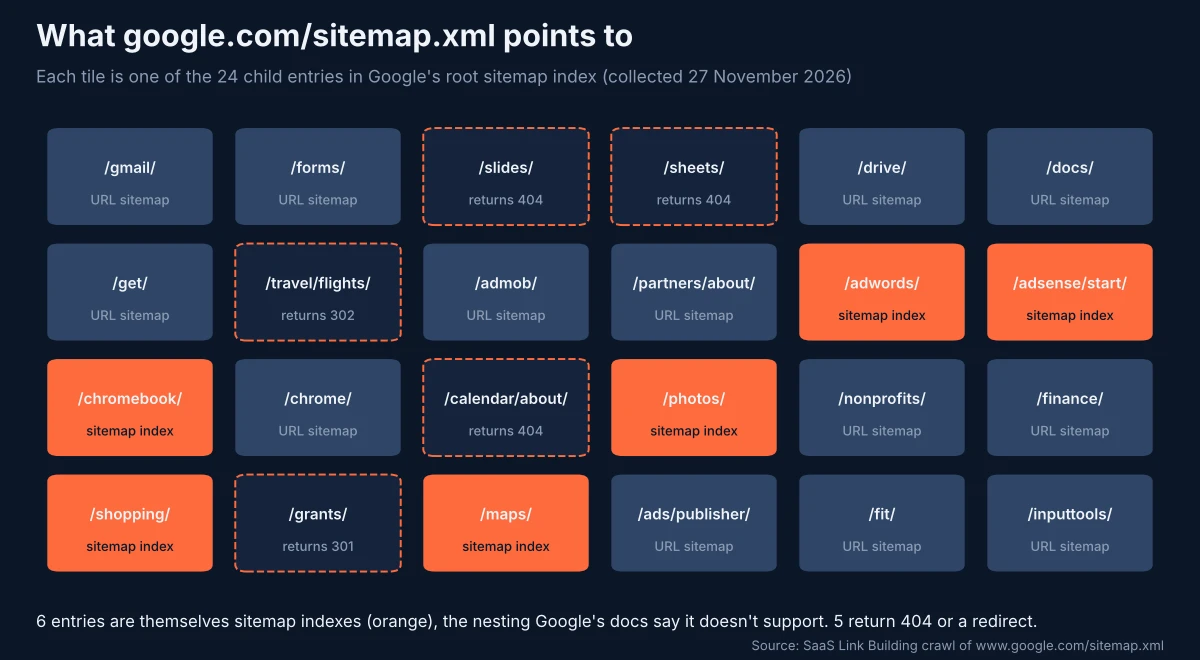
Google's own pages are found through many routes, and its product teams may submit section sitemaps directly in Search Console, so this is not evidence that google.com loses visibility. It does show how easily the pattern appears when separate teams each publish an index and a central file stitches them together. Bing's root sitemap does the same, with a shopping index nested inside it.
Where else the pattern shows up
| Site | Index declared in robots.txt | Entries listed | Entries checked | Of which are indexes |
|---|---|---|---|---|
| google.com | /sitemap.xml | 24 | 24 | 6 |
| apple.com | /shop/sitemap.xml | 47 | 15 | 15 |
| samsung.com | /sitemap.xml | 93 | 15 | 15 |
| veja.abril.com.br | /sitemap.xml | 7,432 | 15 | 15 |
| open.spotify.com | /sitemaps/sitemap-index.xml | 90 | 15 | 13 |
| wise.com | /sitemap | 27 | 15 | 13 |
| yandex.com | /games/sitemaps/sitemap.index.xml | 23 | 15 | 12 |
| testbook.com | /sitemap.xml | 95 | 15 | 5 |
| homedepot.com | /sitemap/main.xml | 15 | 15 | 4 |
| clarin.com | /sitemaps/index.xml | 7 | 7 | 4 |
| bing.com | /sitemap.xml | 12 | 12 | 1 |
Source: SaaS Link Building crawl of the Chrome UX Report top 1,000 origins, 27 November 2026. Google's row reflects a full check of all 24 entries; other rows cap at 15 entries. Samsung's regional indexes (Africa and Albania) also nest.
The structures differ. Apple's shop index lists country storefront indexes, Samsung's root index lists regional indexes, and the Brazilian news site Veja lists 7,432 entries in which every one we checked was another index. Home Depot's main file points to indexes named for product and listing pages.
Context: sitemaps keep coming back to the docs
Sitemaps have been a recurring theme in Google's documentation this year. Our study of which docs pages Google edited without a changelog entry used the lastmod dates in Google's own documentation sitemap, and an earlier crawl found that 39.5% of top-site sitemaps skip lastmod, the field Google uses to schedule recrawls. The update log gives the reason for the 27 November port as preserving still-accurate guidance from early Search Central blog posts.
The 404 edit published the same day covers ground we tested in October, when 15% of 546 top sites did not return a 404 for a missing page. The new guidance names redirecting 404s to the home page as a pitfall to avoid.
What this means for SEO teams
- Flatten your sitemap tree. If a root index lists section indexes, either submit each section index directly in Search Console and declare them separately in robots.txt (robots.txt accepts several Sitemap lines), or make the root index list the final URL sitemaps.
- Check what your CMS and plugins generate. Multi-site setups, marketplace platforms and stores with one index per country are where nesting turned up in our sample; our reading, which is speculation, is that each module writes its own index and a root file then lists them.
- Look for sitemaps Search Console never reports. In the Sitemaps report, compare the sitemaps Google lists as read against the ones your nested indexes contain. If second-level files never appear there, treat that as a sign they are not being read.
- Remove dead entries. Google's own index lists three 404s and two redirects. Entries that fail waste a fetch and hide real problems in reports.
- Do not submit HTML sitemaps. Keep HTML sitemap pages for users and internal linking, and submit XML, RSS or text formats in Search Console.
Methodology
On 27 November 2026 between 17:17 and 17:22 UTC we took the 1,000 origins in the top rank bucket of the current Chrome UX Report top origins list and requested /robots.txt for each with a crawler that identified itself as a research bot. For every origin we parsed the Sitemap lines and fetched up to five declared sitemaps, decompressing gzip files. A file counted as a sitemap index if it contained a sitemapindex element and as a URL sitemap if it contained a urlset element. For each index we fetched up to its first 15 entries and classified them the same way. An origin counted as nesting if any checked entry of any declared index was itself an index. We then requested all 24 entries of www.google.com/sitemap.xml without following redirects. Results reflect what our crawler was served; some sites return bot challenges or HTML to automated requests, which we counted as invalid rather than guessing their contents.
Conclusion
Google has turned a long-standing limit into documented policy: sitemap indexes should list sitemaps, not other indexes. 5.4% of large sites that declare an index still nest them, including Google's own root sitemap, which also lists five entries that no longer return a sitemap.
For most sites the fix is a configuration change rather than a rebuild, and the Search Console Sitemaps report is the quickest way to see whether second-level files are being read at all.
Questions and answers
Does Google support nested sitemap index files?
No. Google's large sitemaps documentation, updated on 27 November 2026, says a sitemap index file can only list individual sitemaps and that nested sitemap index files (an index that references another index) aren't supported.
Can I submit an HTML sitemap in Search Console?
No. Google's build a sitemap page now says an HTML sitemap can help visitors and search engines navigate a site, but it isn't a sitemap format you can submit in Search Console.
How many large sites still nest sitemap indexes?
In our 27 November 2026 crawl of the top 1,000 Chrome UX Report origins, 16 of the 296 origins that declared a sitemap index in robots.txt had at least one index listing another index. Because we checked at most 15 entries per index, that is a minimum.
How many sitemaps can a sitemap index list?
The sitemaps.org protocol caps a sitemap index at 50,000 sitemaps and 50MB uncompressed. Google's documentation also says you can submit up to 500 sitemap index files per site in Search Console.
What else did Google change in its documentation on 27 November?
It expanded its crawling errors troubleshooting guide with guidance on when 404 errors can be ignored, how 404 URLs affect crawl budget, and pitfalls such as blocking 404 pages in robots.txt or redirecting them to the home page.
More releases
-
Industry news
Cloudflare Launches Search for Agents; 5 of the Top 10,000 Sites Answer It After 2 Days
Cloudflare launched Search for Agents on 25 November, giving any customer a one-click AI Search endpoint at /.well-known/search. Two days later, our crawl of the top 10,000 domains found five sites answering it, two on stock settings, and Cloudflare's own blog mixing translated pages into 53% of English results.
-
Studies
Does Google Ignore Canonical Tags? 140 of 149 Top Results Matched Their Own
Google calls the canonical tag a hint, and many SEOs say it ignores it. We checked 32 live US Google searches on 27 November: 140 of 149 ranking pages that declared a canonical were shown at exactly that URL. Most of the overrides we found involved syndicated copies on other domains.
-
Studies
Google Edited 106 Search Docs Pages in 2026; Its Changelog Links Just 54 of Them
Google has edited 106 Search Central and crawling documentation pages in 2026 by their own printed dates, but only 54 are linked from a 2026 changelog entry. Our crawl of Google's developer sitemap also found 28 pages whose sitemap lastmod runs ahead of the date the page shows.
Tell us the site and the goals.
Rankings in Google and visibility in AI answers, from one monthly plan. One call is enough to say which one fits. Email works just as well.