Google AI Mode Camera Takes 10 Photos per Query; 5 of 15 Photo Answers Cited No Sources
Google's AI Mode camera now lets users attach up to 10 photos to one question, a change Google has not announced. In our 24-subject test, photo answers listed 107 sources against 64 for typed questions, but 5 of 15 photo answers cited nothing, and 68% of photo citations hid behind Google redirects.
 Vibhu Dhariwal
Cofounder & CTO, Digital Gratified
- Published
- Section
- Industry news
- Reading time
- 7 minutes
Ras Al Khaimah, United Arab Emirates, .
Google's AI Mode camera in the Google app now lets people capture up to 10 photos in one session and attach them to a single question, Android Authority reported on 25 November after spotting the change in Google app version 17.78.13. Search Engine Roundtable's Barry Schwartz said on 27 November that the feature also worked for him on an iPhone. Google has not announced it: we found no Google blog post or Search Central note, and Google's own help pages do not mention the 10-photo camera.
Photo questions are a different kind of query for publishers, so we ran our own test. We asked AI Mode about 24 subjects twice, once with a photo and once in words, and compared what each answer cited. In the 15 cases where both versions returned an answer, the photo versions listed more sources overall, but one in three listed no sources at all.
What changed
- Camera capture: the AI Mode camera replaces its shutter button with a plus button. Each tap adds a photo, thumbnails stack above the button, and "Add photos" attaches up to 10 images to the compose box, according to Android Authority.
- Rollout: the same report describes it as a server-side change, so updating the app does not guarantee access.
- What was already possible: AI Mode already took image input. Before this change, adding a second photo meant reopening the camera.
What Google's help pages say
We checked the three platform versions of Google's AI Mode help page. The Android version says you can upload more than one item. The desktop version says to upload one or more images. The iPhone and iPad version describes uploading an image or taking a photo, with no line about multiple images, even though the feature has been reported working on iPhone. None of the three versions gives a limit or describes capturing several photos in a row.
Key findings from our test
- Of 24 photo questions, 15 returned an answer. The other 9 returned an error or an "uploaded content is unavailable" message on both attempts.
- Across the 15 matched pairs, photo answers listed 107 sources and typed answers listed 64. The median photo answer listed 7 sources; the median typed answer listed 3.
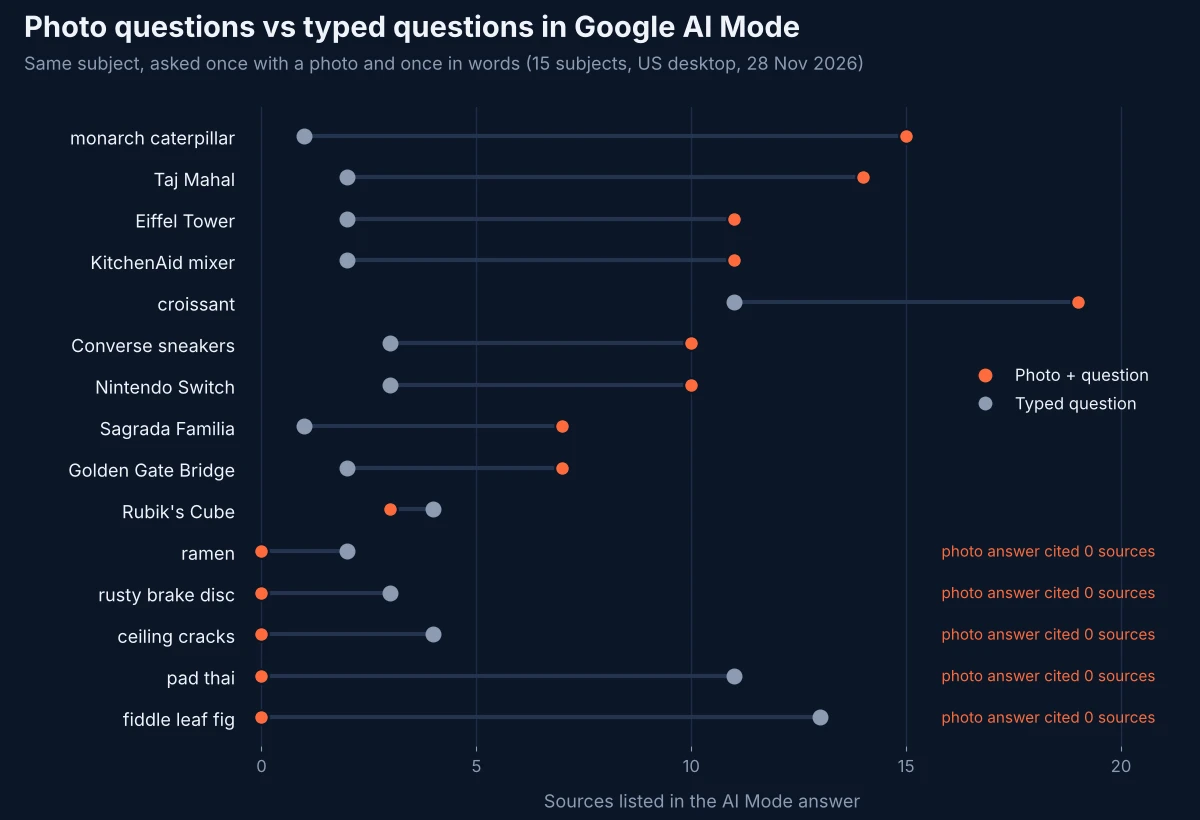
- 5 of the 15 photo answers listed no sources at all, although each ran to between 335 and 697 words. Every typed answer we collected, all 24, listed at least one source.
- 73 of the 107 photo citations (68%) were wrapped in google.com/goto redirect links that hide the destination URL, against 33 of 64 (52%) for typed answers.
- 14 photo citations pointed to Google's own pages (place and entity cards, and Shopping product viewers), against 1 typed citation.
Where the photo answers sent people
The gap depended on the subject. Landmark and product photos drew far longer source lists than the typed versions, while photos of food and household problems often came back with no sources.
| Subject type | Matched pairs | Sources, photo answers | Sources, typed answers | Photo answers with no sources |
|---|---|---|---|---|
| Landmarks | 4 | 39 | 7 | 0 |
| Products | 4 | 34 | 12 | 0 |
| Food | 3 | 19 | 24 | 2 |
| Animals | 1 | 15 | 1 | 0 |
| Home and car repair | 2 | 0 | 7 | 2 |
| Plants | 1 | 0 | 13 | 1 |
| Total | 15 | 107 | 64 | 5 |
Source: SaaS Link Building analysis of Google AI Mode results collected 28 November 2026. Plants, animals and repair have few matched pairs because many of those photo questions failed.
Three patterns stood out:
- Google keeps more of the click on visual queries. For the Golden Gate Bridge photo, 6 of 7 listed sources were Google-hosted place cards, such as Marshall's Beach and the bridge's welcome center. All four product photos produced answers with links into Google's Shopping product viewer, and the stand mixer photo also listed three retailers as Google-hosted cards rather than links to their sites.
- Destinations are harder to see. Two in three photo citations went through Google's /goto redirect, which we have tracked in organic results in our analysis of hidden result URLs. That matters for anyone trying to tie AI Mode visibility to referral data.
- A recognised subject is not always a cited one. The pad thai photo produced a 697-word recipe answer with no listed source, while the typed question about pad thai cited 11. The same split happened for the fiddle leaf fig: 13 sources typed, none for the photo.
Context
Google has been widening what AI Mode accepts as input. Its help pages already cover images, PDFs and Drive files, and we covered Google's October changes to links in AI Mode and AI Overviews when they launched. Our earlier test of AI Mode product cards found all 180 cards linked to Google's own pages, and the photo product answers in this test followed the same pattern, with Google's viewer appearing beside retailer links.
The new camera flow makes multi-photo questions easier, such as comparing two products on a shelf. We could not test multi-photo questions directly, because our collection method attaches one image per question, so the findings above describe single-photo answers.
What this means for SEO teams
- Check image search basics on product and place pages. Photo answers for products and landmarks drew long source lists, so descriptive file names, alt text and product structured data still decide whether a page can be matched to a photo.
- Do not expect citations for "what is this" content. Recipes, plant care and repair guides were the content types most often answered from a photo with no visible source in our test.
- Treat AI Mode referrals as undercounted. With most photo citations behind /goto links and some answers listing no source, visibility in visual answers will not show up cleanly in referral reports.
- Keep Google Business Profile and Merchant Center data current. When AI Mode answers a photo with Google's own place or product views, those listings are the page the searcher sees.
Methodology
On 28 November 2026, between 01:33 and 01:55 UTC, we collected Google AI Mode answers through a SERP API, set to the United States, English and desktop. We chose 24 subjects across six types (plants, products, landmarks, food, animals and home or car repair) and found one openly licensed photo of each on Wikimedia Commons. Each photo was submitted with a fixed question for its type, such as "What plant is this and how do I care for it?" Each subject was also asked as a typed question naming the subject, such as "How do I care for a fiddle leaf fig plant?"
We counted the entries in each answer's source list, flagged entries whose link pointed to google.com/goto, and flagged entries that pointed to other google.com pages (place and entity cards, and Shopping product viewers). Photo questions that returned an error or an "uploaded content is unavailable" message were retried once; 9 still failed and were excluded, leaving 15 matched pairs. AI Mode answers vary between runs and by account and location, so this is a snapshot of 39 answers, not a measure of all AI Mode traffic.
Conclusion
Google's camera change is small on its own: it removes the need to reopen the camera for each photo. But it pushes more questions into a format where, in our test, AI Mode cited sources unevenly. Photos of places and products produced long source lists, many pointing at Google's own pages, while photos of dishes, plants and household problems were often answered with nothing to click.
Google has not commented on the rollout or on how AI Mode picks sources for image questions. We will repeat the comparison if Google documents the feature or adds multi-image support to its help pages.
Questions and answers
How many photos can you attach to one AI Mode question?
Up to 10, using the AI Mode camera in the Google app, according to Android Authority's 25 November report on Google app version 17.78.13. Google's help pages do not state a limit.
Has Google announced multi-photo capture in AI Mode?
No. We found no Google announcement, and none of the three platform versions of Google's AI Mode help page describes capturing several photos in one camera session.
Do AI Mode photo answers cite sources?
Not always. In our test of 15 photo questions that returned answers, 5 listed no sources, including photos of pad thai, ramen and a fiddle leaf fig. All 24 typed questions we asked listed at least one source.
Which photo questions produced the most citations?
Landmarks and products. Four landmark photos produced 39 listed sources against 7 for the typed versions, and four product photos produced 34 against 12. Many of these pointed to Google-hosted place cards or Shopping product viewers.
More releases
-
Explainers
Google Tells Sites to Drop 404s From Sitemaps; 49 of 485 Top Sites Still List Them
Google moved its 404 advice into Search Central on 27 November, telling site owners to remove deleted URLs from sitemaps, not to block them in robots.txt and that a 410 generally means less frequent crawling. Our sample of 9,427 sitemap URLs on 485 top sites found dead pages listed on 49 of them.
-
Updates
Google Says Nested Sitemap Indexes Don't Work; Its Own Sitemap Nests 6 of 24
Google's sitemap documentation now states that a sitemap index can list only individual sitemaps and that nested index files are not supported. Our crawl of the top 1,000 Chrome UX Report origins found 16 of 296 sites using indexes still nest them, including Google, whose root sitemap lists 6 indexes among 24 entries.
-
Industry news
Cloudflare Launches Search for Agents; 5 of the Top 10,000 Sites Answer It After 2 Days
Cloudflare launched Search for Agents on 25 November, giving any customer a one-click AI Search endpoint at /.well-known/search. Two days later, our crawl of the top 10,000 domains found five sites answering it, two on stock settings, and Cloudflare's own blog mixing translated pages into 53% of English results.
Tell us the site and the goals.
Rankings in Google and visibility in AI answers, from one monthly plan. One call is enough to say which one fits. Email works just as well.