Do Toxic Backlinks Hurt Rankings? All 92 Page-One Results We Checked Had Them
Google says it neutralizes spammy links rather than punishing sites for them, yet SEO tools still sell "toxic" link scores. Our check of 92 page-one Google results found spam-scored linking domains on every one, with a median share of 9.3% in the top three and 9.2% in positions seven to nine.
 Vibhu Dhariwal
Cofounder & CTO, Digital Gratified
- Published
- Section
- Studies
- Reading time
- 14 minutes
Ras Al Khaimah, United Arab Emirates, .
Few ideas in SEO are as durable as the "toxic backlink": the belief that spammy sites linking to you can drag your rankings down unless you find them and disavow them. Google has spent close to a decade saying otherwise. On 28 November 2026 we tested the claim against live data, pulling Google's US page-one results for 12 commercial searches and checking the backlink profile of every ranking domain in a commercial backlink index. All 92 results we could identify carried links from domains the index scores as spam, and the share of those links was almost identical at the top of the page and at the bottom.
This investigation sets out who holds the toxic link theory and why, what Google has said on the record, what our data shows, and where the evidence leaves site owners who are still paying for link audits.
The theory: spam links pull rankings down
The theory runs like this. Google uses links as a ranking signal, so bad links should count against you just as good links count for you. If a scraper network, a casino domain or a hacked blog points thousands of links at your site, Google might read that as a link scheme and demote you. Some SEO tool suites turn the idea into a product: they grade each linking domain, flag the worst as "toxic", and generate disavow files to send to Google.
The fear has a real history behind it. Google's 2016 Penguin announcement implies that, before then, the system could affect a whole site's ranking for its link profile. Google still runs a manual action called "Unnatural links to your site", and it still offers a disavow tool. Supporters of the theory ask a reasonable question: if inbound links can never hurt, why do either of those things exist?
What Google has said on the record
Google's public position has moved in one direction since 2016: from penalising sites for bad links towards discounting the links themselves. The table lists the main statements we opened for this piece.
| Date | Source | What it says |
|---|---|---|
| 23 September 2016 | Google Search Central blog, Gary Illyes | Penguin becomes real-time and more granular, devaluing spam instead of demoting whole sites |
| 14 December 2022 | Google Search Central blog | SpamBrain is used to neutralise unnatural links; credit they passed is lost |
| 27 May 2024 (reported) | John Mueller on Reddit, reported by Search Engine Roundtable | Mueller said the toxic link concept was made up by SEO tools to keep customers paying |
| 16 December 2024 | John Mueller on Bluesky | Disavowing toxic links flagged by tools is a waste of billable time |
| Current | Search Console Help, disavow tool | Most sites will not need the tool; use it only for many spammy links tied to a manual action |
| Current | Search Console Help, competitor harm | Google works to stop other site owners from harming your ranking |
The 2016 post is the turning point. In Google's Penguin announcement, Illyes wrote that "Penguin now devalues spam by adjusting ranking based on spam signals", rather than affecting the ranking of the whole site. Devaluing means the link stops counting. It does not mean the link starts counting against you.
Six years later Google went further. The December 2022 link spam update said SpamBrain would "neutralize the impact of unnatural links on search results", and that rankings might change as credit passed by those links was lost. SpamBrain, according to that post, can detect both sites buying links and sites used to pass outgoing links. The language is about removing value, not adding a penalty.
Google's help pages say the same thing in plainer terms. The disavow tool documentation states: "In most cases, Google can assess which links to trust without additional guidance." It tells site owners to disavow only when they have a considerable number of spammy or artificial links and those links have caused, or likely will cause, a manual action. A separate help page on whether competitors can harm your ranking says Google works hard to "prevent other site owners from being able to harm your ranking".
John Mueller has been blunter. In May 2024, replying on Reddit to a site owner whose tool had flagged many links as toxic, he said the concept was invented by SEO tools so that customers keep paying, according to Search Engine Roundtable's report of the thread; he later edited the reply to add that nothing had changed. In December 2024 he described disavowing tool-flagged toxic links, in a Bluesky reply, as "a billable waste of time."
Evidence for the theory
The case for toxic links rests mostly on Google's own machinery, and it deserves a fair hearing.
- Manual actions for inbound links exist. Google's manual actions report includes "Unnatural links to your site", issued when Google detects a pattern of unnatural, artificial, deceptive or manipulative links pointing to a site. Links pointing at you, in other words, can trigger a penalty.
- The disavow tool still exists. Google has not retired it, and its documentation still allows for links that are likely to cause a manual action. A company that ignored every bad link would not need it.
- Links remain a core ranking input. Google's ranking systems guide describes link analysis systems and says PageRank remains one of its core ranking systems. If links carry weight, it is natural to suspect bad ones carry negative weight.
- Penguin once did exactly what the theory describes. The 2016 post implies that, before that change, Penguin could affect the ranking of whole sites. Much of today's fear dates from that era.
Speculation, clearly labelled: it is possible that Google's link systems treat a sudden, very large wave of spam links differently from the steady background noise most sites receive, and that some of the recovery stories practitioners tell are real. We found no Google statement confirming that, and our data cannot test it, because we looked at a single snapshot rather than sites before and after an attack.
What our data shows
If spam-scored links hurt rankings, sites with more of them should, on average, sit lower on page one. We checked whether that pattern appears in live results.
Key findings
- Every result had them. All 92 identifiable page-one results, from 77 distinct domains, had at least five referring domains scored 60 or more out of 100 for spam by the index. 72 had 100 or more.
- They are common, not rare. The median result drew 10.3% of its referring domains from spam-scored sites. 47 of 92 results were at 10% or more, and 22 were at 20% or more.
- Position made almost no difference. The median spam share was 9.3% in positions one to three, 11.9% in positions four to six and 9.2% in positions seven to nine. A rank correlation between position and spam share came out at 0.035, which is effectively zero.
- The most spam-linked result usually lost, but not always. In 3 of the 12 searches, the result with the highest spam share ranked above the result with the lowest share.
- Small sites look the worst on paper and still rank. Results from sites with fewer than 1,000 referring domains had a median spam share of 36.8%, yet they took 8 of the 30 top-three places in our sample. The largest sites, with 100,000 or more referring domains, sat at a median of 6.1%.
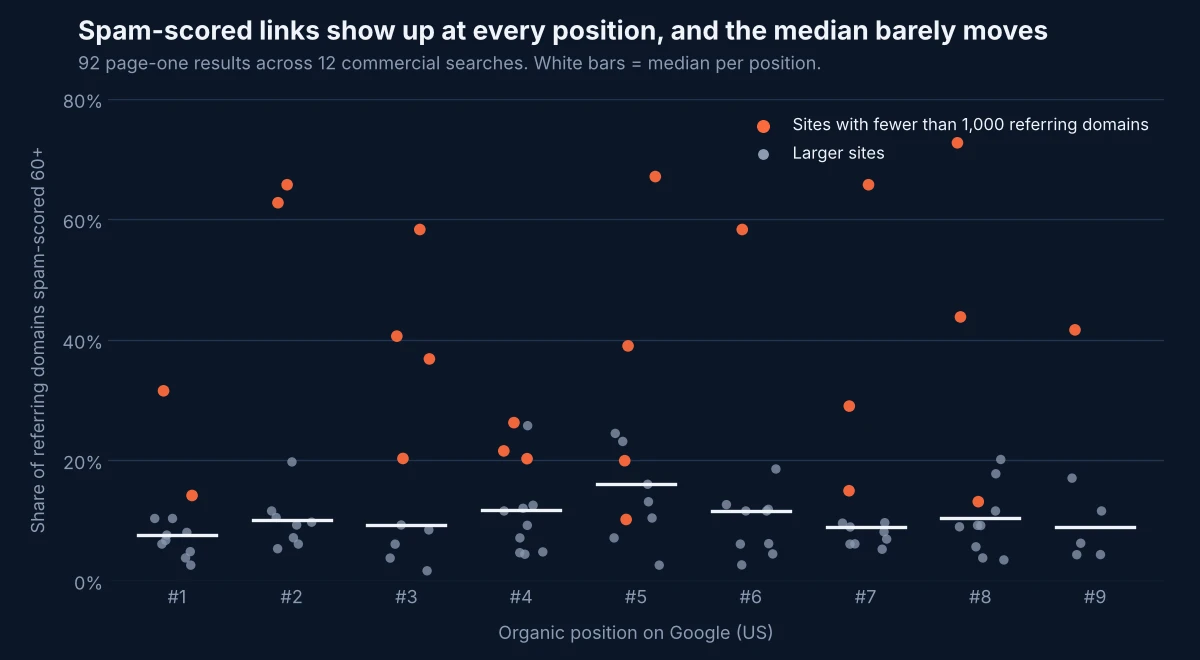
The table below gives the same comparison in position bands, with the count of results at or above 10% and 20%.
| Position band | Results | Median spam share | Results at 10%+ | Results at 20%+ |
|---|---|---|---|---|
| 1 to 3 | 30 | 9.3% | 13 | 7 |
| 4 to 6 | 33 | 11.9% | 22 | 9 |
| 7 to 9 | 29 | 9.2% | 12 | 6 |
Site size explains far more of the variation than position does. A site with 60 referring domains, 35 of them spam-scored, looks alarming in percentage terms; a site with millions of referring domains absorbs hundreds of thousands of spam links and barely moves the ratio. In absolute terms the large sites carried by far the most spam-scored links: the index returned more than a million spam-scored referring domains for one encyclopaedia domain and hundreds of thousands for a large video platform.
| Ranking site's referring domains | Results | Median spam share | Average position | Top-three places |
|---|---|---|---|---|
| Fewer than 1,000 | 23 | 36.8% | 4.8 | 8 |
| 1,000 to 99,999 | 47 | 9.3% | 4.7 | 17 |
| 100,000 or more | 22 | 6.1% | 5.3 | 5 |
Two further details stood out. First, the spam we sampled was often new and indiscriminate. In 36 of our 77 domain lookups, the first spam-scored referring domain the index returned had been first seen on 27 or 28 November (a date that may partly reflect when the index crawled the link), and five domains accounted for 33 of those 36: an online casino domain, a domain named after an anti-parasite drug, a .one domain, an .xyz domain with "seo-anomaly" in its name and a recipe domain. The same handful of spam sites were linking to project management blogs, office furniture retailers and accounting software vendors at the same time. That pattern looks like automated link spam sprayed across the web, not a targeted attack on anyone.
Second, spam scores from tools are blunt. In the lookup for one large forum, the first referring domain returned above the 60 threshold was the BBC's main UK domain, with a score of 63. A disavow file built mechanically from that kind of score would include one of the most authoritative publishers in the world.
Our sample is small and the data is correlational, so it cannot prove what Google does internally. Because we only looked at sites that already rank on page one, it also cannot show whether spam links pushed other sites off it. What it can show is that the pattern the theory predicts is missing: there is no sign that sites with more spam-scored links are being pushed down page one. It fits with our earlier count of spam-scored linkers behind Search Console's links report, which found 150,823 of them (at a lower threshold of 50) across just 12 SaaS sites. None of this means links stop mattering: when we tested whether Google still ranks on links, results with more referring domains tended to rank higher.
Evidence against the theory
- Google's documentation describes neutralising, not punishing. Both the 2016 Penguin post and the 2022 link spam update describe links losing value. Neither describes inbound spam adding a ranking penalty.
- Google's help pages tell most sites to leave the disavow tool alone. The disavow page ties its use to manual actions, not to routine clean-up, and the competitor harm page says Google works to stop third parties from harming you.
- A Googler on record has dismissed it. Mueller rejected the toxic link concept twice in 2024, once on Reddit and once on Bluesky.
- Live results do not show the predicted pattern. In our data, top-three results had almost the same median spam share as results seven to nine, and sites with more than a third of their linking domains spam-scored held top-three places.
- The spam is everywhere. If spam links could demote sites, the domains in our sample, including Google's own domain and a major encyclopaedia, would be among the most exposed. They rank anyway.
The manual action remains the important exception. It targets patterns of unnatural links, and in practice the patterns that matter are the ones a site created or paid for: bought links, excessive link exchanges and automated link building, all listed in Google's link spam policy. Random spam that a site did not build does not fit that description, and Google says that in most cases it can work out which links to trust without help.
Verdict: debunked, for links you did not build
Our verdict is debunked for the version of the theory most site owners worry about: that spammy third-party links, as graded by SEO tools, pull rankings down and must be disavowed. Google has said on the record since 2016 that its systems devalue such links rather than penalising sites, its help pages tell most sites not to use the disavow tool, and our live check of 92 page-one results is consistent with that position: spam-scored links on every one, and no detectable relationship between their share and ranking position.
Two limits apply. First, links a site bought or built to manipulate rankings are a different matter: Google's spam policy covers them and the manual action for unnatural inbound links is real. Second, our data is a single snapshot of 12 searches, covers only sites that already rank on page one, cannot tell built links from unbuilt ones and uses a third-party spam score rather than Google's own assessment, so it cannot rule out rare edge cases. The verdict rests mainly on Google's record; our data supports it rather than proving it.
What this means for SEO teams
- Stop disavowing on tool scores alone. A high spam share is normal, especially for small sites. Our data suggests it says more about the size of your link profile than about risk.
- Check Search Console's Manual actions report first. If there is no "Unnatural links to your site" action, Google's own documentation says you most likely do not need the disavow tool.
- Audit the links you created, not the ones that arrived. Paid placements without
rel="sponsored"orrel="nofollow", excessive link exchanges and keyword-rich widget or footer links are what the spam policy names. Fix or qualify those. - Read rank drops as a quality or relevance question first. A drop that lines up with a core update is far more likely to come from the update than from a wave of casino links. Our investigation into site-wide quality scoring covers what notes filed in the US antitrust trial suggest about how sites are judged as a whole.
- Treat an existing disavow file with care. Google's manual actions page warns against disavowing organic links, and its disavow page says the tool can harm your site if used incorrectly. If an old file disavows whole domains on the strength of a tool score, review it rather than adding to it.
Methodology
On 28 November 2026 we pulled Google's organic results for 12 commercial searches (project management software, CRM software for small business, best VPN, email marketing software, password manager, web hosting, payroll software, best running shoes, standing desk, accounting software for small business, website builder and noise cancelling headphones) through a SERP API, set to the United States and English. We recorded Google's organic position for each result and its host from the displayed breadcrumb, because the SERP API returned redirect addresses for result links. Positions count every organic result, including videos. We excluded 10 results whose host was not shown, mostly video and forum results, leaving 92 results from 77 registrable domains.
For each of the 77 domains we queried a commercial backlink index for two numbers: the total count of live referring domains (including subdomains), and the count of referring domains whose links to the target carry the index's spam score of 60 or more on its 0 to 100 scale. Spam share is the second number divided by the first. We compared spam share across positions with medians and a Spearman rank correlation, and grouped results by the size of the ranking domain's link profile. Data is domain-level, not page-level, and a domain ranking for several searches counts once per result. The spam score is the index's own metric and is not a Google measure. The "first seen" observations come from the first record the index returned for each filtered lookup and do not describe a full sample of each domain's links.
Conclusion
The toxic link theory survives because it sounds logical and because tools sell a fix for it. The evidence points the other way. Google has described devaluing spam links since 2016 and neutralising them with SpamBrain since 2022, its help pages tell most sites to leave the disavow tool alone, and in our check every page-one result carried spam-scored links, with no sign that more of them meant a lower position.
The risk that remains is the one site owners create themselves: paid and manipulative links that can still bring a manual action. Time spent on those is well spent. Time spent disavowing casino domains that link to everyone is, as Mueller put it, mostly billable.
What do you think?
Have you seen a ranking change you could tie to a spam link attack rather than an update, with dates from Search Console to show it? Tell us what happened and what the data showed.
Questions and answers
Do toxic backlinks hurt Google rankings?
Google has said since 2016 that Penguin devalues spam rather than demoting whole sites, and in December 2022 it said SpamBrain neutralizes unnatural links. In our 28 November 2026 check of 92 page-one Google results, every result had spam-scored referring domains, with a median share of 9.3% in positions one to three and 9.2% in positions seven to nine.
Should I use Google's disavow tool?
Google's disavow documentation says most sites will not need it. It advises disavowing only when a site has a considerable number of spammy, artificial or low-quality links and those links have caused, or likely will cause, a manual action.
Can a competitor hurt my rankings by pointing spam links at my site?
Google's Search Console Help says it works hard to prevent other site owners from being able to harm your ranking.
Can inbound links ever lead to a Google penalty?
Yes. Google's manual actions report includes 'Unnatural links to your site', issued when Google detects a pattern of unnatural, artificial, deceptive or manipulative links pointing to a site. Google's link spam policy lists practices such as buying links for ranking purposes and excessive link exchanges.
What has John Mueller said about toxic links?
In a Bluesky reply on 16 December 2024, Google's John Mueller described disavowing toxic links flagged by SEO tools as a billable waste of time. In May 2024, Search Engine Roundtable reported a Reddit comment in which he said the toxic link concept was made up by SEO tools.
More releases
-
Studies
AI Overviews Reach 88.5% of French Keywords; YouTube Took 78 of 344 Citations in Our Test
Four months after Google launched AI Overviews in France, an Ahrefs study puts them on 88.5% of tracked French desktop keywords and estimates a net 24.4% click-through loss. Our own pull of 40 google.fr searches found an overview on 38, with YouTube supplying 22.7% of 344 citations against 3.2% of the organic links beside them.
-
Industry news
Google AI Mode Camera Takes 10 Photos per Query; 5 of 15 Photo Answers Cited No Sources
Google's AI Mode camera now lets users attach up to 10 photos to one question, a change Google has not announced. In our 24-subject test, photo answers listed 107 sources against 64 for typed questions, but 5 of 15 photo answers cited nothing, and 68% of photo citations hid behind Google redirects.
-
Explainers
Google Tells Sites to Drop 404s From Sitemaps; 49 of 485 Top Sites Still List Them
Google moved its 404 advice into Search Central on 27 November, telling site owners to remove deleted URLs from sitemaps, not to block them in robots.txt and that a 410 generally means less frequent crawling. Our sample of 9,427 sitemap URLs on 485 top sites found dead pages listed on 49 of them.
Tell us the site and the goals.
Rankings in Google and visibility in AI answers, from one monthly plan. One call is enough to say which one fits. Email works just as well.