Google AI Mode Labels Personalized Answers; 20 of 20 Logged-Out Answers Asked for Details
Google's AI Mode now labels answers shaped by a user's own Google activity and offers a "Try without personalization" option. In 20 logged-out AI Mode searches we ran on 29 November, none showed the label, and all 20 asked the searcher for personal details before tailoring further.
 Vibhu Dhariwal
Cofounder & CTO, Digital Gratified
- Published
- Section
- Updates
- Reading time
- 8 minutes
Ras Al Khaimah, United Arab Emirates, .
Google's AI Mode has started showing a "Personalized for you" label under answers that draw on a signed-in user's own Google activity. Google promised the label in a 23 November Keyword post by Robby Stein, VP of Product for Search, which said a Personalization icon would come "soon". Search Engine Watch reported this week that the label and its side panel are now appearing in AI Mode, and Google's AI Mode personalization help page now describes how it works.
The label lands days before the December 2026 core update, which Google has said will include improvements to personalized results. To see what rank trackers and logged-out checks can and cannot see, we ran 20 AI Mode searches built around the examples Google itself uses for personalization (trip planning, card rewards, tax preparation and food). None of the 20 answers carried the label. All 20 asked the searcher to share personal details before tailoring the answer further.
What changed
- A visible label. Google's help page says a "Personalized for you" icon appears below a response that used personal context. Selecting it opens a summary that only the account holder can see, even when a thread is shared.
- A one-click opt-out per answer. Below the summary sits a "Try without personalization" option that shows the same response without personal context.
- A "Personalizing" step. The help page says AI Mode can show a "Personalizing" step without the icon when it checked a user's context but did not use it.
- Memory, US English only. The same page says AI Mode memory is limited to the US and English, and personalization requires users aged 18 or over with history and personalized recommendations switched on.
Search Engine Watch's screenshots show the panel opening with the line "Here's what I used to personalize this response. Only you can see this." It also noted a gap between promise and product: the panel currently gives a general "Recent activity" explanation with a link to My Activity, rather than listing the specific items used for that answer. Google's 23 November post had said users would be able to view the context AI Mode used.
How the disclosure now compares across Google Search
We read Google's three current help pages on personalization side by side. Classic results, AI Mode and AI Overviews now carry different levels of disclosure.
| Surface | On-page label | Per-result opt-out | What Google's help page says |
|---|---|---|---|
| Classic web results | "Results are personalized" or "Results are not personalized" at the foot of the page | Yes, "Try without" link | Personalization can reorder results and content blocks; not all results are personalized |
| AI Mode | "Personalized for you" icon under the answer, plus a "Personalizing" step | Yes, "Try without personalization" | Uses Search Services History, memory and connected apps; 18+ only |
| AI Overviews | None documented | None documented | Not named in the AI Mode page body; the settings page refers only to "AI-powered" responses |
The gap matters because Google's 23 November post also said users will see more personally relevant responses in AI Overviews, tailored to recent search context. That change needs no connected apps, and Google has published no label for it. The help page for classic results says plainly: "Not all search results are personalized." No equivalent statement exists yet for AI Overviews.
Our test: what a logged-out check sees
We pulled 20 US English AI Mode answers on 29 November the way automated tools collect them, with no signed-in account or search history, five per topic, using queries that mirror the use cases Google cites: planning a trip, getting more from cards linked to Wallet, preparing for tax season with Drive files, and food choices (Google's own example is telling AI Mode you are no longer vegetarian).
- 0 of 20 answers showed a "Personalized for you" label or a "Personalizing" step.
- 20 of 20 ended by asking for personal details: budget, where you are staying, filing status, monthly spend, dietary preferences or what is in your fridge. One, for "recipes for a dinner party", returned only the question and no recipes.
- 2 of 20 still tailored to location without an account: a tax documents answer added California health insurance rules, and a birthday dinner answer listed California restaurants. That matches Google's settings page, which says some tailoring based on current context, such as location, continues even with personalization off.
- 5 of 20 answers carried no references at all.
The follow-up questions are the part to watch. Each asks for the kind of context Google says signed-in personalization can supply from search history, memory or connected apps such as Wallet and Drive. Our logged-out answers are the generic version; the answer a personalized user gets may start from those details instead.
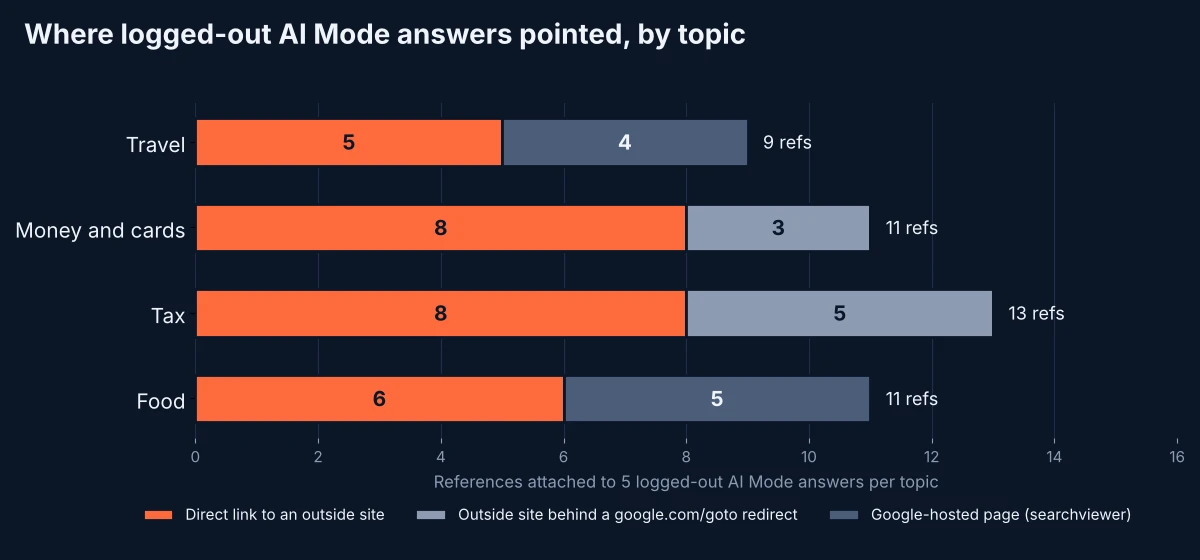
Across the 44 references attached to those answers, 27 linked straight to an outside site, 8 pointed to an outside site through a google.com/goto redirect, and 9 went to Google-hosted searchviewer pages. The Google-hosted pages came only from the two local-style queries (things to do in Chicago this weekend and birthday dinner restaurants). We covered the redirect format in our report on Google's /goto links and rank tracking.
Context: three personalization moves in one week
The label is the third personalization change from Google in a week. On 23 November, Google added Wallet to Personal Intelligence in AI Mode and said Drive and Gemini app connections would follow in the coming weeks; we tested how often money answers already asked for personal details in our Wallet report. On 24 November, Google's Search Status Dashboard preannounced the December 2026 core update, listing among its aims "improving personalized results for people who have personalization turned on." We covered the timing of that notice in our December core update report.
Personalization in Search is not new. Google has offered the "Try without" link on classic results for some time, and its help page describes reordering results based on account activity. What is new is the scale of personal data that AI Mode can draw on (Gmail, Calendar, Photos, Wallet and soon Drive) and the fact that the output is generated text rather than a reordered list.
What this means for SEO teams
- Treat AI Mode tracking data as a baseline, not the answer users see. Logged-out collection returned the unpersonalized version every time in our test. Report it that way to stakeholders, especially after the December core update lands.
- Test signed in, then use the opt-out. Run priority queries in a signed-in browser with history on, check for the "Personalized for you" label, then use "Try without personalization" on the same answer. The difference between the two is the clearest view of personalization you can get today.
- Answer the follow-up questions on your pages. The details AI Mode asked for (budget tiers, filing status, dietary needs, spending categories) are the variables it asked for before narrowing its answers. Pages that segment advice by those variables give it something to cite for each version of the user.
- Watch local and dated queries closely. Location tailoring appeared in logged-out answers already, and Google-hosted pages took every reference in the two local-style queries we ran.
- Do not read AI Overviews changes as unpersonalized. Google says AI Overviews will use recent search context, and it has documented no label there, so a citation you see may not be the one a returning searcher sees.
Methodology
On 29 November 2026 we collected 20 Google AI Mode responses through a SERP API with US location and English language settings and no signed-in account or search history. Queries were grouped into four topics of five, chosen to match the personalization examples in Google's 23 November post: travel (for example "plan a 3 day trip to Lisbon"), money and cards ("which credit card should I use for groceries"), tax ("how to prepare for tax season") and food ("meal prep ideas for the week"). For each response we recorded the paragraph and heading text and the list of reference links. We counted a response as asking for personal details when its text invited the user to share their own circumstances (for example "tell me" or "let me know" followed by details about the user). References were classed as direct outside links, google.com/goto redirects, or Google-hosted searchviewer pages. We searched all collected text for the "Personalized for you" label and a "Personalizing" step; the word "personalized" appeared only in two answers offering a personalized recommendation if the user shared more details. The API returns the unpersonalized experience by design, so this test shows what logged-out tools see; it cannot show what a signed-in user sees. Google's help pages were read on the same day.
Conclusion
Google now tells AI Mode users when an answer was shaped by their own activity and lets them view it without that context. For SEO teams, the label confirms that the AI Mode answer a signed-in customer sees can differ from the one tracking tools collect, and our 20 logged-out answers show where that split begins: every one stopped to ask for details that a personalized session may already hold.
The open questions are how widely the label rolls out, whether the panel will list the specific items used as Google first described, and whether AI Overviews get a comparable disclosure before the December core update starts adding personalization changes of its own.
Questions and answers
What is the "Personalized for you" label in Google AI Mode?
According to Google's AI Mode personalization help page, it is an icon shown below a response that used your personal context. Selecting it shows a summary of the personal information used, which only you can see, plus a "Try without personalization" option.
Who can get personalized AI Mode answers?
Google's help page says users must be 18 or older with history and personalized recommendations turned on. AI Mode memory is available in the US in English only.
Do AI Overviews show a personalization label?
Google has not documented one. Its 23 November post said AI Overviews and AI Mode will give more personally relevant responses tailored to recent search context, but the AI Mode help page body does not discuss AI Overviews.
Can rank trackers see personalized AI Mode answers?
Not in our test. None of the 20 AI Mode answers we collected without a signed-in account showed the label, and all 20 asked the searcher to share personal details instead.
Is the December 2026 core update related to personalization?
Google's Search Status Dashboard says the December 2026 core update includes improving personalized results for people who have personalization turned on. Google said it is scheduled for release in December 2026.
More releases
-
Studies
Google's Discover Job Ads Look Beyond Clicks; 2 of 8 Name AI-Generated Content
Eight live Google job listings for the Discover feed describe ranking models pushed beyond click-through rate toward scroll depth and long-term satisfaction, and two name AI-generated content as feed material. A ninth listing, reported for naming a system called StarSearch, now returns "Job not found". Google's Discover documentation mentions none of this.
-
Studies
Google Targets Long Questions in December; 16 of 20 Shared No Top URL With the Head Term
Google says its December core update will change how it ranks longer, more complex questions. In our 40-search baseline, 16 of 20 long questions shared no organic URL with the head term on the same topic, and forums, video and social posts took 36.3% of their links against 8.6%.
-
Industry news
WSJ Now Blocks All Bots by Default; 19 of 142 News Sites Do, and All 19 Admit Googlebot
The Wall Street Journal's robots.txt now disallows every crawler it does not name. Our check of 142 news sites found 19 using the same default-deny rule, 15 of them News Corp titles. All 19 admit Googlebot and Bingbot; none admits Google-Extended, ClaudeBot or CCBot, while OpenAI's crawlers get in on most.
Tell us the site and the goals.
Rankings in Google and visibility in AI answers, from one monthly plan. One call is enough to say which one fits. Email works just as well.