WSJ Now Blocks All Bots by Default; 19 of 142 News Sites Do, and All 19 Admit Googlebot
The Wall Street Journal's robots.txt now disallows every crawler it does not name. Our check of 142 news sites found 19 using the same default-deny rule, 15 of them News Corp titles. All 19 admit Googlebot and Bingbot; none admits Google-Extended, ClaudeBot or CCBot, while OpenAI's crawlers get in on most.
 Vibhu Dhariwal
Cofounder & CTO, Digital Gratified
- Published
- Section
- Industry news
- Reading time
- 8 minutes
Ras Al Khaimah, United Arab Emirates, .
The Wall Street Journal now tells every crawler it does not name to stay out. Nieman Lab reported on 24 November that Dow Jones rewrote the robots.txt files of its consumer news sites in May so that they disallow all bots by default, then lets in a list of named crawlers. We fetched the robots.txt files of 142 English-language news sites on 28 November to see how far the approach has spread and which crawlers make the cut. Nineteen sites use it. All 19 admit Googlebot and Bingbot. None admits Google-Extended, Anthropic's ClaudeBot, Common Crawl's CCBot or Meta's AI crawler.
Key findings
- 19 of 142 news sites we checked (13%) disallow every crawler that is not named in their file. The list is not random: we picked sites Nieman Lab named alongside a general sample, and none of the 118 sites in that general sample uses the pattern.
- 15 of 16 News Corp sites we checked are default-deny, including six business titles (WSJ, Barron's, MarketWatch, Financial News, Mansion Global and Investor's Business Daily) and nine UK and Australian titles such as The Times, The Sun and The Australian. The New York Post is the exception.
- Allowlists run from 10 to 99 user agents, with a median of 65. The WSJ file names 62, which matches Nieman Lab's count of more than 60.
- Search crawlers always get in: Googlebot and Bingbot are allowed on 19 of 19, Applebot on 18.
- OpenAI is the AI company these files favour: OAI-SearchBot and ChatGPT-User are allowed on 17 of 19, GPTBot on 14. Claude-SearchBot and PerplexityBot are allowed on 2 of 19.
- Google-Extended is shut out on all 19, even though Googlebot is welcome on every one of them.
What Dow Jones changed
Before the switch, the usual publisher pattern was a blocklist: an open User-agent: * group followed by named groups that disallow specific AI crawlers. Dow Jones flipped that. The live WSJ robots.txt opens with a notice that automated collection needs written permission, then a group that disallows everything for User-agent: *. Below it sits a single allow group that lists search engines, ad verification bots, social preview fetchers, several SEO tool crawlers and three OpenAI agents.
Nieman Lab ties the OpenAI entries to News Corp's licensing deal with OpenAI, which it puts at more than $250 million. Dow Jones chief development officer Nolly Evans told the outlet that "the old norms are no longer working." Nieman Lab also cites a bot analytics firm's estimate that about 2% of 1,000 leading English-language publisher sites disallow all bots by default.
Our sample is far smaller and deliberately weighted toward the publishers in that story, so our 13% is not a market estimate. The clearer signal is the general sample: 0 of 118 large news sites outside the named groups block unknown crawlers by default.
Who gets past the default
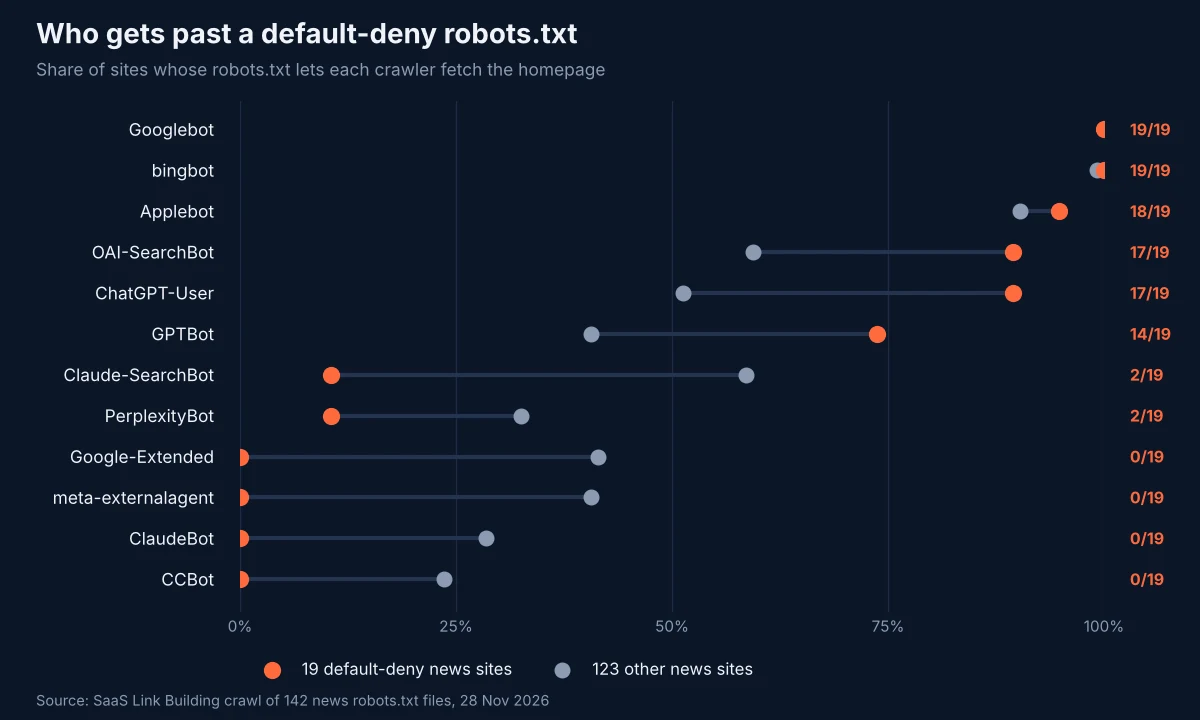
The chart shows the trade these publishers are making. Compared with the 123 news sites that keep an open default, the default-deny group is more generous to OpenAI and far stricter with everyone else. GPTBot is allowed on 14 of 19 default-deny sites but on only 50 of the 123 others. ClaudeBot goes the other way: blocked on 88 of the 123 open-default sites (72%) and on all 19 default-deny sites.
The individual files show how much each allowlist depends on deals and housekeeping rather than a shared policy.
| Site | User agents allowed | GPTBot | OAI-SearchBot | Claude-SearchBot | PerplexityBot |
|---|---|---|---|---|---|
| wsj.com | 62 | Yes | Yes | No | No |
| barrons.com | 77 | Yes | Yes | No | No |
| marketwatch.com | 76 | Yes | Yes | No | No |
| thetimes.com | 47 | Yes | Yes | No | No |
| thesun.co.uk | 48 | Yes | Yes | No | No |
| heraldsun.com.au | 99 | Yes | Yes | No | No |
| adelaidenow.com.au | 62 | No | No | No | No |
| reuters.com | 85 | No | Yes | No | No |
| news.bloomberglaw.com | 92 | No | Yes | Yes | Yes |
| theregister.com | 42 | No | Yes | Yes | Yes |
| publishersweekly.com | 10 | No | No | No | No |
Table: 11 of the 19 default-deny sites. The other eight (fnlondon.com, mansionglobal.com, investors.com, theaustralian.com.au, dailytelegraph.com.au, couriermail.com.au, news.com.au and thescottishsun.co.uk) allow GPTBot and OAI-SearchBot and block the other two. "User agents allowed" counts the named tokens in each file that may fetch an article URL. Source: robots.txt files fetched 28 November 2026.
Two details stand out. Adelaide Now's file names the same user agents as its sibling news.com.au except that it leaves out ChatGPT-User, GPTBot and OAI-SearchBot, so OpenAI's crawlers fall into the default disallow there while news.com.au, The Australian and the Herald Sun admit them. Reuters, by contrast, makes a deliberate split: it allows OAI-SearchBot and ChatGPT-User but not GPTBot.
Why Googlebot gets in and Google-Extended does not
Google's robots.txt specification says only one group applies to a crawler: the one with the most specific matching user agent. Any Google token without its own group falls back to the * group. On a default-deny file that means "disallow everything" unless the token is listed.
None of the 19 files lists Google-Extended, so all 19 opt out of it by omission. Google's Google-Extended documentation, published as a standalone page on 24 November, says the token governs training and grounding in Google's generative AI products outside Search. It does not affect inclusion or ranking in Search, and grounding in AI Overviews and AI Mode is managed through a separate Search generative AI control in Search Console. We covered the rewrite in our report on Google's narrower Google-Extended scope and the Search Console switch in our explainer on the Search generative AI control.
So a default-deny file, read on its own, keeps these publishers out of Gemini training and non-Search grounding but says nothing about AI Overviews. Whether any of them has also used the Search Console control is not visible from outside, and we have not seen any of them say so.
The same fallback catches Google crawlers that are easy to forget. Storebot-Google, which Google says affects every Google Shopping surface, is not named on five of the 19 files (The Times, The Sun, The Scottish Sun, Publishers Weekly and The Register), so it is disallowed there. Googlebot-News has no such problem: Google lists Googlebot as its fallback token, so it inherits Googlebot's access on all 19.
What this means for SEO teams
- If you run a default-deny file, audit it against Google's full crawler list. Any token you leave out is blocked. Check each Google token's fallback in Google's crawler documentation, list Storebot-Google explicitly if Shopping matters, and decide on Google-Extended on purpose rather than by omission.
- Remember that Google-Extended is not your AI Overviews switch. Publishers that want to limit grounding in Search AI features need the Search Console control; robots.txt for Google-Extended does not do it.
- Add your own tools. On default-deny sites, SEO tool crawlers only get in when named. The most widely listed SEO crawler in our sample is allowed on 16 of 19 sites; another popular one on just 8. Site audits run from a blocked crawler will return nothing useful.
- Keep sister sites in sync. The Adelaide Now gap shows how one missing line changes a whole company's AI policy on one domain. Diff robots.txt files across your properties after every change.
- Plan for new search crawlers. A default-deny file blocks any new engine until someone adds it. Assign an owner to review new crawler announcements.
- Do not treat robots.txt as enforcement. Nieman Lab notes that robots.txt is voluntary, and at least one publisher in its report hard-blocks bots instead. We tracked a crawler that most news blocklists missed in our report on the NYT lawsuit against Brave.
Context
Default-deny is the strictest version of a trend we have tracked all month. When DMGT joined the SPUR publisher coalition, 28 of 43 member sites blocked Google-Extended and none blocked Googlebot, as our SPUR robots.txt analysis showed. The default-deny group takes the same line on Google (Search yes, Gemini no) but reaches it without naming Google-Extended at all, and it adds a commercial layer on top: the AI company with a News Corp licensing deal is the one most often let in.
Methodology
On 28 November 2026 we requested /robots.txt from 157 news domains: 16 News Corp sites (six of them business titles), the 8 other publishers named in the Nieman Lab report, and 133 large English-language news and magazine sites chosen before the crawl. We kept 142 valid files. We dropped 14 that returned errors or a page that was not a robots.txt file, and the Telegraph, which served two different robots.txt files depending on the user agent we sent. We parsed each file with an open-source parser that follows Google's most-specific-group matching. A site counts as default-deny when an invented user agent is disallowed from both the homepage and an article path. Crawler access in the chart is measured at the homepage; "user agents allowed" counts named tokens permitted to fetch a sample article path. Robots.txt shows stated policy only. It does not show server-side blocking, licensing terms or what crawlers actually do.
Conclusion
Default-deny robots.txt files are still rare among news sites, but they are now standard across News Corp and a handful of other publishers. In every file we found, the rule protects Google Search traffic and blocks Google-Extended, while OpenAI, which has a licensing deal with News Corp, is the AI company most often let in.
For SEO teams the risk is quieter than the headline: every crawler left off the list is blocked, including Google's shopping crawler on five of the 19 sites. Anyone copying this model should start from Google's full crawler list and the Search Console AI control, not from a competitor's file.
Questions and answers
What is a default-deny robots.txt file?
It is a robots.txt file whose User-agent: * group disallows the whole site, followed by a group that allows a list of named crawlers. Any crawler not on that list is told to stay out. Nieman Lab reported that Dow Jones moved its consumer news sites, including The Wall Street Journal, to this setup in May.
Does blocking Google-Extended remove a site from Google Search or AI Overviews?
No. Google's Google-Extended documentation says the token does not affect inclusion or ranking in Google Search, and that grounding in AI Overviews and AI Mode is managed with the Search generative AI control in Search Console instead.
How many news sites use default-deny robots.txt files?
In our 28 November 2026 check, 19 of 142 English-language news sites did, including 15 of 16 News Corp sites. None of the 118 sites in our general sample did. Nieman Lab cites an outside estimate of about 2% of 1,000 leading English-language publisher sites.
What happens to Google crawlers that are not listed in a default-deny file?
Google's robots.txt specification says a crawler follows the most specific matching group, and falls back to the * group when none matches. On a default-deny file that means the crawler is disallowed. In our sample, Storebot-Google, which Google says affects Google Shopping surfaces, was blocked this way on 5 of the 19 sites.
More releases
-
Updates
Google AI Mode Labels Personalized Answers; 20 of 20 Logged-Out Answers Asked for Details
Google's AI Mode now labels answers shaped by a user's own Google activity and offers a "Try without personalization" option. In 20 logged-out AI Mode searches we ran on 29 November, none showed the label, and all 20 asked the searcher for personal details before tailoring further.
-
Studies
Google's Discover Job Ads Look Beyond Clicks; 2 of 8 Name AI-Generated Content
Eight live Google job listings for the Discover feed describe ranking models pushed beyond click-through rate toward scroll depth and long-term satisfaction, and two name AI-generated content as feed material. A ninth listing, reported for naming a system called StarSearch, now returns "Job not found". Google's Discover documentation mentions none of this.
-
Studies
Google Targets Long Questions in December; 16 of 20 Shared No Top URL With the Head Term
Google says its December core update will change how it ranks longer, more complex questions. In our 40-search baseline, 16 of 20 long questions shared no organic URL with the head term on the same topic, and forums, video and social posts took 36.3% of their links against 8.6%.
Tell us the site and the goals.
Rankings in Google and visibility in AI answers, from one monthly plan. One call is enough to say which one fits. Email works just as well.