Google Redefines Google-Extended; Its Own Robots.txt Bars 41 Other AI Bots From Maps
Google moved Google-Extended to its own documentation page on 24 November, widening it from Gemini Apps and Vertex AI to Google's generative AI products and adding four exceptions. Our crawl found 81 of 536 top-site robots.txt files block it, while google.com bars 41 other AI crawlers from Maps but not Google-Extended.
 Vibhu Dhariwal
Cofounder & CTO, Digital Gratified
- Published
- Section
- Updates
- Reading time
- 7 minutes
Ras Al Khaimah, United Arab Emirates, .
Google gave its Google-Extended robots.txt token a standalone documentation page on 24 November 2026, and the new text does more than move the old paragraph. Where Google previously said the token covered training and grounding for Gemini Apps and Vertex AI, it now covers foundation models behind Google's commercially available generative AI products in general, with four named exceptions. Our crawl of 536 top-site robots.txt files found 81 that disallow Google-Extended for the whole site. Google's own robots.txt takes a different route: it puts Google-Extended in its default group, while 41 named third-party AI crawlers and the planned shared training token get an extra rule that shuts them out of every URL under /maps.
The change is listed in the crawling documentation changelog for 24 November, the day after Google documented a dozen more crawlers and fetchers, which we covered in our report on the 12 newly listed Google crawlers. The common crawlers page now points to the new page instead of describing the token itself.
What changed
The English common crawlers page no longer carries the old definition, but Google's 18 translated versions of that page still do. All 18 were last updated between 2 and 15 November and describe the token in the earlier terms, which lets us compare the two texts directly.
| Topic | Before (translated versions, early November) | New standalone page (24 November) |
|---|---|---|
| Training covered | Future Gemini models that power Gemini Apps and the Vertex AI API for Gemini | Foundation models that power commercially available Google generative AI products and services generating creative or informational output |
| Grounding covered | Gemini Apps and Grounding with Google Search on Vertex AI | Those same products, except Search and other Search services |
| Exceptions | None listed | Four: safety and abuse systems, task-specific models, accessibility and translation features, and products covered by other consents |
| How it is applied | No separate user agent; existing Google crawlers fetch pages | Googlebot, GoogleOther and other training or grounding crawlers record each page's status, and Google applies it downstream |
| Syndicated copies | Not mentioned | Site owners must apply the rule on every domain where their content is published or syndicated |
| Mentions and links | Not mentioned | Responses may still name or link to a blocked site if other sites mention it |
| Google Search | No effect on inclusion or ranking | Same, plus a pointer to the Search generative AI control in Search Console for AI Overviews and AI Mode |
Source: Google Crawling Infrastructure documentation, English Google-Extended page and the 18 translated common crawlers pages, fetched 25 November 2026. Translated text paraphrased in English by our desk.
The four exceptions
The new page says Google-Extended does not apply to:
- Safety systems: models and grounding used to detect spam, abuse, security threats, fraud and other harmful behaviour, or to protect users and Google services.
- Specialised models: models trained or fine-tuned for discrete tasks, such as robotics models or standalone models outside a broader multimodal system, and features built on them.
- Accessibility, transcription and translation features and models.
- Products and features already covered by other consents.
The old text did not say whether content from a site that blocked the token could train, say, a translation model. The new page says the token does not apply to them. It does not list which products fall into each category.
No crawler to block
The page also explains the mechanics more fully. In its words, "Google doesn't run a separate 'Google-Extended web crawler'". Instead, when Googlebot, GoogleOther or other crawlers used for training and grounding fetch a page, they record its Google-Extended status, and Google's systems then restrict training and non-Search grounding for pages that disallow it.
That matters for sites that try to opt out by blocking crawlers. In our crawl, 9 sites disallow GoogleOther for the whole site but neither block Google-Extended nor block all crawlers with a wildcard rule. CNN's robots.txt, for example, groups GPTBot and GoogleOther together but does not name Google-Extended. Under the new description, Googlebot would still record those pages as allowed for Google-Extended. Whether that is intended is a question only those sites can answer.
Our crawl: who blocks the token
Of the 536 valid robots.txt files we fetched from the Tranco top 1,000 domains, 127 name Google-Extended in a group: 81 disallow the whole site, 29 disallow some paths, and 17 name it without disallowing anything. Fewer sites fully block it than block several third-party training crawlers.
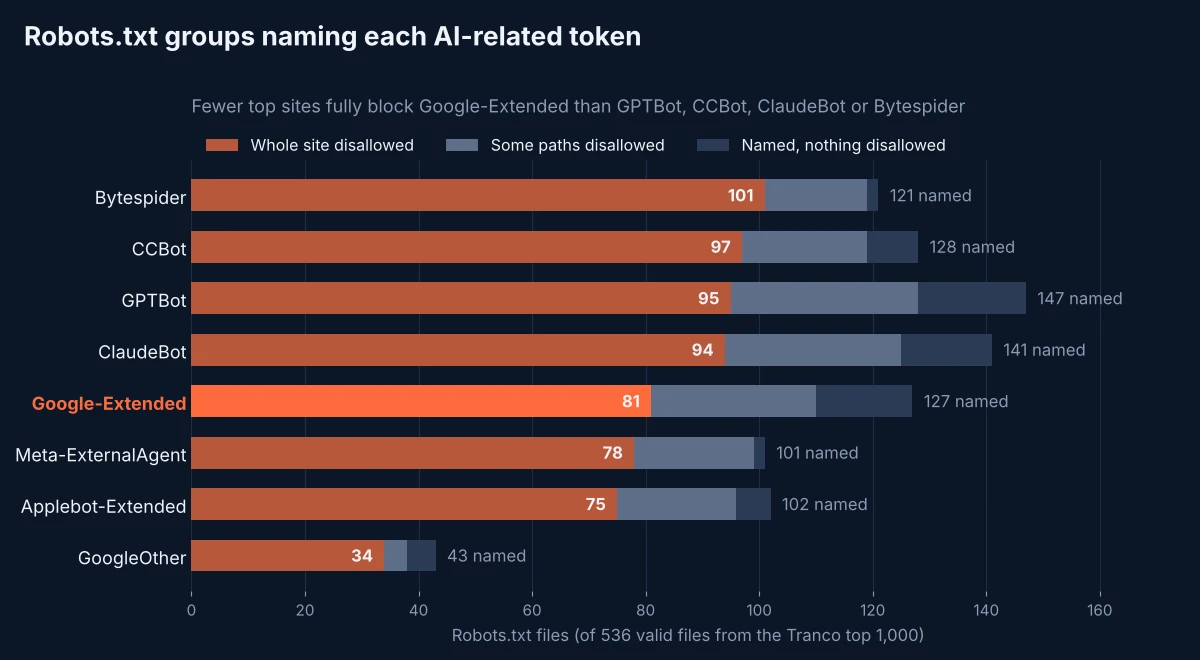
Twenty-five sites disallow GPTBot for the whole site without doing the same for Google-Extended. For 22 of them, Google-Extended is not named anywhere and no wildcard rule blocks everything, so Google's training and non-Search grounding remain allowed. That group includes CNN, eBay, Medium, Forbes, Airbnb, AP News and the Los Angeles Times. Another 32 files never name Google-Extended but block all crawlers through a wildcard rule, which Google-Extended follows by default.
Google's own file treats its token differently
The first group in google.com's robots.txt names three user agents: the wildcard, Google-Extended and Yandex. Further down sits a separate group headed by __usage_ai-training, the shared training token Google says it will support, followed by 41 named AI crawlers including GPTBot, ClaudeBot, CCBot, Applebot-Extended, Meta-ExternalAgent and DeepSeekBot.
The two groups share almost all of their rules. The difference is Maps. The default group, which covers Google-Extended, carries 54 Maps-specific lines, more than 30 of them allow rules for Maps place, search, directions and reservation pages. The AI training group drops all 54 and uses a single Disallow: /maps instead. The same file is served unchanged on google.de, google.co.uk, google.com.br, google.com.hk and doubleclick.net.
Google's October blog post on the shared control says it will read a shared training opt-out as a Google-Extended disallow only when Google-Extended is not named explicitly. Google.com names it explicitly in the default group, so on Google's stated rule the shared token's Maps block would not reach Google-Extended there. We found no Google statement explaining the difference.
Google is not alone in preparing for the shared token. Twenty files in our crawl already contain a __usage_ai-training group, from seven organisations: Google, Meta, X, LinkedIn, IMDb, Corriere della Sera and pixiv. We covered the background in our report on Google's plan to honour a shared AI training opt-out.
What this means for SEO teams
- Re-read what the token now covers. If you blocked Google-Extended for Gemini Apps only, the opt-out now reaches Google's generative AI products more broadly. If you allowed it, the same widening applies to your content.
- Do not rely on blocking crawlers. Blocking GoogleOther or another Google crawler does not set your Google-Extended preference. Name
Google-Extendedin its own group if you want to opt out. - Check syndicated copies. Google now says the rule only covers the domain where it is set. If partners republish your articles, their robots.txt decides whether those copies are used.
- Keep Search separate. Google-Extended still has no effect on Search inclusion or rankings, and it does not control AI Overviews or AI Mode. Those use the Search generative AI control in Search Console, which we explained in our report on how AI Overviews pick sources.
- Plan for the shared token. If you add
__usage_ai-trainingbefore Google supports it in early 2027, remember that an explicit Google-Extended group will override it for Google.
Methodology
On 25 November 2026 (UTC) we downloaded the English Google-Extended page, the English common crawlers page and its 18 translated versions (each requested with an hl language parameter), and compared the Google-Extended text and last-updated date in each. We then requested /robots.txt for the top 1,000 domains in that day's Tranco list over HTTPS, trying the www host when the bare domain failed, and kept 536 responses that returned HTTP 200 with a non-HTML body. Many domains in the list are CDNs, API or ad-serving hosts with no robots.txt. We grouped consecutive user-agent lines as one group and, for each token, recorded whether a group naming it disallowed the whole site (Disallow: / with no Allow: /), disallowed some paths, or disallowed nothing. Wildcard groups were counted separately. Results reflect one fetch per domain.
Conclusion
Google-Extended now has its own page, a wider definition and a written list of uses it does not cover. Its core stays the same: it is a robots.txt token with no crawler of its own, and it does not touch Search rankings. Most top sites in our crawl still do not name it, including many that block GPTBot.
Google's own robots.txt shows how the pieces will fit when the shared training token arrives. A site can block 41 AI crawlers and the shared token from part of its content while leaving Google-Extended under default rules, as long as it names Google-Extended explicitly.
Questions and answers
What does Google-Extended control now?
Google's standalone page, published on 24 November 2026, says Google-Extended manages whether crawled content is used to train foundation models behind Google's commercially available generative AI products, and for grounding in those products, except Search and other Search services. The earlier wording named only Gemini Apps and Vertex AI.
What does Google-Extended not cover?
Google lists four exceptions: models and grounding used for spam, abuse, security and safety; specialised task-specific models such as robotics models; accessibility, transcription and translation features; and products already covered by other consents.
Does blocking GoogleOther opt my site out of Google AI training?
No. Google says there is no separate Google-Extended crawler. Googlebot, GoogleOther and other training or grounding crawlers record each page's Google-Extended status, so the opt-out comes from a robots.txt group naming Google-Extended, or from a wildcard rule that blocks every crawler.
Does Google-Extended affect AI Overviews or rankings?
No. Google says Google-Extended does not affect inclusion in Google Search and is not a ranking signal. For AI Overviews and AI Mode, Google points to the Search generative AI control in Search Console.
How many top sites block Google-Extended?
In our crawl of robots.txt files for the Tranco top 1,000 domains on 25 November 2026, 127 of 536 valid files named Google-Extended: 81 disallowed the whole site, 29 disallowed some paths and 17 disallowed nothing.
More releases
-
Studies
AI Overviews Gave Full Recipes for 33 of 40 Thanksgiving Searches; YouTube Led Citations
Google answered 33 of 40 US Thanksgiving recipe searches on 25 November with an AI Overview laid out as a complete recipe, with measured ingredients and step-by-step instructions. YouTube was the most cited source, with 53 of 294 citations, and 55% of citations came from domains outside the visible results.
-
Industry news
WebMCP Rewrites Its Tool Objects; 3 of 21 Top Sites Using It Still Call the Old API
The WebMCP draft specification dated 24 November now returns AI agent tools as objects with a hidden ID and renames their window field to source, a change Chrome's docs already reflect. Our crawl of the top 3,000 domains found WebMCP signals on 21 sites, and 3 still call only the older navigator entry point.
-
Studies
Is Google Rewriting More Titles Than It Admits? 72.5% of 182 We Checked Were Altered
Google last said in 2021 that it uses the HTML title element around 87% of the time. Our 25 November check of 182 US results found 72.5% of title links differed from the title tag, but most were trims, and the title's own text survived in 86.3%. Verdict: unproven.
Tell us the site and the goals.
Rankings in Google and visibility in AI answers, from one monthly plan. One call is enough to say which one fits. Email works just as well.