Google's Discover Job Ads Look Beyond Clicks; 2 of 8 Name AI-Generated Content
Eight live Google job listings for the Discover feed describe ranking models pushed beyond click-through rate toward scroll depth and long-term satisfaction, and two name AI-generated content as feed material. A ninth listing, reported for naming a system called StarSearch, now returns "Job not found". Google's Discover documentation mentions none of this.
 Vibhu Dhariwal
Cofounder & CTO, Digital Gratified
- Published
- Section
- Studies
- Reading time
- 7 minutes
Ras Al Khaimah, United Arab Emirates, .
Google is hiring for its Discover feed, and its job listings say more about how Discover ranks content than its public documentation does. We read every live Google Careers listing for the Discover team on 28 November 2026. Eight of them describe Discover's ranking, retrieval and user-modelling work. Two say Discover's ranking models are being pushed beyond click-through rate toward scroll depth and long-term satisfaction, and two name AI-generated content as material the feed recommends. A ninth Discover listing, which Search Engine Roundtable reported on 22 November because it named an unannounced system called StarSearch, now returns "Job not found".
Job listings are recruiting documents, not product announcements, and Google has not confirmed any of the systems below in its Search Central documentation. But they are written by the teams that build Discover, and they give publishers figures and priorities that Google's Get on Discover help page does not.
Key findings
- Discover's size, in Google's words: the Discover Experience data science listing puts the feed at more than 500 million daily active users. The user-modelling listings say its models learn from trillions of daily activities and drive hundreds of billions of recommendations a day.
- Clicks are not the target: the Discover Recommendations and Discover Relevance product listings both describe moving deep-learning ranking models beyond click-through rate, toward scroll depth, long-term retention and user satisfaction.
- AI-generated content is in scope: the Discover Relevance listing names web articles, videos, user-generated content and AI-generated content as the content its ranking connects users with. A separate Feed Recommendation listing describes a team that recommends AI-generated content and builds agentic flows to produce it for Discover and notifications.
- Discover's interest models reach beyond Discover: one listing says Discover's user models feed personalisation in Search Suggest, News, Search notifications and Shopping.
- The StarSearch listing is gone: the page now shows "Job not found", and a Google Careers search for "StarSearch" returned three unrelated listings, none of which contains the word.
What the eight listings disclose
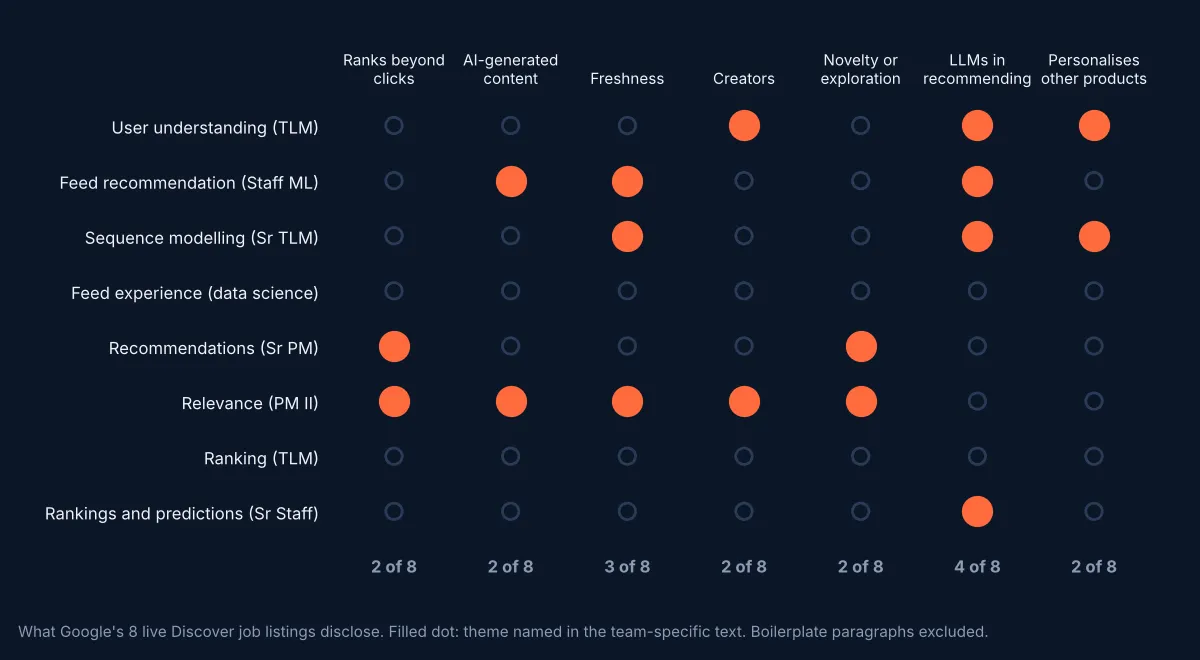
We collected 201 unique listings across six Google Careers searches, then kept the eight whose titles name Search's Discover product. YouTube, Gemini app and other "discovery" roles were excluded. For each, we coded only the team-specific text, ignoring the boilerplate paragraphs Google repeats across many job ads.
| Listing | What it says about Discover |
|---|---|
| Staff Research Data Scientist, Discover Experience | More than 500M daily active users; the team owns non-ranking feed elements, including AI integration into the feed |
| Tech Lead Manager, Discover User Understanding | Token-based Long-Term Interest and Creator models; hundreds of billions of recommendations a day; signals reused in Search Suggest, News, Search notifications and Shopping |
| Senior Tech Lead Manager, Discover Sequence Modeling and Generative Retrieval | User models trained on trillions of daily activities; long-term interests plus in-the-moment intent; Semantic-ID generative retrieval; quality, serving cost and freshness trade-offs |
| Staff ML Engineer, Discover Feed Recommendation | Recommends AI-generated content (AIGC); quality control for factuality, freshness, coherence and tone; content for Discover and notifications |
| Senior Product Manager, Discover Recommendations | Ranking beyond click-through rate toward scroll depth; balancing relevance against novelty, exploration against exploitation |
| Product Manager II, Discover Relevance | Content quality, freshness and real-time context; articles, videos, UGC and AI-generated content; scroll depth and long-term retention over CTR |
| Technical Lead Manager, Discover Ranking | Personalises content for hundreds of millions of users; ranks articles and videos |
| Senior Staff Engineer, Search Discovery rankings | Names a deep learning model called DeepNow; exploring LLMs; optimising for engagement and satisfaction |
What Google's public documentation says
Google's Discover help page tells site owners that content is eligible if it is indexed and meets Discover's content policies, that Discover uses many of the same signals and systems as Search, and that older content can appear if it is relevant. It advises against clickbait that inflates engagement, and recommends large images at least 1,200 pixels wide. The page does not mention scroll depth, retention, novelty, creators or AI-generated content.
The gap matters most in measurement. The same page says the Search Console Discover report shows impressions, clicks and CTR. If the listings describe current practice, Discover's rankers are being tuned toward signals publishers cannot see in that report, such as how far users scroll and whether they keep coming back.
Google's February 2026 Discover core update post is the closest public statement. John Mueller wrote that the update would favour in-depth, original and timely content from sites with topic expertise, reduce clickbait, and keep personalising by creator and source preferences. The Creator models and freshness trade-offs in the listings fit that description, though Google has not linked them.
Context: StarSearch and earlier Discover disclosures
Search Engine Roundtable reported on 22 November that a Google listing for a Senior Software Engineer on Discover feed recommendations described StarSearch as a system that brings new, niche and creator content into Discover and prunes content that draws no engagement. We could not verify that wording ourselves: when we requested the listing's address on 28 November it returned a Google Careers page reading "Job not found". Listings close for many reasons, including a filled role, so the removal alone says nothing about the system.
The listings fit earlier evidence. In October we covered a Google research paper on SDF, Discover's staleness filter, which described ranking as engagement based and said stale stories are removed before ranking. The freshness language in three of the eight listings is consistent with that. The user-modelling listings also land as Google prepares its December 2026 core update, which its Search Status Dashboard entry says will improve personalised results for people with personalisation turned on.
Engagement signals in ranking are not new territory: our review of trial files on how Google uses clicks concluded that court evidence points to Search using click data. What the Discover listings add is a stated move past the click itself.
What this means for SEO teams
- Treat Discover CTR as a partial metric. A high CTR from a strong image and headline may not hold a story in the feed if readers bounce. Pair Search Console's Discover report with analytics data on engaged time and scroll depth for Discover sessions.
- Build for return visits. Both product listings name long-term user satisfaction as an objective, and one adds retention. Series, follow-ups and consistent coverage of a topic give users a reason to keep following a source.
- Expect AI-written competition. If Google recommends its own AI-generated content in Discover, publisher stories will compete with it for slots, much as they already compete with AI Overviews in Search. Original reporting, data and first-hand detail are the parts an AI summary has to borrow.
- Invest in a recognisable author or brand. Creator models, and Google's statement that it personalises by creator and source preferences, point to identity as a durable Discover asset. Consistent bylines and author pages help users and systems connect stories to a source.
- Watch the December core update by surface. With personalisation named in the update notice, split Search Console data by web, Discover and News before and after the rollout.
Methodology
Between 21:15 and 21:25 UTC on 28 November 2026 we queried Google Careers for "Discover", "Discover feed", "Google Discover", "Discover ranking", "Discover recommendations" and "Discover content", collecting up to five results pages per query. This returned 201 unique listings. We kept the eight whose titles name Search's Discover product, downloaded each listing page, and read its team description, responsibilities and qualifications. Paragraphs shared across many Google job ads (for example, generic text about Google Search AI and Gemini, and the phrase "fresh ideas") were excluded from coding. A theme was marked present only when the team-specific text named it; generic qualifications such as "experience integrating generative AI tools into workflows" were not counted as LLM use in recommending. We also requested the address of the StarSearch listing reported on 22 November and searched Google Careers for "StarSearch". Listings change often and describe hiring goals, not confirmed production systems.
Conclusion
Google's public guidance on Discover is about eligibility, images and avoiding clickbait. Its job listings describe a feed of more than 500 million daily users whose ranking teams are working past click-through rate toward scroll depth and retention, whose interest models feed other Google products, and whose content mix includes AI-generated material.
None of that is confirmed in Google's documentation, and job ads can describe ambitions rather than live systems. For publishers, the practical reading is that Discover success is likely to be judged after the click, on what readers do next, and that the Search Console report shows only the first part of that.
Questions and answers
How many people use Google Discover?
A Google Careers listing for a Staff Research Data Scientist on Discover Experience, live on 28 November 2026, describes Discover as having more than 500 million daily active users.
Does Google Discover rank content on clicks?
Two live Discover product management listings say the team is moving deep-learning ranking models beyond click-through rate, toward scroll depth, long-term retention and user satisfaction. Google's public Discover documentation does not describe its ranking signals in this way.
Does Google Discover show AI-generated content?
Two of the eight Discover listings we reviewed name AI-generated content. One says the Feed Recommendation team recommends AI-generated content and builds flows to produce it for Discover and notifications; another lists it alongside web articles, videos and user-generated content. Google has not announced this in its Discover documentation.
What is Google StarSearch?
StarSearch was named in a Google job listing that Search Engine Roundtable reported on 22 November 2026 as a system for bringing new, niche and creator content into Discover. Google has not documented it publicly, and the listing returned "Job not found" when we checked on 28 November.
More releases
-
Updates
Google AI Mode Labels Personalized Answers; 20 of 20 Logged-Out Answers Asked for Details
Google's AI Mode now labels answers shaped by a user's own Google activity and offers a "Try without personalization" option. In 20 logged-out AI Mode searches we ran on 29 November, none showed the label, and all 20 asked the searcher for personal details before tailoring further.
-
Studies
Google Targets Long Questions in December; 16 of 20 Shared No Top URL With the Head Term
Google says its December core update will change how it ranks longer, more complex questions. In our 40-search baseline, 16 of 20 long questions shared no organic URL with the head term on the same topic, and forums, video and social posts took 36.3% of their links against 8.6%.
-
Industry news
WSJ Now Blocks All Bots by Default; 19 of 142 News Sites Do, and All 19 Admit Googlebot
The Wall Street Journal's robots.txt now disallows every crawler it does not name. Our check of 142 news sites found 19 using the same default-deny rule, 15 of them News Corp titles. All 19 admit Googlebot and Bingbot; none admits Google-Extended, ClaudeBot or CCBot, while OpenAI's crawlers get in on most.
Tell us the site and the goals.
Rankings in Google and visibility in AI answers, from one monthly plan. One call is enough to say which one fits. Email works just as well.