Google Targets Long Questions in December; 16 of 20 Shared No Top URL With the Head Term
Google says its December core update will change how it ranks longer, more complex questions. In our 40-search baseline, 16 of 20 long questions shared no organic URL with the head term on the same topic, and forums, video and social posts took 36.3% of their links against 8.6%.
 Vibhu Dhariwal
Cofounder & CTO, Digital Gratified
- Published
- Section
- Studies
- Reading time
- 8 minutes
Ras Al Khaimah, United Arab Emirates, .
Google says its next core update will change how it ranks content for "longer and more complex questions", and our test of the results page as it stands now shows how little those questions have in common with the short keywords most sites track. We searched 20 topics twice on Google in the US on 28 November 2026, once as a head term and once as a long first-person question. In 16 of the 20 pairs, the two result pages shared no organic URL at all, and the long questions sent 36.3% of their organic links to forums, video and social posts, against 8.6% for the head terms.
The December 2026 core update was preannounced on Google's Search Status Dashboard on 24 November. Google's entry says the update focuses on how its systems understand and rank relevant content, including for longer and more complex questions, and on personalized results for people who have personalization turned on. It says the update is scheduled for December and gives no start date. Our snapshot is a baseline taken after the November core update finished and before December's begins, so the same queries can be pulled again once it lands.
Key findings
- Rankings did not carry over. Across 309 organic links, only 7 URLs appeared on both the head term page and the long question page for the same topic. Sixteen of the 20 topics shared none.
- Threads took the top spot. More than half of the long question pages, 11 of 20, put a Reddit thread or Facebook post first. Only 2 head term pages put a community post first, both from Reddit.
- Even domains rarely carried over. Only 28 of the 157 organic links on the long question pages came from a domain that also ranked for the matching head term, and several of those were Reddit.
- Community content took over long questions. Reddit and Facebook each supplied 18 of the 157 long question links, with YouTube on 9 and Quora on 7. For the head terms, Reddit had 7 links and Facebook none.
- Facebook groups were the surprise. Thirteen of the 18 Facebook links on long question pages were posts inside Facebook groups.
- AI Overviews were universal. All 40 pages showed one. Our data feed flagged all 20 long question overviews as loaded asynchronously, against 5 of the 20 head term overviews.
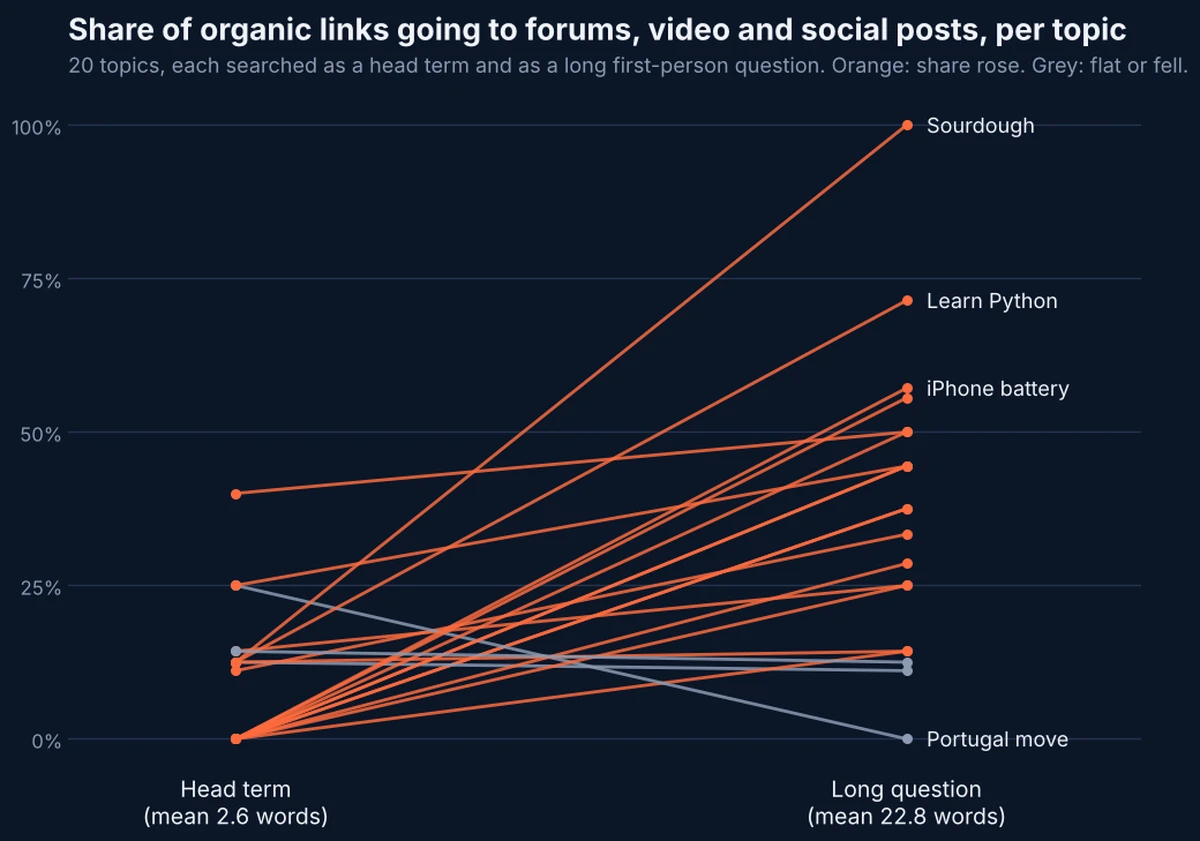
Two different results pages for one topic
The head terms averaged 2.6 words and the long questions 22.8. Each long question kept the topic of its head term but added the searcher's situation: a budget, an age, a symptom, a fix that had already failed. "Water heater" became a question about replacing a 12-year-old gas unit that still works but makes popping noises. "Seo audit" became a question about what to check first after a SaaS blog lost 40% of its organic traffic in a migration.
The pages Google returned for the two versions rarely overlapped. The head term pages were led by banks, retailers, health systems, government agencies and large publishers. The long question pages were led by threads. The sourdough question ("why is my sourdough bread dense and gummy inside even though the starter doubles") returned only four organic links, all of them Reddit or Facebook posts, with Google noting that it had omitted some results. The iPhone battery and dog separation questions each sent four or five of their links to community posts.
The four topics where URLs did carry over were knee pain while running (3 shared URLs), the wedding budget (2), bathroom mold (1) and the home office tax deduction (1). The tax pair shared a government page, which fits a question that has one authoritative answer whatever the wording.
What the page looked like around the links
| Element | Head terms (20 pages) | Long questions (20 pages) |
|---|---|---|
| AI Overview | 20 | 20 |
| AI Overview loaded asynchronously | 5 | 20 |
| People also ask | 20 | 20 |
| Discussions and forums panel | 2 | 7 |
| Things to know | 11 | 0 |
| Perspectives | 10 | 5 |
| Product carousel | 6 | 2 |
| Image pack | 6 | 1 |
| Video results | 6 | 8 |
| Organic links (total) | 152 | 157 |
Counts are pages showing each element. Source: SaaS Link Building analysis of Google US desktop results, 28 November 2026.
Browsing features built for broad intent, such as "Things to know" and image packs, disappeared once the query described a specific situation. The forums panel moved the other way. Google also showed no ads on any of the 40 pages in our pull.
How this compares with our earlier test
In our query length study on 1 November, before the November core update began, forum, video and social links made up 37% of organic results for the longest queries and 15% for head terms. Today's figure for long questions, 36.3%, is almost the same, while head terms came in lower at 8.6%. The two tests used different topics and query sets, so the comparison is a direction, not a measurement of the November update. What both snapshots show is that the gap between short and long versions of a topic is wide and stable.
The Facebook share is the clearest change in kind. In early November we reported that Facebook's AI answer pages were reaching page one for some searches. In this pull, one long question surfaced a Facebook answer page, but most Facebook results were ordinary group posts in which members describe the same problem as the searcher.
What Google has said, and what it has not
Google has not explained what "longer and more complex questions" means in practice or how the December update will treat them. Its core updates guidance says most sites don't need to worry about core updates and may not notice one has happened. The page was last updated on 10 December 2025 and still says Google gives notice "when they happen", with no mention of advance announcements. Our report on the preannouncement covers the dashboard entry and Google's new ranking hub.
Our reading, which is speculation, is that long questions are where the current results page leans hardest on community threads, because few publisher pages answer the exact combination of conditions in a 20-word question. If Google's systems get better at matching those conditions, pages that address them directly could gain ground on threads, or threads could gain further. The data here cannot say which.
What this means for SEO teams
- Do not assume head term rankings cover long questions. In 16 of our 20 topics, no page that ranked for the short keyword also ranked for the long question. Track a sample of long, situational questions alongside head terms.
- Save a baseline now. Export Search Console query data before the December rollout starts and split it by query length, so you can see after the update whether your long-query impressions moved separately from your head terms.
- Write for the situation. The long questions carried constraints such as a budget, an age or a failed fix. A page that names and answers those constraints gives Google more to match than a general guide.
- Know who you compete with. On long questions your rivals were Reddit threads, Facebook groups, YouTube videos and Quora answers in our pull, not other brands. First-hand detail, numbers and worked cases are what those threads offer.
- Check how your tools count AI Overviews. Every long question overview loaded asynchronously in our data. Trackers that read only the first page response may miss them.
Methodology
On 28 November 2026, between 17:19 and 17:20 UTC, we requested 40 Google results pages from a SERP data API, set to the United States, English, desktop and the first page. We wrote 20 topics across finance, consumer products, health, home, travel, pets, software, parenting and tax, each as a head term of two to four words (mean 2.6) and as a long first-person question of 19 to 26 words (mean 22.8). Each query was requested once. For each page we recorded the result elements present, the organic links (up to 10), each link's registered domain, and whether the AI Overview was flagged as asynchronous. "Forum, video and social" counts organic links on reddit.com, facebook.com, youtube.com, quora.com, tiktok.com, instagram.com, linkedin.com, medium.com, x.com, Stack Exchange sites and any domain containing "forum" or "community". URL overlap compares exact organic URLs, ignoring page fragments; domain overlap compares registered domains. This is a single, logged-out snapshot from one location and device with a hand-picked query set. Results vary by user, time, location and personalization, and 40 pages are too few for statistical significance.
Conclusion
Google has told site owners that its December core update will look at how it handles longer, more complex questions. On today's results pages, those questions already behave like a separate market: they share almost no URLs with the head terms on the same topic, and more than a third of their organic links go to community posts.
We will pull the same 40 queries once the December update has finished rolling out and report what moved. Until then, the useful step is to measure your own long-query visibility separately, because a head term report will not show it.
Questions and answers
What does the December 2026 core update focus on?
Google's Search Status Dashboard entry of 24 November says it focuses on how Google's systems understand and rank relevant content, including for longer and more complex questions, and on personalized results for people who have personalization turned on. It is scheduled for December 2026, with no start date given.
How often did long questions and head terms share results in this test?
Rarely. Across 20 topics and 309 organic links, only 7 URLs appeared on both the head term page and the long question page for the same topic, and 16 of the 20 topics shared no URL at all.
Which sites ranked most for the long questions?
Reddit and Facebook each supplied 18 of the 157 organic links on the long question pages, YouTube 9 and Quora 7. Thirteen of the 18 Facebook links were posts inside Facebook groups. 11 of the 20 long question pages put a Reddit or Facebook post first.
Did every search show an AI Overview?
Yes. All 40 pages in our 28 November pull showed an AI Overview. All 20 long question overviews were flagged as loading asynchronously, against 5 of the 20 head term overviews.
More releases
-
Updates
Google AI Mode Labels Personalized Answers; 20 of 20 Logged-Out Answers Asked for Details
Google's AI Mode now labels answers shaped by a user's own Google activity and offers a "Try without personalization" option. In 20 logged-out AI Mode searches we ran on 29 November, none showed the label, and all 20 asked the searcher for personal details before tailoring further.
-
Studies
Google's Discover Job Ads Look Beyond Clicks; 2 of 8 Name AI-Generated Content
Eight live Google job listings for the Discover feed describe ranking models pushed beyond click-through rate toward scroll depth and long-term satisfaction, and two name AI-generated content as feed material. A ninth listing, reported for naming a system called StarSearch, now returns "Job not found". Google's Discover documentation mentions none of this.
-
Industry news
WSJ Now Blocks All Bots by Default; 19 of 142 News Sites Do, and All 19 Admit Googlebot
The Wall Street Journal's robots.txt now disallows every crawler it does not name. Our check of 142 news sites found 19 using the same default-deny rule, 15 of them News Corp titles. All 19 admit Googlebot and Bingbot; none admits Google-Extended, ClaudeBot or CCBot, while OpenAI's crawlers get in on most.
Tell us the site and the goals.
Rankings in Google and visibility in AI answers, from one monthly plan. One call is enough to say which one fits. Email works just as well.