Anthropic Bans Claude for Deceptive AI Answer Seeding; 3 of 106 Top Results Flag Risk
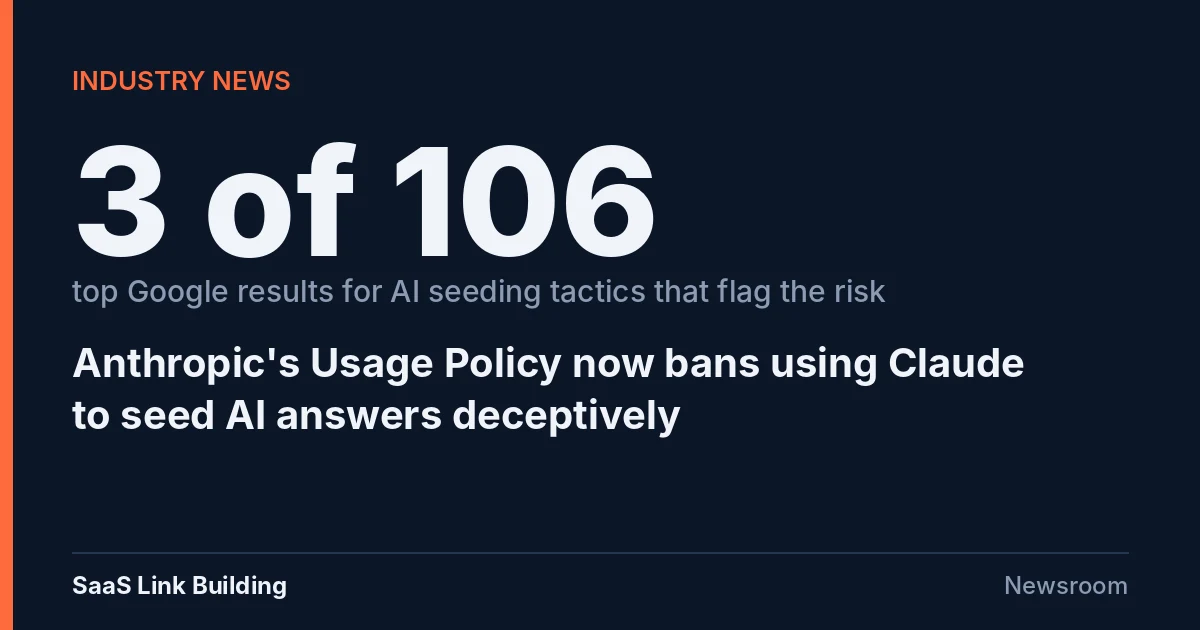
Anthropic's Usage Policy, in force since 12 November, bars using Claude to seed search engines and AI systems with content that hides its origin, authorship or independence. In 13 Google searches for seeding tactics, all showed an AI Overview, and only 3 of 106 page-one titles or snippets mentioned risk, spam or ethics.
 Vibhu Dhariwal
Cofounder & CTO, Digital Gratified
- Published
- Section
- Industry news
- Reading time
- 8 minutes
Ras Al Khaimah, United Arab Emirates, .
Anthropic's revised Usage Policy took effect on 12 November 2026, and it now names a tactic that sits close to a growing corner of AI search marketing. The updated policy bars anyone from using Claude to "manipulate the sources from which search engines or AI systems draw answers" by seeding them with content that hides its origin, authorship or independence. Anthropic published the changes on 8 October.
To see how the practice is presented to marketers who search for it, we ran 13 Google searches for terms such as "llm seeding", "how to get cited by claude" and "buy brand mentions in ai answers" on 14 November. Google showed an AI Overview on all 13. Of the 106 page-one organic results, only 3 used words such as fake, spam, manipulative, ethical or risk in their title or snippet.
What changed
The 8 October announcement says rules on fake accounts, fabricated news sites and similar conduct were moved out of the elections, fraud, privacy and disinformation sections and gathered under one new heading. Anthropic says the section "applies to deceptive activity of any kind (whether political or commercial)", which brings marketing work inside its scope. Its stated reason is that it had seen state media, government propaganda offices and commercial firms run networks of fake accounts and fabricated news sites.
The new section, "Do Not Engage in Deceptive Campaigns or Artificial Activity", lists six prohibited uses:
- Creating or running fake personas, accounts, media outlets or organisations to mislead people about who is behind content or how widely a view is held. Sockpuppets, astroturfing and fake reviews are given as examples.
- Hiding or misrepresenting who sponsored content meant to influence public opinion, officials or other decision-makers.
- Pushing content through networks of fake or seemingly independent outlets, websites or accounts so that a common source is hidden.
- Manipulating the sources search engines or AI systems use for answers by seeding them with content that misrepresents its origin, authorship or independence. The example given is a network of sites posing as unrelated sources that back up the same claims.
- Building or maintaining tools and infrastructure for astroturfing, sockpuppet account creation, coordinated inauthentic behaviour or scaled impersonation.
- Marketing, selling or seeking funding for any of the above as a product or service.
If Anthropic's Safeguards Team suspects a violation, the policy says it may warn the user or throttle, limit, suspend or end their access. The rule binds Claude users. It says nothing about how Claude ranks or cites the web, and it does not penalise the websites that receive seeded content.
How the rule compares with other AI and search policies
We compared Anthropic's clause with OpenAI's usage policies, Google's Generative AI Prohibited Use Policy and Google Search's spam policies. Only one other document says manipulating AI answers is out of bounds, and it governs websites, not users of a model.
| Policy | Applies to | Effective or last updated | Names manipulation of AI or search answers? | Names fake reviews, astroturfing or sockpuppets? |
|---|---|---|---|---|
| Anthropic Usage Policy | Claude users | 12 Nov 2026 | Yes, sources that search engines or AI systems draw answers from | Yes, all three |
| OpenAI Usage Policies | ChatGPT and API users | 20 Nov 2026 (changelog 21 Oct) | No; bans "deceit, fraud, scams, spam, or impersonation" in general | No |
| Google Generative AI Prohibited Use Policy | Users of Google generative AI | 17 Dec 2024 | No; bans spam and impersonation intended to deceive | No |
| Google Search spam policies | Websites in Google Search | 28 Aug 2026 | Yes, generative AI responses in Google Search | Not as terms; covers link spam, scaled content abuse and site reputation abuse |
Google's spam policies for web search define spam to include "attempting to manipulate generative AI responses in Google Search". That wording works on the receiving end: a site that breaks the policy can be demoted or hit with a manual action. Anthropic's clause works on the producing end: it targets the account that uses Claude to make the content. OpenAI's usage policies, which change again on 20 November, cover deception and spam in general terms but do not mention search engines, AI answers or networks of websites.
What Google shows people searching for the tactic
"LLM seeding" is the industry's name for spreading brand information across third-party sites so that AI systems pick it up and cite it. Much of it is ordinary PR. The new clause is aimed at the version where the source is disguised, such as a network of sites that look independent but are not, or fake user accounts that recommend a product.
| Measure (13 searches, Google US) | Count | Share |
|---|---|---|
| Searches showing an AI Overview | 13 of 13 | 100% |
| Page-one organic results collected | 106 | 6 to 9 per search |
| Results hosted on Reddit, LinkedIn, YouTube, Quora, Medium or other social platforms | 15 | 14% |
| Titles or snippets about mentions, seeding, reviews, PR, listicles or third parties | 22 | 21% |
| Titles or snippets mentioning Reddit, forums, Quora or communities | 8 | 8% |
| Titles or snippets mentioning fake, spam, manipulation, ethics, black hat, risk or penalties | 3 | 3% |
The search with the clearest overlap was "seed brand mentions on reddit for ai". Six of its nine results mentioned Reddit, forums or communities, and four were hosted on social or community platforms. One of them was a post warning that brands were creating fake accounts to post "organic" recommendations in niche subreddits. That is the behaviour the new policy names, and it was the only result in the sample whose title or snippet described it as a problem.
Google's own AI Overview for "llm seeding" defined the practice as distributing brand information across high-authority sites, then listed Reddit and Quora, review sites, listicles and LinkedIn as the places to target. It did not mention disclosure, and it cited a Reddit thread alongside several SEO tool vendor and agency guides.
The volume of seeding advice matters because the tactic can work. In October, a Fudan University study of seeded fake concepts found that 8 of 10 AI search tools cited an invented idea within a week of it being planted. Our own tests found self-ranked listicles made up 21% of top-10 results but only 3% of AI Overview citations, which may mean, though we have not tested this, that Google's systems already discount some self-promotion.
What this means for SEO teams
The policy does not ban LLM seeding as such. Publishing under your own name, pitching journalists, sponsoring content with a clear label and earning reviews from real customers all sit outside the clause. What is now prohibited, for anyone using Claude, is producing content that lies about where it came from. Practical steps:
- Audit Claude-assisted workflows. If a team uses Claude to draft Reddit replies, forum posts or reviews that are posted from accounts with no visible link to the brand, that work now falls under the new section.
- Label sponsored placements. The clause on concealed sponsorship covers content meant to influence decision-makers, which, on our reading, could include buyers. Visible disclosure on paid roundups and guest posts removes the ambiguity.
- Retire site networks. Look-alike "independent" sites run by one owner are Anthropic's own example.
- Check vendors. Agencies and tools that sell undisclosed seeding are covered by the clause on marketing such services, if they use Claude to do it. Ask suppliers how mentions are produced and published.
- Keep evidence of authorship. Bylines, author pages and disclosed affiliations make it easier to show that third-party content is what it claims to be, both to platforms and to communities such as Reddit that police brand spam.
Methodology
Policy texts were read from the live pages of Anthropic, OpenAI and Google on 14 and 15 November 2026. Anthropic and Google pages were downloaded and searched for the table's terms; the OpenAI page was read via a web fetch.
On 14 November 2026 (UTC) we ran 13 Google searches through a SERP API with location set to the US and language to English: llm seeding; llm seeding strategy; how to get mentioned in chatgpt answers; how to get cited by claude; how to get your brand recommended by ai; get brand mentioned in ai overviews; seed brand mentions on reddit for ai; how to influence chatgpt recommendations; ai search seeding service; parasite seo for ai search; third party mentions generative engine optimization; buy brand mentions in ai answers; and get recommended by claude ai. We recorded whether an AI Overview was present and kept the page-one organic results, which numbered between 6 and 9 per search (106 in total). Each result was classed with keyword rules applied to its title, snippet and source name. Full AI Overview text was available for "llm seeding" only, because the API's tokens for loading the other overviews expired before they could be fetched. Results are one snapshot.
Conclusion
Of the four policies we compared, Anthropic's is the only model usage policy that bans manipulating AI answer sources by name, matching Google Search's spam policies, which already target the same behaviour from the website side. The rule leaves legitimate brand-building alone, but the search results marketers see for seeding tactics almost never raise the question of disclosure, and Google's own AI Overview did not either.
For teams that use Claude in content or outreach work, the safest reading is simple: any third-party mention should be traceable to the brand behind it.
Questions and answers
When did Anthropic's new rule on AI answer seeding take effect?
Anthropic announced the Usage Policy update on 8 October 2026, and it took effect on 12 November 2026.
Does Anthropic's policy ban LLM seeding entirely?
No. The clause bars using Claude to seed search engines or AI systems with content that misrepresents its origin, authorship or independence, such as networks of sites posing as unrelated sources. Disclosed content published under a brand's own name is not covered by that clause.
Who does the rule apply to?
It applies to people and organisations using Anthropic's products. The policy says Anthropic may warn, throttle, limit, suspend or terminate access if it suspects a violation. It does not set rules for websites that receive the content.
Do OpenAI or Google have a similar rule?
OpenAI's usage policies, effective 20 November 2026, ban deceit, fraud, scams, spam and impersonation but do not mention search engines or AI answers. Google's Generative AI Prohibited Use Policy bans spam and deceptive impersonation. Google Search's spam policies define spam to include attempts to manipulate generative AI responses in Google Search, which applies to websites.
How many of the searches we ran showed an AI Overview?
All 13 Google searches for seeding-related terms that we ran on 14 November 2026 (US, English) showed an AI Overview.
More releases
-
Studies
November Core Update, Day 1 to 4: 75% of Top-10 URLs Held vs 64% the Week Before
Google's November 2026 core update has so far moved page one less than the week before it. Across 19 high-volume US keywords, 75.4% of top-10 URLs held their place in the first snapshot after the 10 November start, against 64.2% in the prior week, with recipes, video and health sources moving most.
-
Explainers
Merchant Center Bans Dates in Promotion Titles; 36 of 38 Translations Still List Them
Google's Merchant Center editorial requirements now say promotion titles must not include dates in any format, leaving dates to the promotion date fields. Our check of the help page in 48 language settings found only US English carries the new rule; 36 of 38 served versions still list date formats.
-
Studies
Can AEO Formatting Win AI Overview Citations? 89% of 306 Came From Beyond Page One
Google says AI Overviews need no special formatting. We tested the AEO checklist on 31 live searches: FAQ schema and summary boxes showed no benefit, question headings helped only in pooled numbers, and 272 of 306 citations went to pages that did not rank on page one for the query.
Tell us the site and the goals.
Rankings in Google and visibility in AI answers, from one monthly plan. One call is enough to say which one fits. Email works just as well.