Google Retires Its Data Feed Validator; All 18 Book Actions Translations Still Link It
Google removed its retired Data Feed validation tool from the English book actions documentation on 18 November, leaving two manual checks and no replacement. Our check found all 18 translated versions still link to the tool, which now returns a 404, and still carry a 20 February update stamp.
 Vibhu Dhariwal
Cofounder & CTO, Digital Gratified
- Published
- Section
- Updates
- Reading time
- 6 minutes
Ras Al Khaimah, United Arab Emirates, .
Google removed its Data Feed validation tool from the book actions documentation on 18 November 2026, replacing the section that told providers to test their feeds in it with a short manual checklist. The Search Central changelog gives the reason plainly: the tool "has been turned down and is no longer available." Our check of the live pages on 19 November found that the English page is the only version that changed. All 18 translated versions of the same page still carry the old section and still link to the validator, whose address now returns an HTTP 404 error.
What changed
Book actions let book retailers and libraries add buy and borrow links to Google's book knowledge panels through a schema.org DataFeed file. Before this week, the feed section of the documentation sent providers to an external validator hosted at actions.google.com and walked them through fixing the errors it reported. The English page now has a "Check your feed for common errors" section instead.
| Element | Before (still live in 18 translations) | After (English, 18 November) |
|---|---|---|
| Section title | Test your feed with the Data Feed validation tool | Check your feed for common errors |
| Link to a validator | Yes, to actions.google.com/tools/feed-validator | None |
| Step: pick the right option in the tool's "Validate in" field | Yes (choose Book Action) | Removed |
Step: check that @type is spelled correctly | Yes | Yes |
Step: set @context to https://schema.org on ReadAction and BorrowAction | Yes | Yes |
| Number of checks | 3 | 2 |
Nothing else in the feed workflow moved. The page still says Google fetches a book feed once a day and typically indexes the content within two days, and it still asks providers to submit the feed for a manual review of its deep links. The feature also remains restricted: Google says it is limited to providers "with a wide selection of available books," and registering interest does not guarantee a place.
What our check found
We fetched the English page and every language version it lists in its hreflang tags (18 in total) and searched each one for the old section anchor and for links to the validator. We then requested the validator addresses directly.
- 18 of 18 translations (Arabic, Chinese in simplified and traditional script, French, German, Hindi, Indonesian, Italian, Japanese, Korean, Polish, Portuguese for Brazil, Russian, two Spanish variants, Thai, Turkish and Vietnamese) still contain the "test your feed" section and a localised link to the validator.
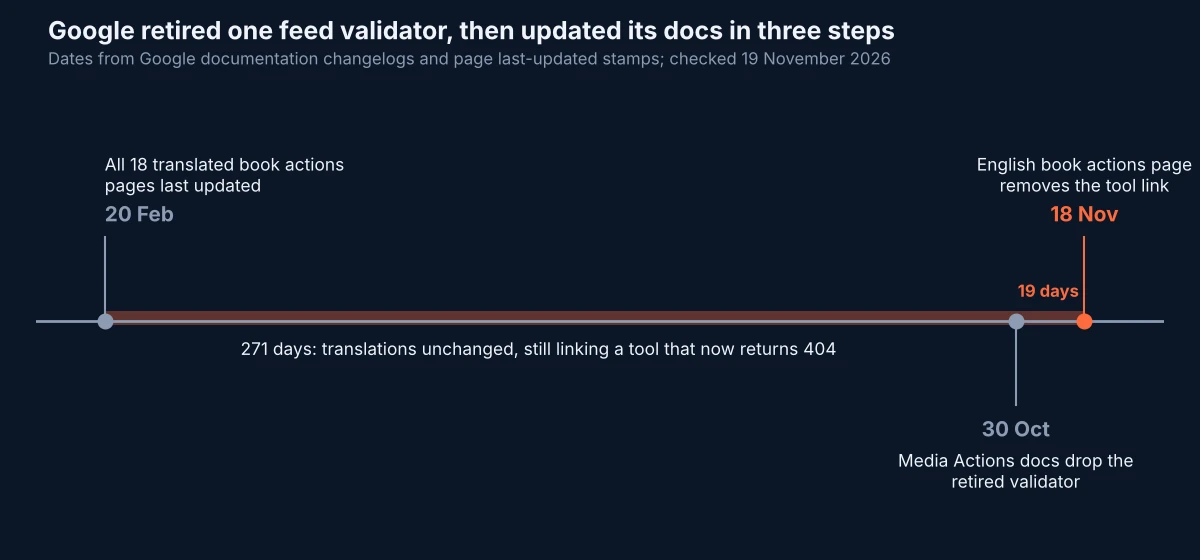
- All 18 show the same last-updated stamp, 20 February 2026, which is 271 days before the English change. The English page now shows 18 November 2026.
- The validator itself returns 404 at all four addresses we tried: its root, the /u/0/ path the translations link to, and that path's German and Japanese variants.
- The English page names no replacement tool. It does not mention Search Console or any other validator, only the two manual checks.
Book actions was not the first to drop it
The same validator served other feed-based Google features, and the book page was late to the change. Google's Media Actions changelog records that on 30 October it removed references to the retired Data Feed Validation tool in favour of a JSON Schema Validation tool and Catalog Properties in Search Console. The old Media Actions help page for the validator now redirects to a page titled Monitor the status of the feed, which says a Google representative can create a catalog property for an eligible feed, showing 90 days of ingestion history with error detail per entity type.
The book actions page does not offer either alternative. Google has not said whether book providers can request a catalog property, so it would be speculation to assume the Media Actions route applies to them. Providers who want an answer should ask through the review process the page describes.
Lag between English and translated Google documentation is a pattern we have measured before. When Merchant Center banned dates in promotion titles, we found that 36 of 38 translations still listed them. Translated pages carry their own last-updated stamps, which makes the gap easy to check.
Why it matters beyond book providers
Few SEO teams run a book actions feed, but the change is a useful signal for anyone who maintains structured data from Google's documentation. This is the third entry this month in the Search Central documentation changelog, after the new page on identifying Search traffic by Referer header on 12 November and the "things to do" support added to aggregator units on 9 November. Our earlier count of Google's search documentation changes in 2026 showed how often these pages move without a blog post or announcement.
Two practical points follow. First, a localised help page is not a reliable record of current guidance: in this case every translation points to a dead tool. Second, when Google turns down a validator, it does not always say what replaces it. The English book page now relies on checks that a team has to run itself.
What to do
- If you run a book actions feed: stop sending colleagues to the old validator link, and remove it from internal runbooks. Validate the feed against the schema.org
DataFeed,Bookand action types with your own JSON tooling, and confirm the two checks the page now lists:@typespelling and"@context": "https://schema.org"on ReadAction and BorrowAction. - Test the deep links by hand. Google's review still focuses on whether the buy and borrow links open the right page, and the page recommends manual testing of a sample.
- Ask about monitoring. If you have a Google contact for the feed, ask whether a Search Console catalog property is available, as it is for Media Actions feeds. Do not assume it is.
- Read the English version. For any Google Search documentation your team relies on, use the English page and check the Search Central changelog, which has an RSS feed, rather than a translation.
- Audit other links to Google tools. Search your own documentation and client playbooks for actions.google.com/tools addresses and replace any that now return 404.
Methodology
On 19 November 2026 we requested the English book actions page and each of the 18 language versions listed in its hreflang annotations (ar, de, es, es-419, fr, hi, id, it, ja, ko, pl, pt-BR, ru, th, tr, vi, zh-CN and zh-TW) using the hl parameter. For each page we searched the article body for the old section anchor (test-your-feed-with-the-data-feed-validation-tool), the new anchor (check-your-feed-for-common-errors) and links containing feed-validator, and recorded the page's last-updated stamp. We compared the old and new section text using the Spanish translation as the record of the earlier version. We then requested four validator addresses (the root, the /u/0/ path and its German and Japanese variants) and recorded the HTTP status of each. Media Actions details come from that documentation's changelog and the page the old validator help page now redirects to.
Conclusion
Google has retired the Data Feed validation tool and on 18 November removed it from the English book actions documentation, 19 days after doing the same in Media Actions. The English page now offers two manual checks and no replacement tool, while all 18 translations still send readers to an address that returns 404.
For most SEO teams the direct impact is small. The broader lesson is that Google's translated documentation can trail the English version by months, and that a retired Google tool can disappear without a named successor.
Questions and answers
What did Google change in the book actions documentation?
On 18 November 2026 Google replaced the "Test your feed with the Data Feed validation tool" section with a "Check your feed for common errors" section and removed the link to the tool, according to the Search Central documentation changelog.
Why was the Data Feed validation tool removed?
Google's changelog says the tool has been turned down and is no longer available. On 19 November 2026 the tool's addresses returned HTTP 404 in our check.
What does Google now ask book actions providers to check?
The English page lists two checks: that the value of @type is spelled correctly, and that @context is set to https://schema.org for both ReadAction and BorrowAction.
Is there a replacement validator for book actions feeds?
The book actions page names none. Google's Media Actions documentation, which dropped the same tool on 30 October, points to a JSON Schema Validation tool and Search Console catalog properties, but Google has not said whether these apply to book feeds.
Are the translated book actions pages up to date?
No. In our 19 November check, all 18 language versions still contained the old section and the validator link, and all showed a last-updated date of 20 February 2026.
More releases
-
Industry news
Bing Opens Web IQ to All Azure Users; 107 of 128 Sites That Block AI Bots Admit Bingbot
Microsoft made Web IQ, its Bing-powered grounding service for AI agents, available to all Azure customers on 17 November, fed by Bingbot's index. Our crawl of 508 top-site robots.txt files found 107 of the 128 sites that block AI crawlers still let Bingbot in, and one homepage using Bing's grounding opt-out.
-
Studies
Optimizely Hack Hit 178 Brands; 123 of 3,009 Top Sites Run a CSP That Would Block It
An attacker used an Optimizely signup flaw on 16 November to plant malicious JavaScript in customer snippets served on 178 organisations' sites. Report URI found a strict Content Security Policy stopped it. Our crawl of 3,009 top homepages found only 123 with a policy that blocks both routes the payload used.
-
Studies
Only 6.9% of ChatGPT Prompts Show Buying Intent; Our Test Found Brands in 15 of 15
Only 6.9% of prompts in a SparkToro panel of 12,321 US ChatGPT users showed purchase research. Our own 30-prompt test of OpenAI's GPT-6.1 Sol found the other side: all 15 buying questions got brand picks, usually three with one favourite, while 14 of 15 everyday tasks named no brand.
Tell us the site and the goals.
Rankings in Google and visibility in AI answers, from one monthly plan. One call is enough to say which one fits. Email works just as well.