Gemini 4 Neon Launches Without Search; 3 of 4 Gemini 4 Model Cards Name a Search Product
Google released Gemini 4 Neon on 18 November for the Gemini app and API, but our check of all four Gemini 4 model cards finds Neon is the only one that names no Search product. Its $3 and $15 API pricing also undercuts Carbon once Carbon's introductory price ends on 1 December.
 Vibhu Dhariwal
Cofounder & CTO, Digital Gratified
- Published
- Section
- Industry news
- Reading time
- 7 minutes
Ras Al Khaimah, United Arab Emirates, .
Google released Gemini 4 Neon on 18 November 2026, the fourth Gemini 4 model in just over five weeks, and the first that Google has not tied to Search. In the launch post on Google's Keyword blog, Koray Kavukcuoglu, SVP at Google DeepMind and Chief AI Architect, describes Neon as bringing "frontier-level intelligence with fast end-to-end task completion" and lists the Gemini app, the Gemini API, Gemini for business and Google Antigravity as places to use it. AI Mode, AI Overviews and Google Search are not mentioned. We checked the distribution section of all four Gemini 4 model cards on Google DeepMind's site: Neon's is the only one that names no Search product.
What changed
- A new middle model. Google's developer guide places Neon between Gemini 4 Hydrogen and Gemini 4 Carbon, for complex tasks that run at high frequency. It has a 1 million token context window and four thinking levels (low, medium, high by default, and xhigh).
- Paid access only. The Gemini API changelog lists Neon as generally available on the paid tier at $3 per million input tokens and $15 per million output tokens. There is no free tier.
- Neon replaces Argon in the Gemini app. 9to5Google reported that the app's model picker now offers Hydrogen for everyday help, Neon for deeper analysis and Carbon for code and complex work, with Argon gone from the menu. Google's AI plans page now lists Neon and Hydrogen for Google AI Pro in the Gemini app, and Carbon, Neon and Hydrogen for Ultra.
- No Search rollout announced. None of the Google pages we read on 20 November says Neon is in AI Mode, AI Overviews or Search.
Our check: which Gemini 4 models Google lists for Search
Each Gemini 4 model card has a "Distribution" section listing the products the model ships in. We read all four on 20 November (UTC) and compared them with Google's API pricing page and the AI Mode help page.
| Model | Model card published | Search product named in model card | Named on AI Mode help page | API price per 1M input / output tokens | Free API tier |
|---|---|---|---|---|---|
| Gemini 4 Argon | 13 October 2026 | Google AI Mode | No | $2 / $10 until 30 November, then $4 / $20 | No |
| Gemini 4 Carbon | 10 November 2026 | Google AI Mode | Yes | $2 / $10 until 30 November, then $4 / $20 | No |
| Gemini 4 Hydrogen | 12 November 2026 | Google Search | Yes | $1.50 / $7.50 | Yes |
| Gemini 4 Neon | 18 November 2026 | None | No | $3 / $15 | No |
Source: SaaS Link Building review of the Gemini 4 Neon, Hydrogen, Carbon and Argon model cards, the Gemini API pricing page and the AI Mode help page, collected 20 November 2026 (UTC). See Methodology.
Three details stand out:
- Neon is the only one of the four with no Search channel. Its card lists the Gemini app, Gemini API, Google AI Studio, Gemini for business and Google Antigravity. Hydrogen's card adds Google Sheets and Google Search, and the Carbon and Argon cards both list Google AI Mode.
- The help page names two models, not three. The AI Mode help page describes Carbon, which users pick from the menu in the "Ask anything" bar, and Hydrogen, which it calls helpful for fast, all-round answers. Argon is not named, even though its model card still lists AI Mode and Google's October launch said it was rolling out there to AI Pro and Ultra subscribers. Google has not said whether Argon has left AI Mode.
- Same knowledge cutoff for all four. Each card gives a knowledge cutoff of March 2026. The Neon, Hydrogen and Carbon cards all describe their models as adapted from or based on earlier Gemini 4 models, so Neon is a new tier, not newer training data.
Context: four models, three routes into Search
Search has taken each Gemini 4 release so far in a different way. Argon reached AI Mode for paying subscribers on 13 October, as we reported in our coverage of the Argon rollout. Carbon followed on 10 November for Ultra subscribers and later appeared for Pro accounts too, which Google's Rajan Patel said was not a bug, as covered in our report on Carbon in AI Mode. Hydrogen, on 12 November, became the model in Search for all users, the release we tested in our 24-search Hydrogen check.
Neon breaks that pattern. Nothing on Google's pages rules out a later Search launch, and Google added Carbon to AI Mode for Pro users without a new announcement, so a quiet arrival is possible. For now, the evidence points one way: Google is positioning Neon for developers and Gemini app users, not searchers.
Why the API pricing matters to SEO teams
Neon still touches search work through the API. Its model page marks Grounding with Google Search as supported, meaning a developer can have the model run Google searches and answer from the results. Many AI visibility trackers and in-house prompt monitoring scripts work this way. The pricing page gives every Gemini 3 and newer model a shared allowance of 5,000 free grounded search requests a month, then charges $14 per 1,000, with a daily cap of 1,500 requests. It also notes that one request to Gemini may trigger more than one Google search, each billed separately.
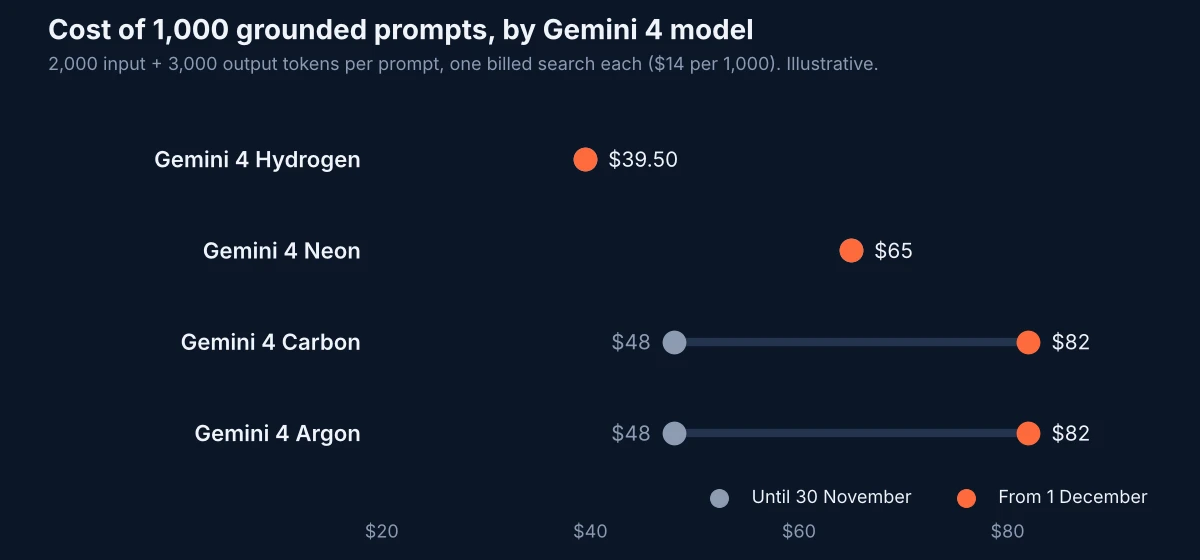
On those assumptions, a 1,000-prompt run costs about $65 on Neon, against $48 on Carbon or Argon until 30 November and $82 from 1 December, when their introductory prices double. Hydrogen comes in at about $39.50. In every case the $14 search charge is a large slice of the bill, so how many searches a prompt triggers matters as much as which model runs it. These are our own estimates, not Google figures; real token counts vary with thinking level and prompt length.
There is a wider caution too. API answers are not the same as what searchers see. A separate academic study we covered found that API results recovered only a minority of the pages a consumer chatbot cited, and Neon is not even the model behind AI Mode.
What this means for SEO teams
- Do not treat Neon as an AI Mode model. If you track AI Mode citations, the models Google documents there are Hydrogen for everyone and Carbon for paying users. Neon answers in the Gemini app are a separate surface; label them as such.
- Recheck tracker settings before 1 December. If your monitoring runs on Carbon or Argon through the API, its token cost doubles on 1 December. Neon becomes the cheaper of the three on that date.
- Count searches, not just prompts. Grounded searches are billed one by one at $14 per 1,000 after the free allowance. Log how many searches each prompt triggers so cost and coverage estimates hold up.
- Watch the AI Mode help page. It already has Carbon and Hydrogen sections. If Neon reaches Search, or Argon is formally retired from it, that page and the model cards are where the change is most likely to show first.
- Remember the March 2026 cutoff. All four models share it. Answers about anything after March, including new products, prices or pages, depend on retrieval, which is where your crawlable content counts.
Methodology
On 20 November 2026 (UTC) we downloaded the four Gemini 4 model cards on deepmind.google and recorded each card's publication date, knowledge cutoff, model dependency and the products listed under "Distribution". We downloaded the Gemini API pricing page, changelog and Neon model page from Google AI Studio's documentation, the English AI Mode help page and the Google AI plans page, and searched each for the four model names. The cost estimate assumes 2,000 input tokens and 3,000 output tokens (including thinking tokens, which Google bills as output) per prompt, standard paid-tier prices, and one billed grounded search per prompt after the free 5,000 a month is used up. We did not run Neon, check which model served any AI Mode answer, or test Argon's availability in AI Mode.
Conclusion
Gemini 4 Neon is a significant model for developers and Gemini app users, but on Google's own documentation it is not a Search model. Of the four Gemini 4 releases, it is the only one whose model card names no Search product, and Google's AI Mode help page names only Carbon and Hydrogen.
For SEO teams, the practical news is in the API: a price change on 1 December that reorders the cost of Gemini-based tracking, and grounded search charges that make up a large share of the bill. Whether Neon, or Argon's absence, eventually shows up in AI Mode is the next thing to watch.
Questions and answers
Is Gemini 4 Neon available in Google AI Mode or AI Overviews?
Google has not said so. Its 18 November launch post lists the Gemini app, Gemini API, Gemini for business and Google Antigravity, and the Neon model card's distribution list names no Search product. Google's AI Mode help page names only Gemini 4 Carbon and Gemini 4 Hydrogen.
Which Gemini 4 models does Google list for Search?
The Gemini 4 Hydrogen model card lists Google Search, and the Carbon and Argon model cards list Google AI Mode. Hydrogen became the model in Search for all users on 12 November 2026.
How much does Gemini 4 Neon cost in the Gemini API?
Google's pricing page lists Neon at $3 per million input tokens and $15 per million output tokens on the paid tier, with no free tier. Carbon and Argon cost $2 and $10 until 30 November 2026, rising to $4 and $20 from 1 December.
Does Gemini 4 Neon support Grounding with Google Search?
Yes. The Neon model page marks Grounding with Google Search as supported. Google's pricing page gives Gemini 3 and newer models a shared 5,000 free grounded search requests a month, then charges $14 per 1,000, with a daily cap of 1,500 requests.
What is Gemini 4 Neon's knowledge cutoff?
The Neon model card gives a knowledge cutoff of March 2026, the same as the Hydrogen, Carbon and Argon model cards.
More releases
-
Updates
Google Adds an AI Mode Sidebar to Its Homepage; Search Button Held in 30 of 30 Checks
Google began rolling out a collapsible sidebar of recent AI searches on its desktop homepage on 19 November 2026, Robby Stein said. Two days later, all 30 signed-out sessions we loaded across 20 locales still showed the classic Google Search button, with no sidebar or AI Mode button.
-
Studies
Google Calls '7 Tips' Posts Commodity Content; They Held 39% of Page One in Our Test
Google is telling brands to stop publishing generic "Top 10" tips posts, but its results still reward them. Across 30 US tips searches on 21 November, numbered lists held 90 of 233 page-one organic results and a third of AI Overview citations, and a page titled exactly like Google's own commodity example ranked first.
-
Industry news
Google Adds Target, Experian and H&R Block to Search Apps; Help Page Lists 0 of 8
Google is adding Target, Albertsons, Safeway, Shaw's, Experian and H&R Block as Connected Apps in Search and the Gemini app, with Angi and Thumbtack to follow. Its Search help page lists none of the eight yet, and in our 16-search test a partner's own site ranked in the organic top 10 on 10.
Tell us the site and the goals.
Rankings in Google and visibility in AI answers, from one monthly plan. One call is enough to say which one fits. Email works just as well.