Google's Dive Deeper Links Reach AI Mode; All 32 Closing Links in Our Test Led to Google
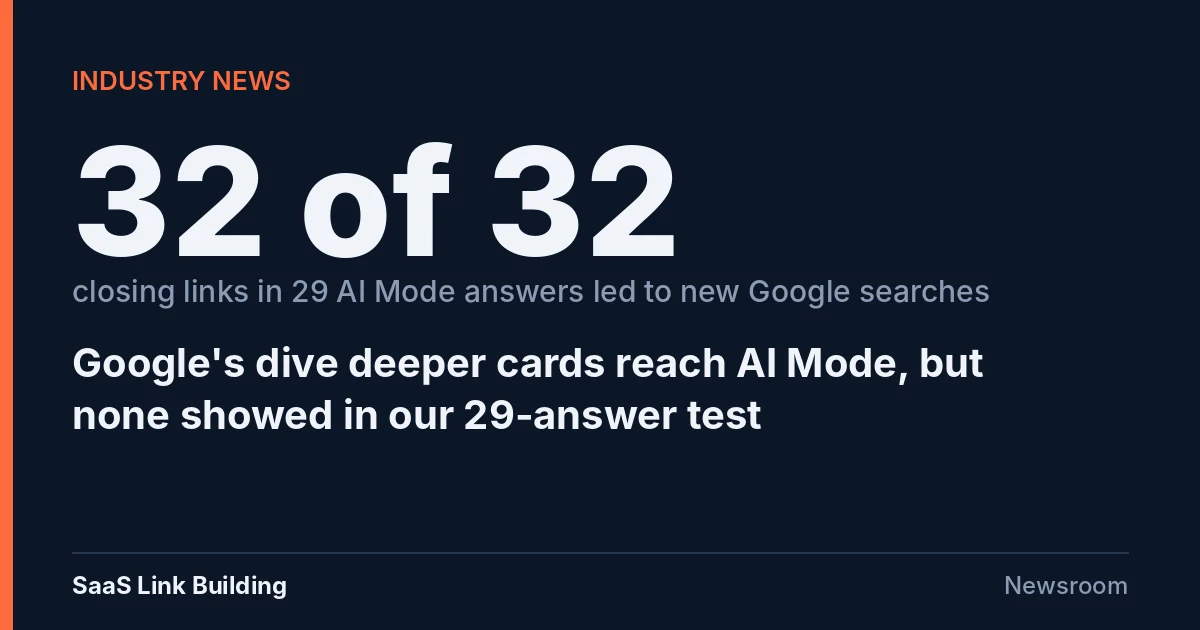
Google's dive deeper links, announced on 15 October to make the links at the end of some AI Mode answers more prominent, have been reported live since 21 November. In 29 logged-out answers we pulled on 29 November, none closed with publisher article cards, and all 32 closing links opened another AI Mode search.
 Vibhu Dhariwal
Cofounder & CTO, Digital Gratified
- Published
- Section
- Industry news
- Reading time
- 7 minutes
Ras Al Khaimah, United Arab Emirates, .
Google's "dive deeper" links, which it promised would turn the links at the end of some AI Mode answers into prominent, thumbnail-led cards for related articles, have been reported live in AI Mode since the weekend of 21 November. An SEO consultant posted examples on X that day, and Search Engine Roundtable and Search Engine Land have since reported the feature as live. To see what a typical searcher gets, we pulled 29 logged-out AI Mode answers on 29 November. Every one of them ended by offering to go further, but none closed with a block of publisher articles. The 32 links that did appear in those closing lines all opened a new AI Mode search on Google.
What Google announced
The feature dates to Google's 15 October post on AI Mode and AI Overviews, written by Hema Budaraju, VP of Product Management. Item four of five, on prominent links to related articles, said Google would make the links shown at the end of some AI responses "more engaging and prominent, with image thumbnails and a more clickable design". The same post promised more inline links, inline links placed higher in responses, a test of a dedicated section for official websites, wider news carousels and clickable creator names. We covered that announcement in our report on Google's AI Mode and AI Overviews link changes.
A similar "dive deeper" treatment had already been seen in Google Discover before the AI Mode sightings. We found no Google post or Search Status Dashboard entry giving a rollout date for AI Mode, so the timing rests on the public sightings, not on a Google confirmation. The word some in Google's own description matters: the company never said every answer would carry the block.
Key findings from our pull
- All 29 answers closed with an offer to keep going. Typical forms were "Would you like to dive deeper into..." or a short list of angles to explore next.
- 13 of those closings carried links, and all 32 links stayed on Google. Each pointed to a google.com search URL with the udm=50 parameter, which opens a fresh AI Mode answer for a suggested follow-up question.
- No closing section showed publisher articles with thumbnails. Beyond the standard source list, we found no separate block of related articles at the end of any answer.
- Publisher links inside the answer text were scarcer. 17 inline links to publisher pages appeared across 12 answers. 11 answers had no clickable link in either the body or the closing lines.
- Ads appeared in three answers. Three desktop answers (Lisbon in winter, sourdough fermentation and noise cancelling headphones) carried sponsored units for tours, baking kits and a headset.
| What we counted | Desktop (23 answers) | Mobile (6 answers) |
|---|---|---|
| Answers ending with an offer to explore further | 23 | 6 |
| Closings with links to new AI Mode searches | 9 | 4 |
| Links to new AI Mode searches in closings | 22 | 10 |
| Closings with a related-articles block (thumbnails) | 0 | 0 |
| Inline links to publisher pages in answer text | 11 (in 8 answers) | 6 (in 4 answers) |
| Answers with a sponsored unit | 3 | 0 |
Source: SaaS Link Building newsroom pull of logged-out Google AI Mode answers, 29 November 2026. Methodology below.
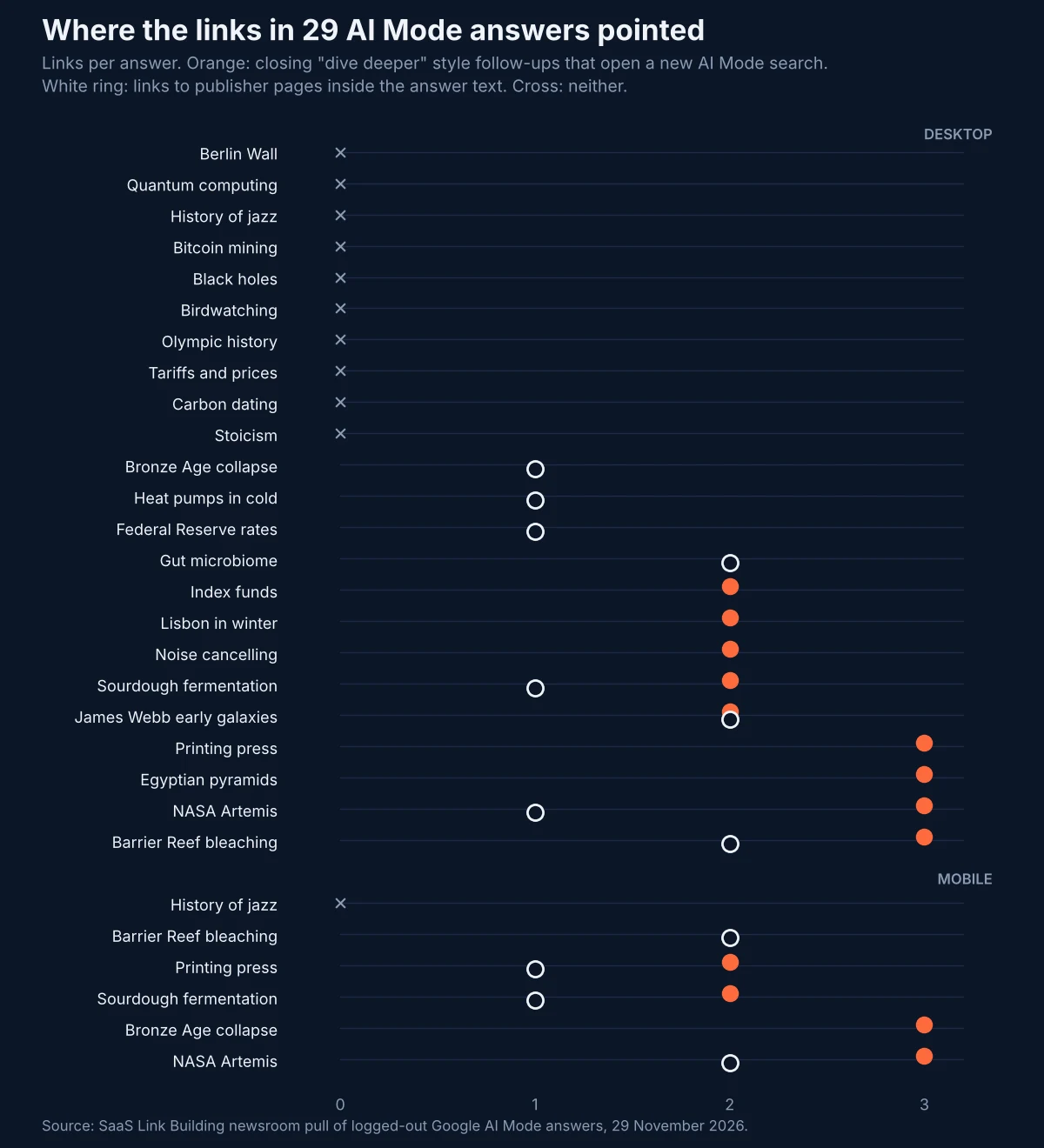
Desktop and mobile gave different endings for the same question
We ran six of the queries on both desktop and mobile, and two of the six pairs changed format between devices. The Bronze Age collapse answer ended with an unlinked list on desktop but three linked follow-ups on mobile. The Great Barrier Reef answer did the reverse: three linked follow-ups on desktop, and on mobile an offer to set up a task to track future bleaching updates. The NASA Artemis and sourdough pairs kept the same number of linked follow-ups, the printing press pair dropped from three links to two, and the history of jazz closed with a plain question on both. AI Mode answers are generated per request, so variation is expected, but it means a single screenshot says little about how often a closing format appears.
Context: Google's own description of AI Mode links
Google published a new page, Attribution and factuality in Search generative AI features, on 24 November. It says the systems show links "where they're most helpful" and lists the display options as inline link icons, grouped source cards and expandable link carousels showing site names, favicons and article titles. It does not mention a closing block of related articles or the follow-up prompts we saw. We looked at the source selection side of that page in our explainer on how AI Overviews pick sources.
The pattern of links that lead back into Google is not new to AI Mode. In earlier tests we found all 180 AI Mode product cards linking to Google's own pages, and on 24 November most AI Overviews we checked still placed their first link in the final third, despite Google's promise to move links higher. The closing follow-ups we counted today are a different element from the dive deeper cards, but they occupy the same position Google described: the end of the response.
What this means for SEO teams
- Do not plan around the end-of-answer cards yet. In our logged-out sample the closing slot went to follow-up questions or ads, not to publisher cards. Treat the feature as a possible extra source of visits, not a channel to forecast.
- Read the follow-up prompts as a map of the next query. The suggested follow-ups ("how qubits actually work", "where to stay", "commercial lander contracts") are the questions AI Mode expects next. Content that answers those specific angles is what would be retrieved for the follow-up answer.
- Keep images and titles strong on explainer content. Google says the dive deeper links use image thumbnails, and its attribution page says link carousels show article titles and favicons. Pages without a clear lead image and a descriptive title have less to show in any card-based layout.
- Segment AI Mode traffic before judging the change. Visits from AI Mode arrive as Google traffic. If you have seen a lift in referrals to deep explainer pages since 21 November, compare landing pages rather than totals, because Google says the feature appears on some responses only.
- Check signed-in behaviour yourself. Our pull was logged out. If you track AI Mode manually, record whether you are signed in and on which device, since our paired queries show the closing format changes between requests.
Methodology
On 29 November 2026, between 05:21 and 05:24 UTC, we requested 29 Google AI Mode answers through a SERP API that returns AI Mode results logged out, with its default United States location and English language. The set covered 23 informational queries chosen to match the broad, exploratory questions Google described (history, science, money, travel and how-to topics), all on desktop, plus six of the same queries repeated on mobile. For each answer we saved the parsed response and the raw HTML page the API returned.
We classified the closing of each answer as an offer with links, an offer without links, or a block of publisher articles. A link counted as a closing follow-up when it sat in the final paragraph or list and pointed to a google.com search URL carrying udm=50. Inline publisher links were links to non-Google pages inside the answer text, excluding the numbered source list. We searched the visible text of each raw page for a related-articles block and for "Sponsored" labels. Limits: the sample is small and logged out, it reflects one location and one morning, and a block that Google loads only after scrolling or user interaction may not appear in a fetched page. The feature may also still be rolling out.
Conclusion
Google said it would make the links at the end of some AI Mode answers more prominent, and practitioners have seen the new cards in the wild. In 29 logged-out answers we pulled, though, the end of the response belonged to Google's own follow-up questions: 32 links, every one leading to another AI Mode search, against 17 inline links to publishers and no closing article cards. Until Google says how often the dive deeper block appears, teams should treat it as an occasional bonus and keep measuring AI Mode referrals page by page.
Questions and answers
What are dive deeper links in Google AI Mode?
Google announced them on 15 October 2026 as a redesign of the links shown at the end of some AI Mode responses, adding image thumbnails and a more clickable design so people can explore related articles on a topic.
Are dive deeper links live in AI Mode?
An SEO consultant posted examples on X on 21 November 2026, and Search Engine Roundtable and Search Engine Land have reported the feature as live. We found no Google post giving a rollout date, and Google described the links as appearing on some responses, not all.
Did the AI Mode answers in our test link to publishers at the end?
No. In 29 logged-out AI Mode answers pulled on 29 November 2026, none closed with a block of publisher articles. 13 closings carried 32 links, and every one opened a new AI Mode search on Google. The answers did include 17 inline links to publisher pages in their text.
Did ads appear in the AI Mode answers?
In 3 of the 23 desktop answers, yes: sponsored units for Lisbon tours, sourdough baking kits and an aviation headset. None of the 6 mobile answers carried one.
More releases
-
Industry news
Search Console AI Report Reportedly Gets Clicks; UK Rule on AI Metrics Starts in 3 Days
Google plans to add click data to Search Console's generative AI report in the coming weeks, Search Engine Roundtable reported on 29 November, citing an unnamed source. Google has not confirmed it. A UK rule requiring AI engagement metrics takes effect on 3 December, and none of 177 AI Overview links we pulled carried a referral marker.
-
Studies
Google Wants Separate Cyber Monday Pages; 24 of 30 Top Retailers Rank One First
Google has advised dedicated Black Friday and Cyber Monday pages since 2020. Searching 30 US retailers on 29 November, we found 24 ranking a year-free Cyber Monday or Cyber Week page first. Kohl's, JCPenney and Dell, missing for Black Friday, now lead their results, while Old Navy has no result of its own.
-
Explainers
Google Says Wait a Week to Judge Core Updates; Thanksgiving Swung Demand by Up to 156%
Google says site owners should judge a core update by comparing the week after it ends with the week before it began. For the November 2026 update, that later week holds Thanksgiving, Black Friday and Cyber Monday. In our Google Trends pull, interest in eight common searches moved by between -37% and +156% across the two windows.
Tell us the site and the goals.
Rankings in Google and visibility in AI answers, from one monthly plan. One call is enough to say which one fits. Email works just as well.