Google Merges AdSense for Search Rules; 9 of 12 Numeric Ad Limits Vanish in January
Google will merge its AdSense for Search and Search ads policies into one rulebook on 17 January 2027. Our line-by-line comparison finds nine of the 12 numeric limits in today's rules missing, while no-results pages, repeated ads, interstitials and broken-up ad units become explicit bans.
 Vibhu Dhariwal
Cofounder & CTO, Digital Gratified
- Published
- Section
- Explainers
- Reading time
- 8 minutes
Ras Al Khaimah, United Arab Emirates, .
Google will replace its two sets of AdSense for Search (AFS) rules with one unified policy on 17 January 2027, according to an entry posted this month on the AdSense policy change log. The change merges the current AFS policies with the Search ads policies that govern ads served through the Custom Search Ads (CSA) protocol. Google says the rewrite will "simplify our policy structure" and modernise requirements. We compared the published January text line by line with both live policy pages: nine of the 12 numeric limits in today's rules do not appear in the new text, while five new or tightened prohibitions do.
AdSense for Search is the product that lets a site show Google search ads on its own search results pages, including pages built on Programmable Search Engine. It also powers the related search units used by many search arbitrage publishers, so the rewrite reaches beyond ad operations teams.
What changed
The new text is organised into four sections: content requirements, user intent and traffic quality, ad implementation and placement, and other Google advertising demand. Most rules already existed in one of the two current pages, but several are reworded, widened to all AFS traffic, or turned from guidance into hard requirements.
| Rule | Current policies | From 17 January 2027 | Change |
|---|---|---|---|
| Search boxes | AFS: at most two AdSense for Search boxes per page | At most two Google search boxes per page | Kept, reworded |
| Requests per action | Search ads: one request per click or scroll | One request per new search, click or scroll | Kept, new search added |
| Ads versus results | Search ads: ads should not outnumber results | No AFS ads where all paid promotion, Google or third party, outnumbers organic results | Tightened |
| No-results pages | Search ads: ads should appear on pages with results | Explicit ban, defined to include zero results, placeholder text and gibberish | Tightened |
| Restricted result types | Search ads only; includes news aggregation; written approval exception | All AFS; news aggregation not listed; no approval exception | Changed |
| Repeated ads | Not covered | Each ad shown once unless Google approves in writing | New |
| Interstitials | Not covered | No content between an ad and its landing page, or before an AFS page | New |
| Ad modification | AFS: no code changes, no framing, no altering the Google logo | No framing, obscuring, altering or reordering ads; one continuous ad block | Expanded |
| Per-device ad caps | Search ads: desktop and mobile unit and ad counts | Not in the text | Removed |
| Annual query cap | AFS: 5 billion queries per account, August to July | Not in the text | Removed |
| Paying users to search | Both pages | Not in the AFS text; still in the AdSense Program policies | Moved |
| Backfilling | Search ads: no AdSense for Content, Ad Manager or AdMob | No AdSense for Content or Ad Manager; other slots may use them | Kept, clarified |
Source: Google AdSense Help, compared by the SaaS Link Building Newsroom. "Current" refers to the live AFS and Search ads policy pages.
The numeric limits that disappear
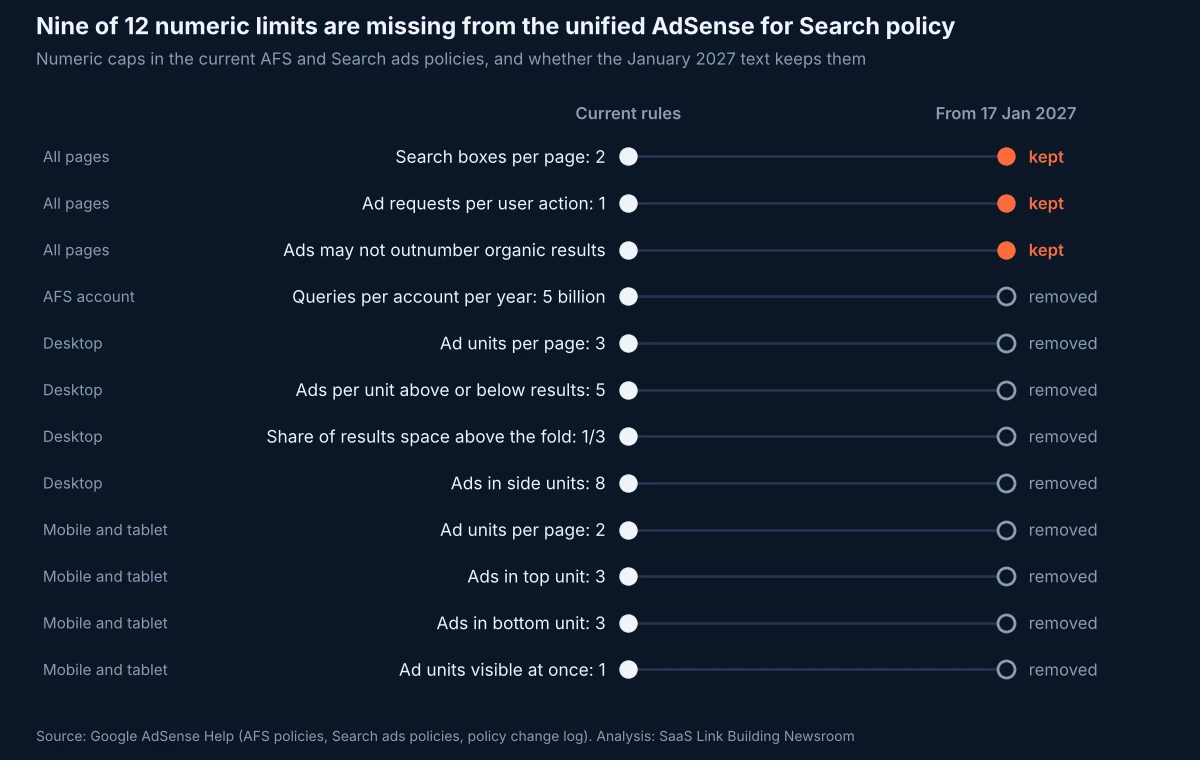
The current Search ads policies spell out exact layouts. On desktop, a results page may carry three ad units, five ads per unit above or below results, eight ads in side units, and ads may fill no more than a third of the results area before scrolling. On mobile and tablet the cap is two units, three ads in each of the top and bottom units, and only one unit visible at a time.
None of those device-specific counts appears in the January text. The current AFS policies also set a limit of five billion queries per account per year, which is likewise absent. What survives are three general limits: two search boxes per page, one ad request per user action, and no more ads than organic results.
The ad-to-result ratio now counts paid promotion from any source, so a page that pads its results with third-party ads or sponsored listings can break the rule even if its Google ad count is low. The ad attribution rule is widened in the same way: every ad, Google or not, must be clearly distinguishable from search results.
Firmer language and new bans
By our count, the two live pages use "should not" five times and "must not" never. The January text uses "must not" ten times and "should not" not at all. The live pages already use the mandatory "may not" 15 times, so many rules were binding before, but the softer guidance is gone.
The no-results rule is the clearest example. Today the Search ads page says ads should supplement results rather than act as results. From January, Google defines a no-results page to include a reply saying the site does not know the answer, results made of placeholder text, and results that are incoherent or use made-up words. Related search suggestions and recommended articles do not count as results.
Three prohibitions have no equivalent in either current page: showing the same ad more than once, placing interstitial content between an ad click and its destination or before an AFS page, and breaking up an ad unit with other ads or content. The restricted categories list (videos, images, people, music and content from other Google services) now applies to all AFS traffic, without the written approval exception the Search ads page offers today.
What moves elsewhere
Some rules leave the AFS text but remain in force through other documents. The unified policy says it applies in addition to the AdSense Program policies, which still bar offering users compensation for viewing ads or performing searches, and bar showing search boxes or results through software such as toolbars. The copyright wording is replaced by a requirement to follow the Google Publisher Policies.
The text also states that AFS is only supported in web environments, which matches Google's April 2025 removal of app support. It brings ads served through Programmable Search Engine and the CSA protocol under one definition of "AFS ads".
What this means for SEO teams
For most sites this is an ad operations change, not a ranking one. Google's Search Central documentation changelog does not mention it, and nothing in the change log ties it to Search systems. It still matters to SEO teams in three places. It is also the second consolidation of Google's publisher and advertiser tooling this week, after Google began merging Google tags into Tag Manager containers.
- Internal search pages. Sites that monetise their own search results with AFS need those pages to return real results. From January, an empty or nonsense results page carrying AFS ads breaks an explicit policy, not just a guideline.
- Related search and arbitrage content. Publishers that buy traffic and send it to related search pages rely on the CSA protocol. Our reading (not a Google statement) is that the gibberish and unanswered-query examples target low-effort and automatically generated result pages, an area where Google has also been tightening its rules for related search, including the November 2025 requirement to declare the exact ad creative that sent each visit.
- Layout freedom with a catch. Losing the per-device caps gives design teams room, but the ratio rule now counts every sponsored element on the page.
What to do before 17 January
- List every template that loads AFS or CSA code, including related search on content pages.
- Count all ads and sponsored listings on each results template against the number of organic results, not just Google units.
- Check what each template shows for empty, very short and nonsense queries, and make sure no ad request fires there.
- Remove any interstitial, pop-up or redirect step between an ad click and the advertiser, and any screen shown before a results page loads.
- Audit result types: pages made mostly of videos, images, people or music results cannot carry AFS ads, and the written approval route is gone.
- Confirm the same ad cannot render twice on infinite scroll or repeated requests.
This month Google also retired its Data Feed validation tool, and this AdSense change appeared only on the AdSense change log, not on Search Central. Teams that track our running count of Search documentation changes should add the AdSense change log to their watch list.
Methodology
On 20 November 2026 we downloaded three Google AdSense Help pages: the policy change log entry titled "Updates to the AdSense for Search policies (January 2027)", the live AdSense for Search (AFS) policies and the live Search ads policies. We extracted the policy text from each page, excluding navigation and the AFS FAQ section, and matched each rule in the two current pages to the unified text by hand. A numeric limit is any rule that sets a count, ratio or share. Phrase counts ("should not", "must not") are case-insensitive counts across the extracted text. Word counts: 1,089 words for the unified text against 1,376 for the two current pages combined. The CSA implementation guide was not compared.
Conclusion
Google's unified AdSense for Search policy trades detailed layout caps for broader, firmer rules. From 17 January 2027, nine of the 12 numeric limits in today's policies are gone, while no-results pages, repeated ads, interstitials and broken-up ad units are explicitly banned, and the ratio of ads to results counts every sponsored element on the page. Google has not said whether enforcement will change, but publishers that run AFS on internal search or related search pages have eight weeks to bring their templates in line.
Questions and answers
When do the new AdSense for Search policies take effect?
Google's AdSense policy change log says the unified AdSense for Search policies take effect on 17 January 2027, when the current AFS policies and Search ads policies will be updated.
Which AdSense for Search limits are removed?
The unified text drops the desktop and mobile ad unit and ad count caps from the Search ads policies, the one-third screen share rule and the five billion annual query cap from the AFS policies. It keeps the two search box limit, one ad request per user action and the rule that ads may not outnumber organic results.
What is newly banned under the January 2027 AFS policy?
The unified text explicitly bans showing the same ad more than once without Google's written approval, interstitial content between an ad and its landing page or before an AFS page, and splitting an ad unit with other ads or content. It also defines no-results pages to include placeholder text and gibberish results.
Is paying users to search still allowed?
No. The rule is no longer repeated in the AFS text, but the unified policy applies in addition to the AdSense Program policies, which still prohibit offering users compensation for viewing ads or performing searches.
Does the AdSense for Search change affect Google rankings?
Google has not linked the change to Search ranking. It is an AdSense policy change posted on the AdSense policy change log, and the Search Central documentation changelog does not mention it.
More releases
-
Updates
Google Adds an AI Mode Sidebar to Its Homepage; Search Button Held in 30 of 30 Checks
Google began rolling out a collapsible sidebar of recent AI searches on its desktop homepage on 19 November 2026, Robby Stein said. Two days later, all 30 signed-out sessions we loaded across 20 locales still showed the classic Google Search button, with no sidebar or AI Mode button.
-
Studies
Google Calls '7 Tips' Posts Commodity Content; They Held 39% of Page One in Our Test
Google is telling brands to stop publishing generic "Top 10" tips posts, but its results still reward them. Across 30 US tips searches on 21 November, numbered lists held 90 of 233 page-one organic results and a third of AI Overview citations, and a page titled exactly like Google's own commodity example ranked first.
-
Industry news
Google Adds Target, Experian and H&R Block to Search Apps; Help Page Lists 0 of 8
Google is adding Target, Albertsons, Safeway, Shaw's, Experian and H&R Block as Connected Apps in Search and the Gemini app, with Angi and Thumbtack to follow. Its Search help page lists none of the eight yet, and in our 16-search test a partner's own site ranked in the organic top 10 on 10.
Tell us the site and the goals.
Rankings in Google and visibility in AI answers, from one monthly plan. One call is enough to say which one fits. Email works just as well.