OpenAI Adds 130 ChatGPT-User IP Ranges; Allowlists From 6 November Miss 35% of Them
OpenAI published a new ChatGPT-User IP list on 25 November with 367 entries, up from 237 in its 6 November file. The 130 added /28 blocks grow its small-block address pool by 55%, all sit in Microsoft Azure, and 62% are outside the US, so allowlists built from the old file now miss 35% of entries.
 Vibhu Dhariwal
Cofounder & CTO, Digital Gratified
- Published
- Section
- Industry news
- Reading time
- 7 minutes
Ras Al Khaimah, United Arab Emirates, .
OpenAI published a new version of its ChatGPT-User IP address list on 25 November 2026, the file sites use to verify requests from the agent that fetches pages when ChatGPT users ask it to. The file, timestamped 07:18:51 on 25 November, lists 367 address blocks, up from 237 in the previous version dated 6 November. Nothing was removed. OpenAI has not published a note about the change, which PPC Land reported on 25 November. Our analysis of the file's history and of Microsoft's published cloud address ranges shows the expansion is larger, and more international, than the headline address count suggests.
What changed
- 130 new /28 blocks, 2,080 addresses. Every new entry is a block of 16 addresses. Total listed addresses rose from 69,312 to 71,392, about 3%.
- The small-block pool grew 55%. That 3% figure is flattened by one large block, 9.129.0.0/16, which alone holds 65,536 addresses and did not change. Excluding it, the /28 blocks held 3,776 addresses before and 5,856 now, a rise of 55.1%.
- 35% of the list is new. 130 of the 367 entries did not exist in the 6 November file, so a firewall allowlist copied from that file now misses about a third of the published ranges.
- All of it is Azure. Every one of the 130 new blocks falls inside a regional range in Microsoft's Azure IP ranges and service tags file (the edition dated 23 November). So did 236 of the 237 older entries; the /16 overlaps ranges Microsoft lists for several regions.
- The other two OpenAI lists did not move. The OAI-SearchBot list still carries a 2 January 2026 timestamp (39 entries) and the GPTBot list a 22 September 2026 one (18 entries). None of the three files share a range.
The largest single rise in the file's history
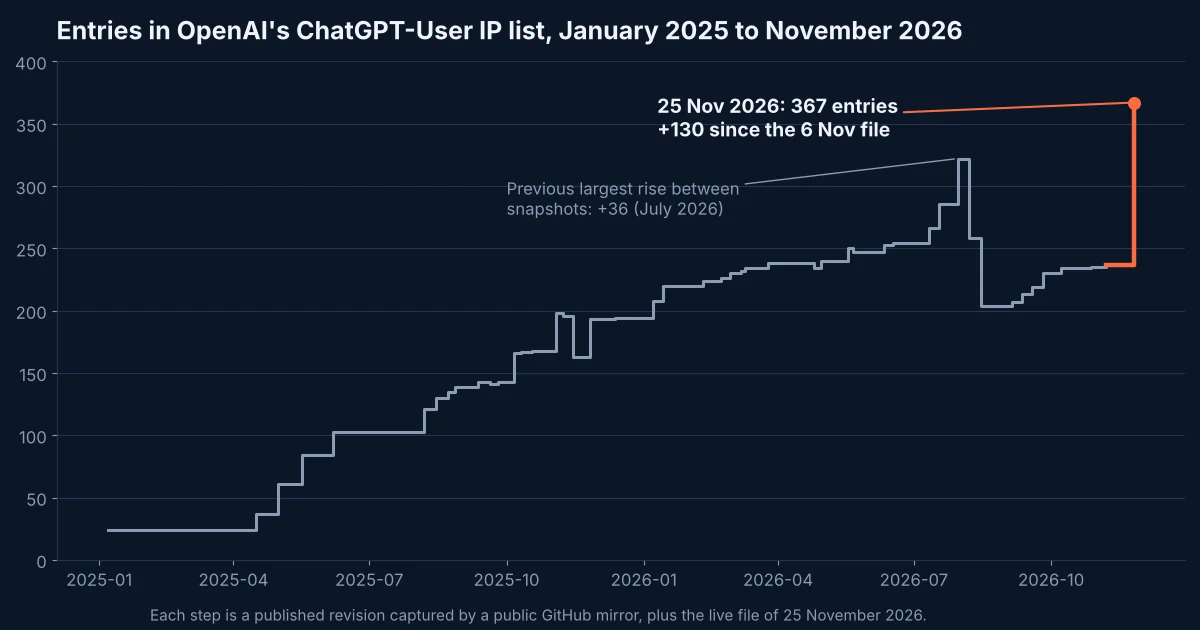
OpenAI does not keep a public changelog for these files, so we rebuilt one from a public GitHub mirror that has saved a copy of the ChatGPT-User file roughly once a week since January 2025. Across 51 saved snapshots, the list grew from 24 entries (file dated 6 January 2025) to 237. The biggest rise between two snapshots before this week was 36 entries, recorded in the file dated 30 July 2026. Two weeks later the list had shrunk to 204, the sharpest cut in its history.
The large block has its own history. The mirror first shows 9.129.0.0/17 in the file dated 16 June 2026, which multiplied the listed address count roughly ninefold overnight. It widened to the full /16 in the file dated 20 October 2026. Since then, the small blocks are where the change has been happening.
Where the new addresses are
We matched each /28 block to the Azure region whose published range contains it. The new blocks are spread thinly: 130 blocks across 31 regions and 105 different /24 networks. Only 5 of them share a /24 with a block OpenAI already listed, so this is mostly new ground rather than neighbouring addresses.
| Area (Azure regions) | /28 blocks in 6 Nov file | Added 25 Nov | Growth |
|---|---|---|---|
| United States (11 regions) | 118 | 50 | +42% |
| Asia-Pacific (13 regions) | 55 | 36 | +65% |
| Europe (14 regions) | 51 | 30 | +59% |
| Brazil South | 11 | 13 | +118% |
| Canada Central | 1 | 1 | +100% |
| Total | 236 | 130 | +55% |
Source: our match of OpenAI's ChatGPT-User files (6 and 25 November 2026) against Microsoft's Azure service tags file of 23 November 2026. Region counts cover regions with at least one block in either file. The 9.129.0.0/16 block is excluded.
Half of the older /28 blocks sat in US regions; only 38% of the new ones do. Brazil South more than doubled, from 11 blocks to 24, and the list now reaches into three regions it did not cover before: UK South, Italy North and Australia Southeast. The two biggest single additions were Central US (17 blocks) and South Central US (16). OpenAI has not said why it added capacity or why in these places, and the file alone cannot tell us whether the new blocks are already sending traffic.
Why this matters more for ChatGPT-User than for other bots
OpenAI's crawler documentation describes ChatGPT-User as the agent behind certain user actions in ChatGPT and Custom GPTs, and says: "Because these actions are initiated by a user, robots.txt rules may not apply." Google says much the same of its user-triggered fetchers, which generally ignore robots.txt and come from their own published IP ranges, a set we examined in our analysis of Google's 2,181 crawler IP prefixes. For agents like these, a robots.txt line does little; the controls that work sit at the server, CDN or firewall level, and they usually key on IP ranges.
That cuts both ways. Sites that allowlist ChatGPT-User by IP, so that pages load when a ChatGPT user asks for them, will now reject a third of the published ranges unless their list refreshes. Sites that block anything claiming the ChatGPT-User name but arriving from an unlisted address, a common defence against spoofed bots, will treat genuine OpenAI traffic from the new blocks as fake. The same verification problem shows up with Google, where our test of Googlebot reverse DNS found 31 of 208 Google IPs had none. OpenAI's documentation gives no update schedule for the files and does not describe a reverse DNS check for ChatGPT-User, so the JSON file is the reference to verify against.
What SEO and site teams should do
- Refresh any hardcoded list today. If your WAF, CDN rule or server config holds a copy of the ChatGPT-User ranges, compare it with the live file. A copy of the 6 November file is missing 130 entries.
- Automate the fetch. Pull the JSON on a schedule (daily is cheap) and rebuild the rule from it, rather than pasting ranges by hand. Read the creationTime field to see when OpenAI last changed it.
- Do not assume growth only. The list fell from 322 to 204 entries between late July and mid-August. Your sync should remove ranges as well as add them.
- Check your logs for rejected requests. Search the last 48 hours for the ChatGPT-User user agent with 403 or challenge responses, and check whether the source IPs fall in the new blocks.
- Keep the three bots separate. GPTBot, OAI-SearchBot and ChatGPT-User use separate, non-overlapping lists and serve different purposes. OAI-SearchBot, for example, is the crawler behind the clicks counted in ChatGPT Business Hub. Updating one list does not update the others.
Methodology
On 25 November 2026 at about 21:19 UTC we downloaded openai.com/chatgpt-user.json, searchbot.json and gptbot.json. We cloned the public GitHub mirror of OpenAI's crawler IP files and extracted all 51 saved versions of the ChatGPT-User file, dated by each file's creationTime field; the most recent saved version is dated 6 November 2026. We compared prefixes as exact networks to count additions and removals, and summed addresses per prefix. We downloaded Microsoft's public Azure service tags file (ServiceTags_Public_20261123.json) and assigned each /28 block to the most specific AzureCloud regional range containing it, then grouped regions by geography. The mirror is captured about weekly, so changes between its snapshots may combine more than one OpenAI revision.
Conclusion
OpenAI's 25 November revision is the biggest addition the ChatGPT-User list has seen: 130 blocks, a 55% larger pool of small ranges, and a clear tilt toward Azure regions outside the US. Because the agent may ignore robots.txt, IP rules are what decide whether ChatGPT can fetch a page, and any rule built from an older copy of the file is now a third out of date. Teams that verify or allow AI agents by IP should sync from the source file rather than trust a static list.
Questions and answers
What is ChatGPT-User?
It is the user agent OpenAI uses for certain user actions in ChatGPT and Custom GPTs, such as fetching a page a user asks about. OpenAI's documentation says robots.txt rules may not apply to it because the actions are initiated by a user.
How many IP ranges are in the ChatGPT-User list now?
The file dated 25 November 2026 has 367 entries: 366 blocks of 16 addresses and one /16 block (9.129.0.0/16), for 71,392 addresses in total. The previous file, dated 6 November, had 237 entries.
Did OpenAI remove any ChatGPT-User IP ranges?
No. All 237 entries in the 6 November file are still in the 25 November file. OpenAI has removed ranges before: the list fell from 322 to 204 entries between the files dated 30 July and 14 August 2026.
Did the GPTBot and OAI-SearchBot lists change too?
No. In the files we downloaded on 25 November, the OAI-SearchBot list was still dated 2 January 2026 with 39 entries and the GPTBot file was dated 22 September 2026 with 18 entries. None of their ranges overlap with ChatGPT-User's.
Where is the official ChatGPT-User IP list?
OpenAI publishes it at openai.com/chatgpt-user.json and links it from its crawler documentation. The documentation does not say how often the file is updated.
More releases
-
Updates
Google Local Pack Shows 'No Reviews' for Rated Firms; 0 of 238 Hit in Our Logged-Out Pull
Google's local pack is showing "No reviews" for some businesses that have reviews, Search Engine Roundtable reported on 26 November. Our logged-out pull of 238 listing appearances in 34 Google local result sets across seven US locations found none affected, and review counts matched Maps records in all seven we cross-checked.
-
Studies
Is Google Burying Independent Review Sites? They Took 14 of 31 No. 1 Spots in Our Test
Independent review sites say Google pushed them out of product search. Our pull of 31 "best [product]" searches on 26 November found specialist review sites held 14 No. 1 spots, level with media brands, while retailers and forums took 45.9% of page one and specialists were missing from 7 searches.
-
Explainers
Google Lets Owners Hide Booking Partners; 87 of 114 Book Buttons Led to 21 Platforms
Google now lets Business Profile owners hide third-party booking, appointment and reservation partners with a switch, though removal still runs through the partner. In our pull of 240 salon and barber listings in four US cities, 114 showed a booking button and 87 of those led to one of 21 outside platforms.
Tell us the site and the goals.
Rankings in Google and visibility in AI answers, from one monthly plan. One call is enough to say which one fits. Email works just as well.