Google Tests a Sign-In Wall After One Search; Its Help Page Still Cites Only reCAPTCHA
Google is showing some logged-out searchers a sign-in screen after a single query, 106 days after a similar test appeared only after several result pages. A Googler says first-page gating may not be intended. Google's own help page for blocked searchers still describes only reCAPTCHA, with no mention of signing in.
 Vibhu Dhariwal
Cofounder & CTO, Digital Gratified
- Published
- Section
- Industry news
- Reading time
- 7 minutes
Ras Al Khaimah, United Arab Emirates, .
Google appears to be asking some logged-out searchers to sign in before it shows any results at all, a step beyond the sign-in prompt it tested in August, which only appeared after several pages of results. SEO consultant Brodie Clark posted a video of the screen on X, and Search Engine Roundtable reported it on 17 November 2026. Clark said he had been seeing the login screen regularly for a couple of days, including in an incognito window, where he had never met it before. Google's Rajan Patel replied on X that he was looking into it and did not believe it was meant to appear on the first page of results, while adding that Google "may be testing something here". Google has made no formal announcement.
We checked what Google's own public pages say about blocking automated searches. Its help page for blocked searchers still describes only reCAPTCHA, never a sign-in, and it names rank-checking software as automated traffic. The test is the latest of ten dated events we have tracked in Google's logged-out search crackdown since January 2025, and four of them fall in the last 65 days.
What changed
- The trigger moved to the first query. In the version reported on 3 August 2026, Google showed a message asking users to sign in to verify they were human only after they clicked through several results pages. In the version Clark recorded, the sign-in screen appeared after a single search. That is 106 days between the two sightings.
- It is not universal. Clark said Google usually lets mobile users carry on logged out. Search Engine Roundtable noted that the prompt normally takes a few queries to appear, not one.
- Google has not said what the test is for. Patel's reply is the only on-record Google comment, and it leaves open whether first-page gating is intended or a side effect of something else being tested.
- Google's help documentation has not caught up. Our check of the live help page found five mentions of reCAPTCHA and no mention of signing in or of a Google Account.
What Google's own pages say about automated searches
We read the three Google pages that set the rules for automated access to Search: the help page for blocked users, the robots.txt file on www.google.com and the Google Terms of Service. None of them describes a sign-in requirement.
| Google page | What it says about automated searches | What we counted |
|---|---|---|
| "Unusual traffic" help page | Searchers who trip the filter "most likely" see a reCAPTCHA; automated traffic includes software that sends searches to see how a page ranks | 5 mentions of reCAPTCHA, 0 of signing in or of an account |
| google.com robots.txt | The catch-all group disallows /search, with exceptions for two information pages and map results; a separate group lets two social media link-preview bots fetch /search | 265 lines; 170 Disallow and 65 Allow rules in the main group |
| Google Terms of Service (effective 30 July 2026) | Bars using automated means to access a Google service against machine-readable instructions such as robots.txt | No mention of a sign-in requirement for Search |
Taken together, the pages show why Google treats rank trackers and SERP scrapers as one problem. The help page lists search scrapers and software that checks rankings side by side, and the robots.txt rule that disallows /search applies to every crawler not given its own group. The one exception is a group for the link-preview bots of two social networks, which a comment in the file says may fetch markup when google.com/imgres links are shared.
Context: ten events in 22 months
Sign-in gating is the most visible piece of a campaign that began with a JavaScript challenge. According to the 9 November court order in Google's case against SerpApi, the challenge, called SearchGuard, launched in January 2025 and at first blocked SerpApi's service. Google filed that suit in December 2025, saying in a post by its general counsel that scrapers of that kind ignore the directives sites set. The court has now dismissed Google's complaint twice, as we covered in our reading of the second dismissal, and Google has until 30 November to refile.
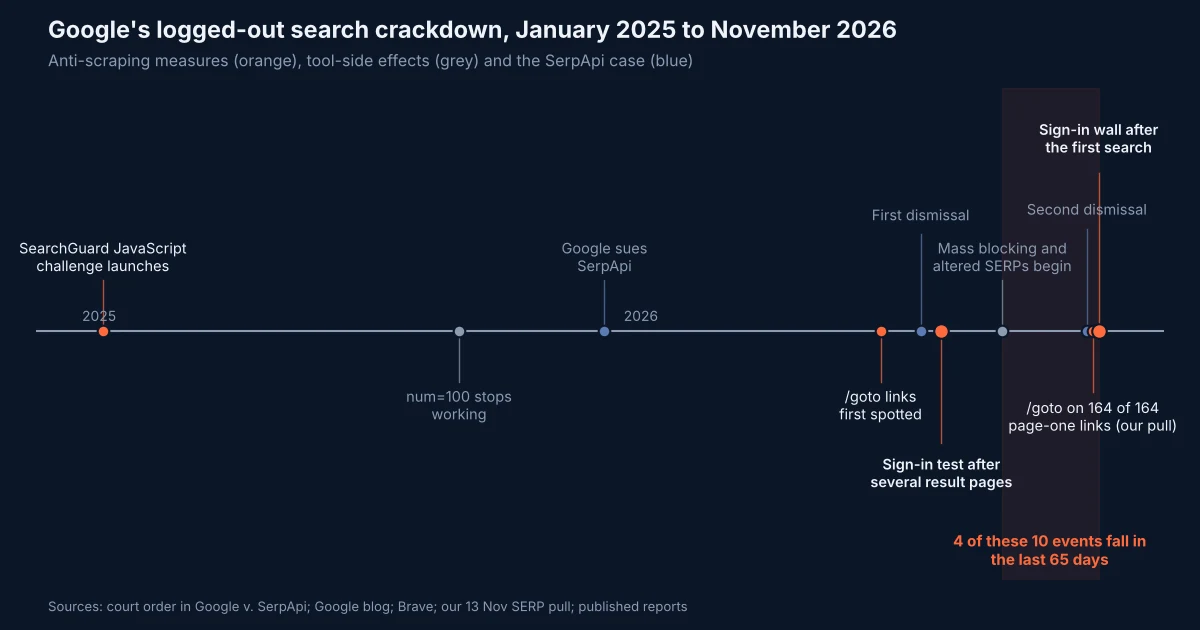
The pace has picked up since late summer. Google confirmed the rollout of google.com/goto result links in August, which hides destination addresses from tools that read the page. One rank-tracking provider's study, which we reported in our story on poisoned SERPs, found Google began failing requests in bulk on 13 September and then served altered results to suspected bots. In our own pull of 20 US desktop searches on 13 November, all 164 page-one organic links came back wrapped in /goto, up from 74.0% on 31 October. Two days earlier, Brave said scrapers pushed out by Google had flooded its own engine, and announced encrypted result links of its own.
Gating results behind a Google Account is a different kind of barrier. A JavaScript challenge or a /goto redirect can, at a cost, be handled by software. In our reading, a login ties each search to an account Google can rate-limit, flag or close, which is far harder to spread across thousands of throwaway identities.
What this means for SEO teams
- Treat a sudden drop in tracked rankings as a data problem first. If a tracker suddenly returns blank pages, login screens or unfamiliar results, check the raw SERP snapshot before reporting a ranking loss. Search Console data comes from Google's own records of real searches rather than from scraping, so these measures do not touch it.
- Ask your rank-tracking and SERP data vendors how they collect results. Request their failure rate per day since September, how they detect altered or gated pages, and whether any collection relies on logged-in accounts, which may carry terms of service risk for the vendor.
- Do not use personal or company Google Accounts for automated checks. Google's terms bar automated access against its robots.txt, which disallows /search, so using an account that way would put it in breach of those terms.
- Expect manual spot checks to hit the prompt too. Clark met it in an incognito window. Teams that check rankings by hand in private windows may need to sign in, which brings personalisation back into the results they see. Note the signed-in state next to any screenshot you share with a client.
- Check the inputs behind AI visibility reports. If a tool reports how often you appear in AI answers, ask whether any of its data comes from Google result pages and how it collects them now.
Methodology
On 18 November 2026 (IST) we fetched the live English versions of Google's "Unusual traffic from your computer network" help page (support.google.com/websearch/answer/86640), the robots.txt file at www.google.com and the Google Terms of Service. For the help page we extracted the article text and counted mentions of "reCAPTCHA", "sign in", "sign-in" and "account". For robots.txt we parsed the user-agent groups and counted Allow and Disallow lines in the catch-all group (lines 1 to 239), and listed every rule beginning with /search. The timeline draws on primary documents where they exist (the court order and Google's blog post), on dates reported in our earlier coverage, and on Search Engine Roundtable's reports of the 3 August and 17 November sign-in sightings. We did not attempt to trigger the sign-in prompt ourselves. The /goto figures come from our own SERP pull on 13 November 2026, described in our Brave story.
Conclusion
Google has not confirmed a policy of requiring sign-in for Search, and its own Googler on the thread suggested first-page gating may not be intended. Even so, the direction across 22 months is consistent: each Google measure has made logged-out, automated access to Google results harder, and the gap between steps has shortened from months to days.
For SEO teams the practical point is that third-party ranking data now depends on how well vendors cope with these barriers. Until Google says more, check raw SERPs before acting on sudden drops, and lean on Search Console for what real users actually saw.
Questions and answers
Is Google requiring sign-in to use Search?
No policy has been announced. Some logged-out users have reported a sign-in screen after their first search, and Google's Rajan Patel said on X he was looking into it and did not believe it was meant to appear on the first page of results.
When did Google first test a sign-in prompt for Search?
A version reported on 3 August 2026 asked users to sign in to verify they were human after they had clicked through several pages of results. The first-search version was reported on 17 November 2026, 106 days later.
What does Google's help page say happens when it detects automated traffic?
Google's "Unusual traffic from your computer network" help page says affected users will most likely see a reCAPTCHA. It does not mention signing in, and it lists software that checks how a page ranks as automated traffic.
Does Google's robots.txt allow crawlers to fetch search results?
The main group in google.com/robots.txt disallows /search, with exceptions for /search/about, /search/howsearchworks and map results. A separate group allows the facebookexternalhit and Twitterbot link-preview crawlers to fetch /search.
Does this affect Search Console data?
No. Search Console reports Google's own records of real searches rather than scraped result pages, so it is the more reliable source when third-party rank trackers show sudden drops.
More releases
-
Industry news
FBI Ties SEO Poisoning to $28M in Ransomware; WordPress Holds 30 of 189 Lure-Term Results
The FBI says Gootloader ranked lure pages on more than 1,000 hijacked WordPress sites, leading to over $28 million in ransomware payments. We searched the 20 phrases it listed: WordPress sites hold 30 of 189 page-one results, and 5 still answer XML-RPC.
-
Studies
Meta Paused Its Crawling Terms; Only 2 of 485 Top Sites Block Its Ads Crawler
Meta has paused the business terms that would have let it crawl advertisers' websites from 20 November. Our repeat robots.txt crawl of the top 1,000 domains finds little change: 12.8% of 485 sites now block Meta's AI training crawler, up from 12.0% in October, and only 2 block Meta-ExternalAds.
-
Updates
Google Details How to Allow Google-Agent; 24 Top Sites Block a Name Google Never Listed
Google published a guide on 17 November explaining how to let Google-Agent through CDNs, firewalls and bot managers. Our crawl of 1,159 top-site robots.txt files the same day found 24 naming an undocumented GoogleAgent-Mariner token, against 14 naming Google-Agent, which Google says generally ignores robots.txt.
Tell us the site and the goals.
Rankings in Google and visibility in AI answers, from one monthly plan. One call is enough to say which one fits. Email works just as well.